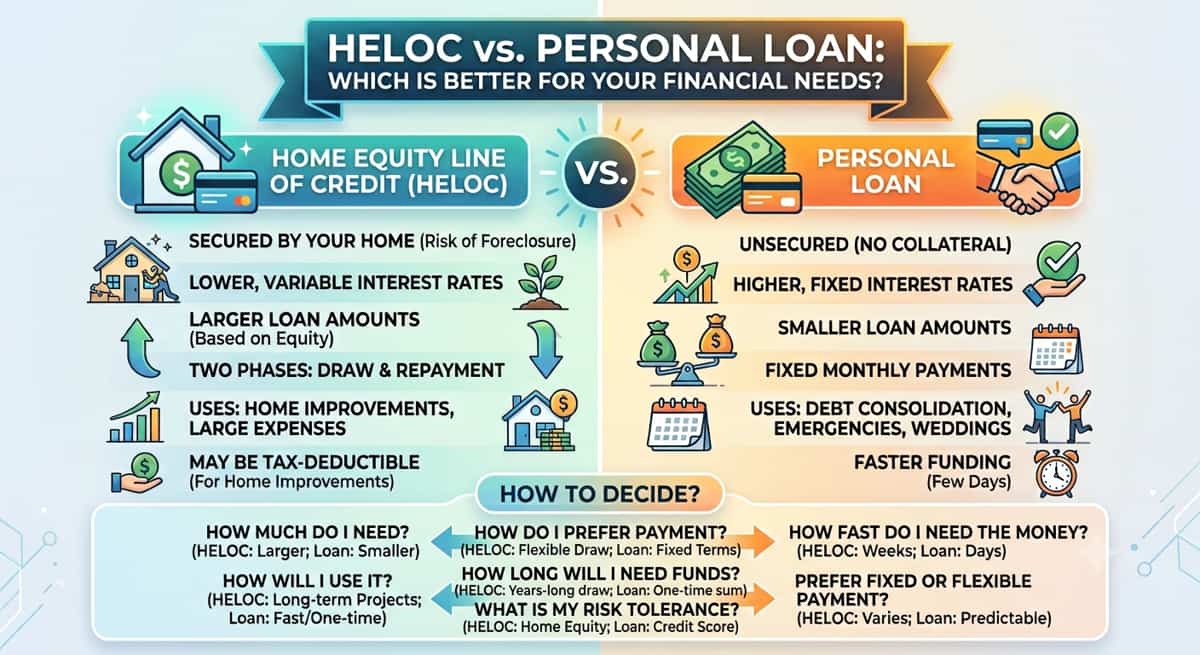
When you need access to extra funds, choosing the right borrowing option can have a lasting impact on your finances. Two of the most common choices are a Home Equity Line of Credit (HELOC) and a personal loan, but they serve different purposes and come with distinct advantages. A HELOC allows homeowners to borrow against the equity they've built in their property, often offering lower interest rates and flexible access to funds. In contrast, a personal loan provides a lump sum with fixed monthly payments and doesn't require your home as collateral.
The better option depends on factors such as how much you need to borrow, your credit profile, repayment preferences, and whether you own a home with sufficient equity. In this guide, we'll compare HELOCs and personal loans, explain their key differences, highlight the pros and cons of each, and help you determine which option best fits your financial needs and long-term goals.
What Is a HELOC?
A HELOC, or home equity line of credit, lets you borrow against the equity you've built up in your home. Think of it like a credit card, except instead of a bank deciding your limit based on your income and credit score alone, your limit is tied to how much your home is worth minus what you still owe on your mortgage.
How a HELOC Works
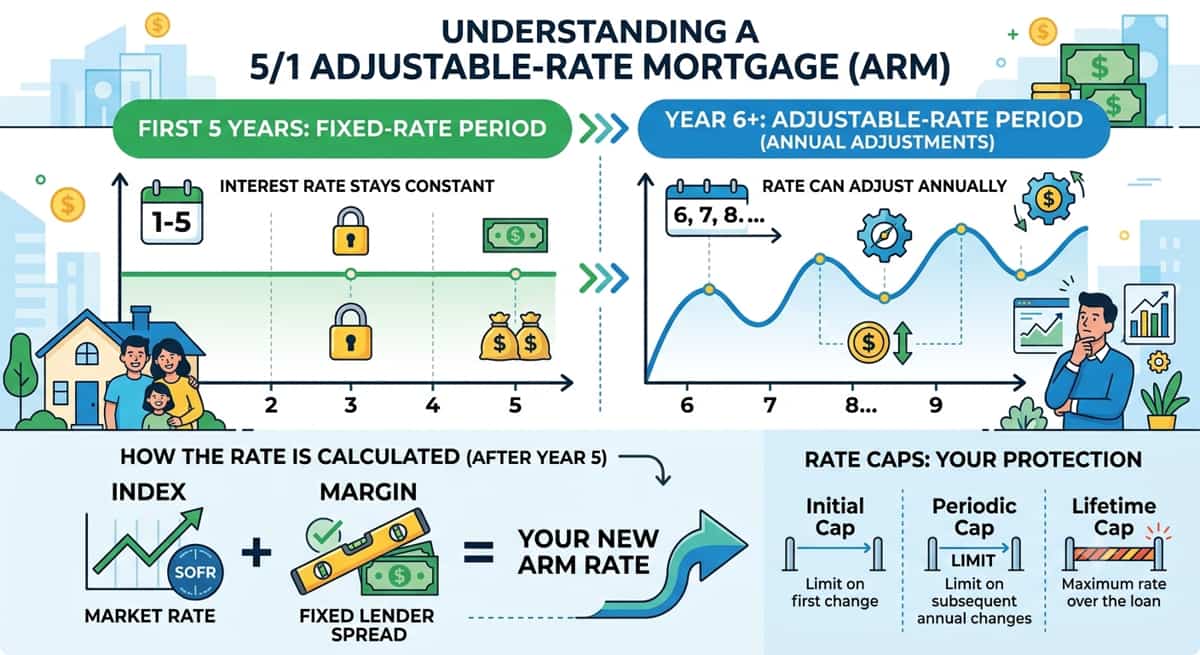
A HELOC has two phases. During the "draw period" (usually 5 to 10 years), you can borrow money as you need it, pay it back, and borrow again, similar to a credit card. You typically only pay interest on what you actually use, not the full credit line. Once the draw period ends, you enter the "repayment period," where you can no longer draw new funds and start paying back both principal and interest, usually over 10 to 20 years. Most HELOCs come with a variable interest rate, meaning your payment can go up or down as market rates change.
What You Can Use a HELOC For
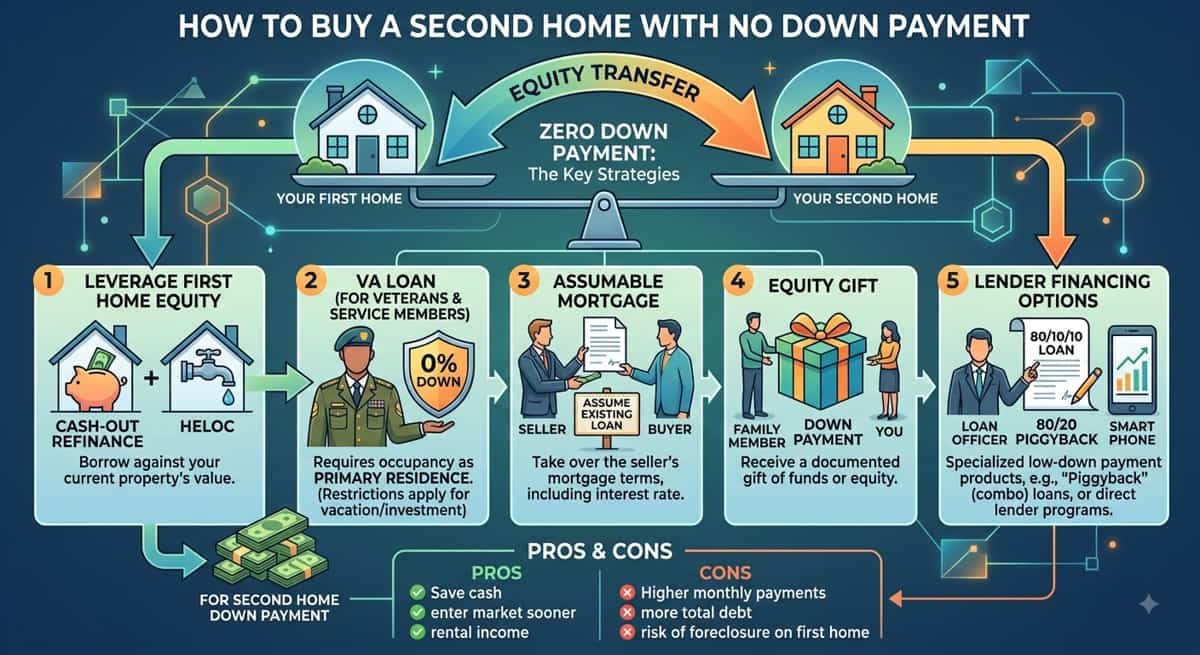
People use HELOCs for all kinds of things: home renovations, paying off higher-interest debt, covering college tuition, or having a financial cushion for emergencies. Because your home secures the loan, lenders are often willing to offer larger amounts and lower rates than unsecured borrowing options.
What Is a Personal Loan?
A personal loan is money you borrow in one lump sum and pay back in fixed monthly installments over a set period, usually 2 to 7 years. Most personal loans are unsecured, meaning you don't need to put up your home, car, or any other asset as collateral.
How Personal Loans Work
Once approved, you receive the full loan amount upfront, often within a few days. You then repay it in equal monthly payments at a fixed interest rate, so you know exactly what you owe each month until the loan is paid off. Because there's no collateral involved, lenders rely heavily on your credit score and income to decide whether to approve you and what rate to offer.
Common Uses for Personal Loans
Personal loans are popular for debt consolidation, medical bills, moving expenses, weddings, or smaller home projects. They're a good fit when you need a predictable, one-time amount of money and want a clear payoff date.
HELOC vs. Personal Loan: Key Differences at a Glance
Here's a side-by-side look at how these two options compare.
Feature | HELOC | Personal Loan |
Collateral | Your home | Usually none (unsecured) |
Typical rates | Often lower, but variable | Often higher, but fixed |
Loan amounts | Larger (based on home equity) | Smaller, capped by lender policy |
Repayment structure | Draw period, then repayment period | Fixed monthly payments from day one |
Tax deductibility | Possible, only if used to improve your home | Not deductible |
Impact if you can't pay | Risk of foreclosure | Credit damage, collections |
Credit score impact | Hard inquiry, plus a new credit line | Hard inquiry, plus a new installment loan |
Funding speed | Can take a few weeks (appraisal required) | Often as fast as 1–3 business days |
Interest Rates: Which Costs Less?
Rates change constantly based on the market, the Federal Reserve, and your personal credit profile, so it's worth checking current rates with a lender before deciding. That said, there are some general patterns worth knowing.
Why HELOCs Often Have Lower Starting Rates
Because your home backs the loan, lenders take on less risk, which usually means they can offer you a lower starting rate than an unsecured personal loan. If you have strong home equity and good credit, a HELOC can be one of the more affordable ways to borrow a large amount of money.
Variable Rate Risk Explained
The catch is that most HELOCs have variable rates, so your payment isn't locked in. If rates rise, your monthly payment can climb too, sometimes by a noticeable amount. A personal loan's fixed rate means your payment stays the same for the life of the loan, which can make budgeting easier even if the starting rate is a bit higher. Always ask a lender for current rate ranges based on your credit profile before comparing offers, since advertised rates are not guaranteed for every borrower.
Risk Comparison: What's on the Line?
This is probably the most important factor to think through, because it's not just about cost, it's about what happens if things don't go as planned.
HELOC Risk — Your Home as Collateral
Since your home secures a HELOC, falling behind on payments puts your home at risk. If you're unable to keep up with payments, the lender could eventually foreclose. This doesn't mean a HELOC is a bad choice; plenty of homeowners use them responsibly. It just means you should only borrow an amount you're confident you can repay, even if your income or expenses change.
Personal Loan Risk — Credit Score and Unsecured Debt
A personal loan doesn't put your home on the line, but missing payments will still hurt your credit score and can lead to collections or legal action from the lender. The risk is less severe than losing your home, but it's still a real financial consequence that can follow you for years.
Which Is Better for Home Improvement Projects?
For larger renovations, like a kitchen remodel or a room addition, a HELOC is often the more practical choice. You can draw funds as the project progresses instead of taking out the full amount upfront, and interest may be tax-deductible if the funds go toward improving the home that secures the loan. A personal loan can still work well for smaller projects, like updating a bathroom or replacing flooring, especially if you want a fixed payment and don't want to touch your home equity.
Which Is Better for Debt Consolidation?
If you're consolidating high-interest credit card debt, both options can work, but they fit different situations. A HELOC may offer a lower rate, which can save you more money over time, but it stretches your repayment period and puts your home behind the debt. A personal loan keeps things simpler: one fixed payment, one fixed timeline, and no risk to your home, which many people find easier to stay disciplined with.
Which Is Better for Emergency Expenses?
When you need money fast, a personal loan usually wins on speed, often funding within a few business days with no appraisal required. A HELOC can take several weeks to set up because it typically requires a home appraisal and more paperwork. However, if you already have an open HELOC before the emergency happens, it can act like a ready-to-use safety net you can draw from instantly.
Qualification Requirements: HELOC vs. Personal Loan
Credit Score & DTI Requirements
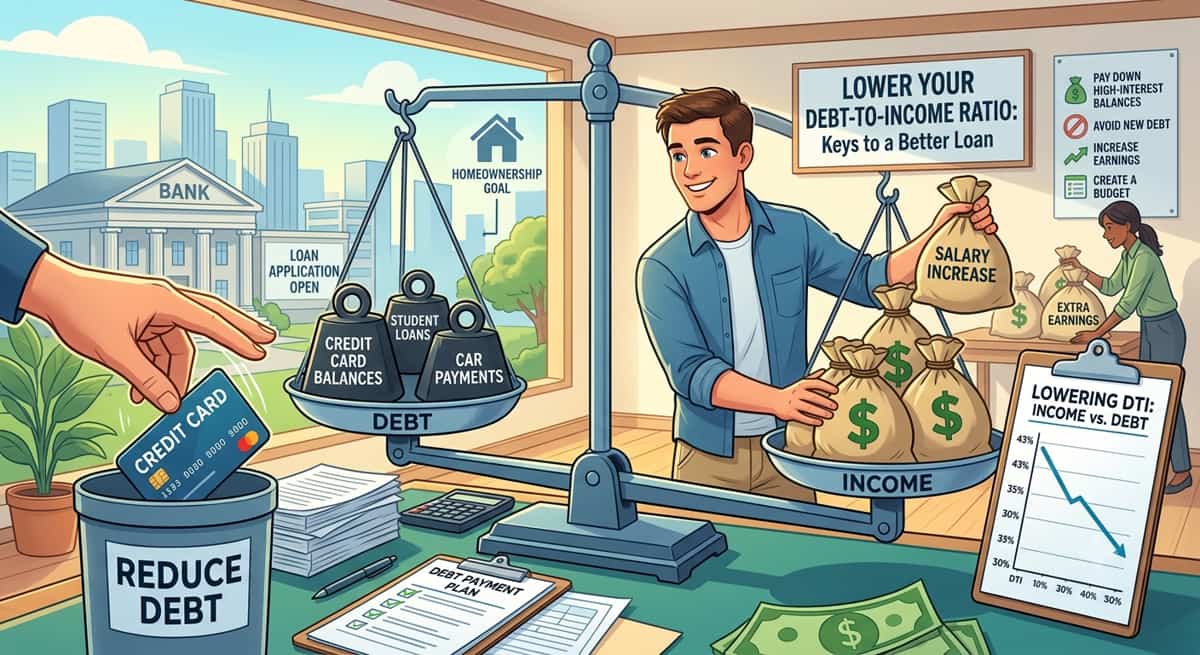
Both loan types typically look at your credit score and debt-to-income (DTI) ratio, which compares your monthly debt payments to your income. Higher credit scores and lower DTI generally mean better rates and higher approval odds for either option.
Home Equity/LTV Requirements for HELOCs
For a HELOC, lenders also look at your loan-to-value (LTV) ratio, meaning how much of your home's value you've already borrowed against through your mortgage. Most lenders want you to keep your combined mortgage and HELOC balance below a certain percentage of your home's appraised value.
Income Verification for Personal Loans
Personal loan lenders rely more heavily on income verification and credit history since there's no collateral to fall back on. Steady income and a solid credit history go a long way toward getting approved at a competitive rate.
Tax Implications: Is HELOC Interest Deductible?
Under current IRS rules, HELOC interest may be tax-deductible, but only if the funds are used to buy, build, or substantially improve the home that secures the loan. If you use a HELOC for something unrelated, like paying off credit cards or covering everyday expenses, that interest generally isn't deductible. Personal loan interest is not tax-deductible in almost all cases, regardless of how you use the funds. Tax rules can be complex and change over time, so it's always a good idea to check IRS or talk to a tax professional about your specific situation before assuming a deduction applies.
How to Decide: A Quick Decision Framework
If you're still weighing your options, ask yourself these questions:
How much do I need? Larger amounts often favor a HELOC; smaller, defined amounts often favor a personal loan.
How will I use it? Home improvements may benefit from HELOC tax advantages; debt consolidation or emergencies often favor the simplicity of a personal loan.
How comfortable am I with risk? If you don't want your home tied to the debt, a personal loan removes that risk entirely.
How fast do I need the money? Personal loans usually fund faster than HELOCs.
Do I prefer a fixed or flexible payment? Personal loans offer predictability; HELOCs offer flexibility with more rate uncertainty.
There's no single right answer, it depends on your equity, your goals, and how much risk you're comfortable taking on.
Talk to a Licensed Mortgage Advisor Before You Decide
Choosing between a HELOC and a personal loan isn't just about interest rates on paper, it's about what fits your home, your income, and your long-term plans. A licensed mortgage advisor can walk through your specific numbers, explain what you'd actually qualify for, and help you avoid costly mistakes either option can carry. If you're ready to explore your options, reach out for a free, no-obligation consultation to find the borrowing solution that truly fits your needs.