Credit card debt is a beast that can grow quickly and before you know it, there are thousands of outstanding charges to pay. It all starts with a balance or two but quickly spirals into several monthly payments, crazy interest charges and the overwhelming feeling that despite paying every month you never seem to be getting anywhere. For those looking for a smarter alternative to take back control of their finances, two common options pop up whenever you search for debt consolidation methods: home equity line of credit (HELOC) or personal loan. They can both make managing your finances easier than making multiple credit card payments a month since they only require one monthly payment, and they sometimes have lower interest rates than most credit cards. But that's where the similarities stop.
A HELOC stands for home equity line of credit, and it gives homeowners the ability to borrow money while utilizing the equity they have built in their home usually at competitive rates with flexible access to funds. A personal loan, in contrast, is unsecured, doesn't need home equity as collateral and features fixed monthly payments that make budgeting easier. All options have advantages, costs, risks, and eligibility requirements. Going with the wrong one could end you up paying more in the long run or undertaking unwarranted financial risk.
What Is a HELOC?
A home equity line of credit allows you to borrow from the equity you've built in your house. Rather than receiving one full, lump sum of cash, you get a line of credit available to withdraw from when needed (similar to using a credit card but with your home providing the guarantee.) That is what generally gets you a lower interest than an unsecured loan.
How a HELOC Works (Draw Period vs. Repayment Period)
A HELOC has two phases. The draw period typically covers 5 to 10 years, in which you can borrow against it as desired pay it back and borrow again, similar to a revolving credit card. Your home will be under construction during this time, and most lenders desire only interest-only payments. After the draw period ends, you enter the repayment period, usually 10 to 20 years, during which time you must pay both principal and interest and will no longer be able to withdraw new funds.
Typical HELOC Rates and Terms in 2026
Rates on HELOCs are commonly variable and linked to the prime rate, but many lenders now have a option for fixed-rate borrowing on part of the balance. As your home is securing the loan, rates typically come in a few percentage points lower than you would find on a personal loan or credit card.Exact rates depend on your credit score and how much equity you have, as well as your lender, so make sure to check our current HELOC rates or get a few quotes before putting pen to paper.
What Is a Personal Loan?
A personal loan is a lump sum of money you borrow and pay back in fixed monthly installments, usually over two to seven years. It's unsecured, meaning you don't have to put up your home or any other asset as collateral. That makes it faster and simpler to get, but also a bit more expensive.
How Unsecured Personal Loans Work
You apply, get approved based mostly on your credit score and income, and if approved, receive the full loan amount upfront, often within a few days. From there, you make the same fixed payment every month until the loan is paid off. Because there's no collateral backing the loan, lenders take on more risk, and they charge a higher interest rate to make up for it.
Typical Personal Loan Rates and Terms in 2026
Rates on personal loans vary widely based on credit score, ranging from around 7% for borrowers with excellent credit to 20% or more for those with weaker credit. Loan amounts typically range from a couple thousand dollars up to $50,000 or more, depending on the lender and your income.
Key Differences at a Glance
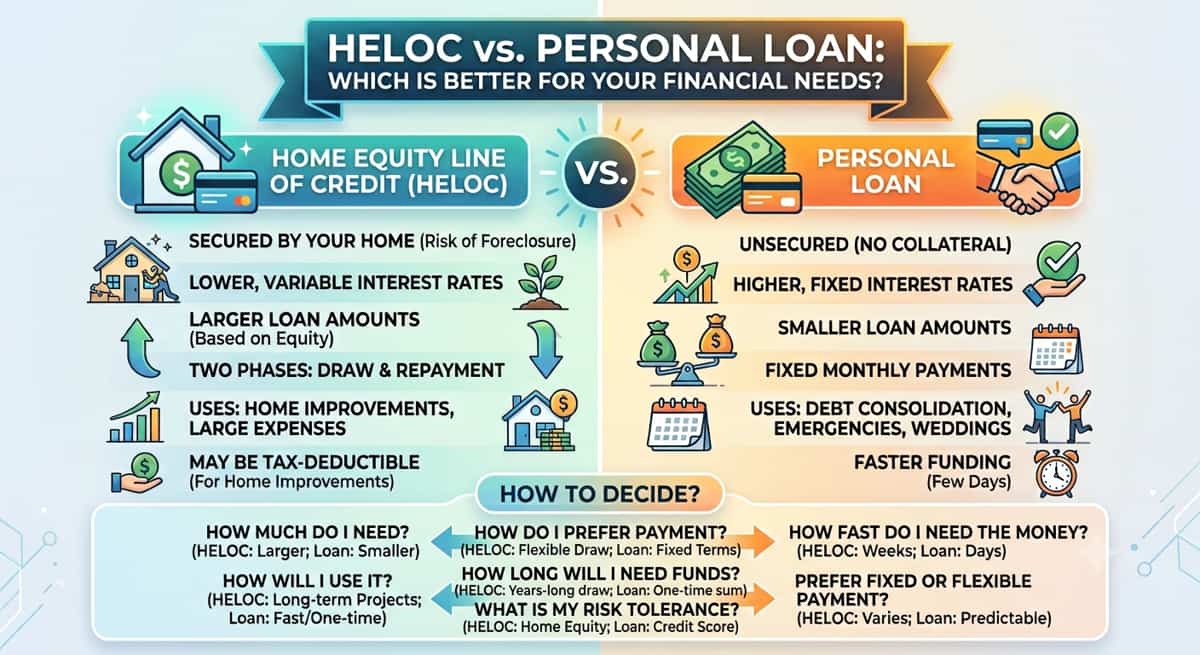
If you just want the short version: a HELOC usually offers a lower interest rate because it's backed by your home, but it puts your house at risk if you can't keep up with payments. A personal loan has a higher rate but doesn't touch your home equity, and you can typically get the money faster with less paperwork. Here's how they stack up side by side.
HELOC | Personal Loan | |
Collateral | Your home | None (unsecured) |
Typical rate | Lower, often variable | Higher, usually fixed |
Loan term | 10–20 years (draw + repayment) | 2–7 years |
Funding speed | 2–6 weeks | 1–7 days |
Credit needed | Good to excellent, plus home equity | Fair to excellent |
Risk if you default | Possible foreclosure | Credit damage, collections |
HELOC vs. Personal Loan: Side-by-Side Comparison
Interest Rates Compared
This is usually the deciding factor for a lot of people. Because a HELOC is secured by your home, lenders can offer a noticeably lower rate than they would on an unsecured personal loan. Over a large debt balance, that difference can save you a meaningful amount in interest. But remember, HELOC rates are often variable, so your payment can rise if interest rates go up, while most personal loans lock in a fixed rate from day one.
Collateral and Risk (Secured vs. Unsecured)
This is the part that deserves the most attention. A HELOC is secured by your home, which means if you're unable to keep up with payments, your lender could eventually start foreclosure proceedings. A personal loan is unsecured, so if you fall behind, the consequences are damage to your credit and possible collections, but your house isn't directly on the line. If you're already stretched thin financially, that difference in risk matters just as much as the interest rate.
Loan Amounts and Access to Funds
Because a HELOC is tied to your home's equity, it can often provide access to a larger amount of money, sometimes tens or even hundreds of thousands of dollars, depending on how much equity you have. Personal loans tend to max out lower, often in the $35,000–$50,000 range, which may be plenty if your debt is more modest.
Repayment Structure (Variable vs. Fixed)
Personal loans give you predictability: the same payment every month until it's paid off. HELOCs, especially during the draw period, can have payments that shift depending on how much you've borrowed and where interest rates stand. If you like knowing exactly what you'll owe each month, that's a point in favor of a personal loan.
Funding Speed and Approval Process
If you need money quickly, a personal loan usually wins. Approval can happen in a day or two, with funds arriving within a week. A HELOC involves a home appraisal, more documentation, and underwriting, so it can take anywhere from two to six weeks to close.
Tax Implications: Is HELOC Interest Deductible for Debt Consolidation?
This is one of the most common questions homeowners ask, and it's worth clearing up. Under current IRS rules, HELOC interest is only tax-deductible if you use the funds to buy, build, or substantially improve the home that secures the loan. If you're using a HELOC purely to pay off credit cards or other debt, that interest generally isn't deductible. This is a common misconception, so don't count on a tax break if consolidation is the only use for the funds. Tax rules can also depend on your individual situation, so it's a good idea to check with a tax professional before assuming how this applies to you.
Which Option Is Better for Your Credit Profile?
Strong Home Equity and Good Credit
If you've built up significant equity and your credit is solid, a HELOC is often the more cost-effective route. You'll likely qualify for a lower rate, access to a larger credit line, and more flexibility in how you draw the funds. Just go in with a clear repayment plan so the lower rate doesn't tempt you into borrowing more than you need.
Limited Home Equity or Are Not a Homeowner
If you don't own a home, or you haven't built up much equity yet, a personal loan is really your main path. It doesn't require any collateral, so your eligibility is based on your income and credit rather than what your home is worth.
Need Funds Fast
When timing matters more than getting the lowest possible rate, a personal loan usually makes more sense. The quicker approval and funding process means you can start consolidating your debt within days rather than weeks.
Risks to Consider Before Using Home Equity to Consolidate Debt
Before you make the leap into borrowing against your home, it's worthwhile to be honest with yourself about pros and cons. First and foremost, your home is the asset. As your finances change, it may not be possible to maintain payments; this could lead to foreclosure which is simply not an option with a personal loan. Second, a HELOC can extend your repayment period long past the original debt you're consolidating and you may ultimately pay more in total interest over time, even at a lower rate. Third: when you open a home equity line of credit (HELOC), it usually has closing costs, appraisal fees and even annual fees, which chip away at the amount you actually save. And if your HELOC has a variable rate (most do), when interest rates go up, your payments in the future might rise which complicates budgeting later. None of this means that a HELOC is a bad decision, it just means that it warrants thorough consideration rather than an impulsive choice in the heat of financial adversity.
Talk to a Licensed Mortgage Advisor
When paying off credit card debt, it is not just about finding the lowest interest rate, but a solution that allows you to invest in your financial future. Although both a HELOC and personal loan could work for consolidating high-interest balances, which option is best will have to do with your particular situation. If you've built up a lot of equity in your home, then a HELOC will provide lower rates with more flexible money borrowing options, but it puts your home as collateral. Keep in mind that a personal loan will not put your home at risk, and the payments are predictable every month; however, your interest rate may be higher depending on your credit profile. You also need to know when it comes with what trade-off before taking the leap.
Don’t follow cookie-cutter advice; instead, spend more time in looking at your budget, repayment targets, amount of home equity available and risk tolerance. By weighing the total cost of each option in terms of interest, fees, length of time to payback and overall financial impact on you over your lifetime, it enables you to make a more informed decision.
Professional guidance based on the right path will help simplify if you're not sure which path financially makes more sense for you. Contact us for a FREE, no-obligation consultation today, and together we will create a debt consolidation plan designed to work best for you and help you take the first step towards financial recovery.