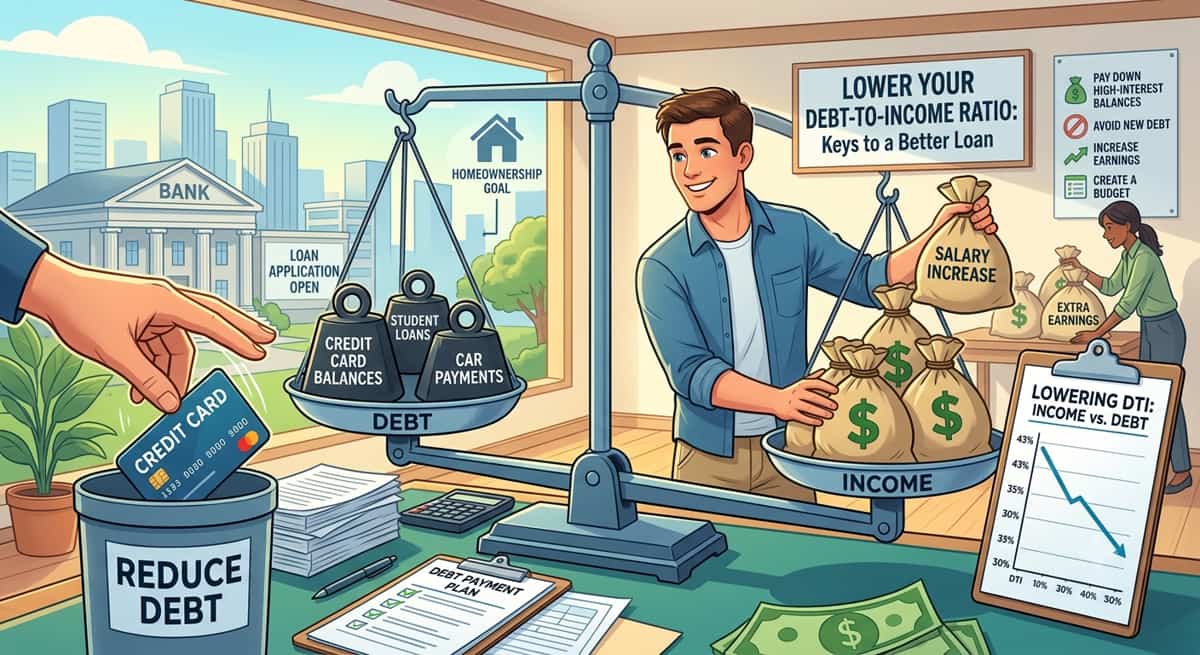
Your debt-to-income (DTI) ratio is one of the key factors lenders consider when evaluating your ability to repay a loan. It compares your monthly debt payments with your gross monthly income, helping lenders determine how much of your income is already committed to debt. A high DTI ratio can make it harder to qualify for a mortgage, personal loan, or other financing and may affect the interest rate and loan terms you receive. The good news is that you can take practical steps to lower your DTI before submitting a loan application. Paying down existing balances, avoiding new debt, increasing your income, and reviewing your monthly expenses can all help improve your financial profile.
By lowering your DTI in advance, you may strengthen your loan application and improve your chances of receiving more favorable terms. Understanding where your DTI stands and taking action early can make the borrowing process smoother and more manageable.
What Is a Debt-to-Income (DTI) Ratio?
Your debt-to-income ratio is simply a comparison between what you owe every month and what you earn every month. Lenders use it to answer one basic question: after you pay your bills, do you have enough room left over to comfortably make a mortgage payment?
Here's the formula in plain terms:
DTI = Total monthly debt payments ÷ Gross monthly income (before taxes)
So if you pay $2,000 a month toward debts (including your future mortgage payment) and you earn $6,000 a month before taxes, your DTI is 33%.
Lenders actually look at two versions of this number:
Front-end ratio — just your housing costs (principal, interest, taxes, insurance, and HOA dues if you have them) compared to your income.
Back-end ratio — housing costs plus every other monthly debt you have, like car payments, student loans, credit cards, and personal loans.
Most of the time, when people talk about the DTI ratio for a mortgage, they mean the back-end ratio, because it gives lenders the full picture of your financial life, not just your housing.
It's worth pointing out that DTI is not the same thing as your credit score. Your credit score tells a lender how reliably you've paid your bills in the past. Your DTI tells them how much room you have in your budget right now. You can have excellent credit and still get turned down for a loan because your DTI is too high which is why it deserves just as much attention as understanding your baseline credit score requirements for a mortgage.
Why Your DTI Ratio Matters When Applying for a Mortgage
Your DTI ratio directly affects three things: whether you get approved, how much you're approved for, and sometimes the interest rate you're offered. A lower DTI generally signals lower risk to a lender, and lower risk can mean better loan terms.
It also affects your actual buying power. Two people earning the same income can qualify for very different loan amounts simply because one of them is carrying more monthly debt. If you're already paying $800 a month toward a car loan and credit cards, that's $800 a month that can't go toward your mortgage payment in the lender's eyes even if you feel like you can afford more.
There's also a regulatory reason DTI matters so much. Lenders are required to make a reasonable, good-faith effort to confirm you can actually repay the loan before they approve it. This is often called the "ability-to-repay" standard, and your DTI ratio is one of the main tools they use to check it. In other words, this isn't just a lender preference, it's baked into how mortgages are underwritten across the industry.
What's Considered a "Good" DTI Ratio by Loan Type
There's no single magic number, because the maximum DTI a lender will accept depends on the type of loan you're applying for and sometimes on how strong the rest of your application looks. Here's a general guide:
Loan Type | Typical Max DTI | Notes |
Conventional | Around 45%, sometimes up to 50% | Higher DTI may be allowed with strong credit, savings, or reserves |
FHA | Around 43% | Some flexibility with compensating factors like a strong payment history |
VA | No fixed cap | Lenders instead look at your "residual income" what's left after all expenses |
USDA | Around 41% | Designed for lower- and moderate-income borrowers in eligible rural areas |
If your DTI is above these general ranges, it doesn't automatically mean you'll be denied. Lenders often look at "compensating factors" , things like a large down payment, significant savings, or a long history of paying bills on time that can offset a higher DTI. But the lower your DTI, the more loan programs and options you'll have open to you, and often the better your terms will be.
How to Calculate Your DTI Ratio (Step-by-Step)
Before you can lower your DTI, it helps to know exactly where you stand. Here's how to figure it out yourself:
Step 1: Add up your monthly debt payments. Include things like car loans, minimum credit card payments, student loans, personal loans, child support or alimony, and your estimated new mortgage payment. You don't need to include everyday expenses like groceries, utilities, or insurance premiums that aren't tied to a debt.
Step 2: Add up your gross monthly income. This is your income before taxes are taken out. Include your salary, plus any reliable additional income like bonuses, freelance work, or rental income (as long as it's documented).
Step 3: Divide your total debt by your total income, then multiply by 100.
Here's a quick example: Say your monthly debts add up to $2,300, and your gross monthly income is $6,500.
$2,300 ÷ $6,500 = 0.354, or about 35%
That 35% is the number a lender will use to help decide how much house you can afford. If you want a faster way to check this, a mortgage DTI calculator can do the math for you in seconds.
7 Proven Strategies to Lower Your DTI Ratio Before Applying
Once you know your number, the next step is bringing it down. These strategies are listed roughly in order of how quickly they tend to make a difference.
1. Pay Down High-Balance or High-Payment Debts First
When it comes to DTI, it's not the total amount you owe that matters most, it's your monthly payment. Focus on debts with the highest monthly payment, not necessarily the highest balance. Paying down a credit card with a $150 minimum payment will move your DTI more than paying the same amount toward a loan with only a $40 payment. If you're not sure where to start, list out every debt along with its monthly payment, and tackle the biggest payments first.
2. Avoid Taking On New Debt or Credit Inquiries
This is one of the simplest rules, and also one of the easiest to accidentally break: don't open any new credit before or during your loan application. That means no new car loans, no new credit cards, no "buy now, pay later" plans, and no co-signing for someone else's loan. Even a small new payment can push your DTI past a lender's limit, and new credit inquiries can also affect your credit score at the exact moment it matters most.
3. Pay Off or Pay Down Small Balances to Eliminate Monthly Payments
If you have a debt that's close to being paid off say, a small personal loan or a credit card with a low balance paying it off completely can help more than putting the same money toward a bigger debt. Why? Because once that debt is paid off, its monthly payment disappears from your DTI calculation entirely. Wiping out a full payment line, even a small one, is often more effective than chipping away at a larger balance.
4. Increase and Properly Document Your Income
Lowering your DTI isn't only about paying down debt, raising your documented income works too, since it's the other half of the equation. If you're due for a raise, ask your employer to confirm it in writing. If you have side income, make sure it's something you can show a consistent history for, since lenders typically want to see it reported and stable over time. If you have rental income, be aware that lenders usually need a track record of it before they'll count it. Even a job offer letter for new employment can sometimes be used, depending on the loan program.
5. Refinance or Consolidate High-Interest Debt Strategically
In some cases, refinancing or consolidating high-interest debt into a single loan with a lower monthly payment can meaningfully improve your DTI ratio before you lock in a home loan. This can work well for things like high-interest credit cards. That said, this move needs to be timed carefully. Opening a new consolidation loan too close to your mortgage application can create a new credit inquiry and a new account, which can work against you. If you're considering this route, it's worth talking to a loan officer first to make sure the timing works in your favor rather than against it.
6. Delay Large Purchases Until After Closing
It's tempting to buy new furniture, a car, or appliances once you know you're house hunting but wait until after closing. Financing a big purchase before your loan closes can raise your DTI at the worst possible time and even put your approval at risk, even if the purchase happens after you've already been pre-approved. Lenders often re-check your credit and debts close to closing, so this isn't a step to skip.
7. Work With a Licensed Loan Officer to Identify Compensating Factors
Sometimes the fastest way to improve your chances isn't lowering your DTI at all, it's understanding what other strengths in your file can offset it. A licensed loan officer can look at your full financial picture and identify compensating factors, like strong savings, a longer work history, or a larger down payment, that might qualify you even before your DTI hits the "ideal" number. This is where a personalized conversation can save you a lot of guesswork.
How Long Does It Take to Lower Your DTI Ratio?
This depends on which strategy you use. Paying down a credit card balance or eliminating a small loan can show up on your credit report and therefore in your DTI within 30 to 60 days, sometimes faster if you pay in full and the creditor reports quickly. Income-based improvements, like a raise or new documented income, usually take longer to count, since lenders often want to see it established over a few months.
Because of this, it's a good idea to start working on your DTI at least three to six months before you plan to apply. That gives you enough time for debt paydowns to reflect on your credit report and, if needed, enough time to build a documented income history. If you're closer to applying than that, don't worry even a few weeks of focused effort on the right debts can still make a real difference.
Common Mistakes That Keep Your DTI Ratio High
A few well-meaning moves can actually work against you:
Closing old credit card accounts. It feels responsible, but closing an account doesn't erase debt you still owe, and it can raise your credit utilization, which may hurt your credit score without helping your DTI at all.
Forgetting about student loan payments. Even loans in deferment or on an income-based plan are often still counted by lenders, sometimes using a calculated payment rather than $0. Don't assume they won't count just because your actual payment is low or paused.
Ignoring debt you've co-signed for. If your name is on someone else's loan, it's typically counted as your debt too, even if someone else is the one making the payments.
Financing something new before closing. As mentioned above, this is one of the most common last-minute mistakes and one of the easiest to avoid simply by waiting.
How a Licensed Mortgage Loan Officer Can Help You Lower Your DTI
A DTI calculator can give you a number, but it can't tell you the full story and that's where a licensed loan officer makes the real difference. A good loan officer can look at your specific debts, your income situation, and the loan programs you qualify for, and then build a plan that's tailored to you instead of a generic checklist.
That might mean identifying which debt to pay off first for the biggest impact, spotting compensating factors that could offset a higher DTI, or simply walking you through the timing so a well-intentioned decision like consolidating debt or buying a car doesn't accidentally derail your approval. It also means having someone in your corner who knows exactly what each loan program (conventional, FHA, VA, or USDA) allows, since the "right" DTI target really does depend on which loan fits your situation.
If your DTI feels like it's standing between you and your next home, a conversation with a licensed loan officer is often the fastest way to find out where you really stand and what it will actually take to get you approved.
Final Thoughts: Take Control of Your DTI Before You Apply
Your DTI ratio isn't fixed; it's one of the most changeable numbers in your loan application, and small, focused moves can shift it faster than you might expect. Paying down the right debts, holding off on new credit, and documenting your income properly can all add up to real progress in a matter of weeks.
If you're not sure where your DTI stands or which strategy will make the biggest difference for your situation, a licensed mortgage loan officer can walk through your numbers with you and build a plan that fits your timeline and your goals. Reach out today to get a clear picture of where you stand and what it will take to get you to closing.