Maybe you've been dreaming about a lake house for family summers. Maybe your parents are getting older and you want a place near them. Or maybe you just want a second property that could turn into a rental someday. Whatever the reason, one question usually stops people before they even start looking: "Can I actually do this without a big pile of cash sitting in savings?"
Here's the honest answer: yes, it's possible to buy a second home without writing a big down payment check but it's not exactly "free." In almost every case, you're not skipping the down payment entirely. You're using something you already have, usually the equity in your current home, to cover it. Think of it less like "no down payment" and more like "no new cash out of your pocket."
Is It Really Possible to Buy a Second Home With No Down Payment?
In most cases, yes but with an important catch. Lenders treat a "second home" (like a vacation house you'll personally use) very differently from an "investment property" (a place you plan to rent out full-time). Second homes usually come with friendlier rates and lower down payment requirements than rental properties, because lenders see them as lower risk.
That said, a standard mortgage on a second home almost always requires some down payment out of pocket, often 10% or more. So when people talk about buying a second home "with no down payment," what they usually mean is: they're not pulling that money from a savings account. Instead, they're tapping the value they've already built up in their current home, or using a specific loan program that doesn't require a traditional down payment at all. We'll cover exactly how below.
Second Home vs. Investment Property: Why Lenders Care
Before you go any further, it helps to know which bucket your purchase falls into, because it changes everything about how you'll finance it.
A second home is a place you or your family will actually use for part of the year a beach condo, a ski cabin, a house near aging parents. Lenders usually require that you live in it for some portion of the year and that it's not being rented out full-time.
An investment property is a place bought mainly to generate rental income. You don't need to live there at all.
Why does this matter so much?
Down payment: Second homes often need a smaller down payment than investment properties.
Interest rate: Investment property loans usually carry higher rates, since lenders see them as riskier.
Approval process: Lenders dig deeper into investment property applications, sometimes counting expected rental income differently.
If you tell a lender it's a second home but you're really planning to rent it out on Airbnb every week of the year, that's called occupancy fraud, and it can cause real problems down the road, including the lender demanding full repayment of the loan. Be upfront about your plans from the start.
Loan and Financing Options for Buying a Second Home With No Down Payment
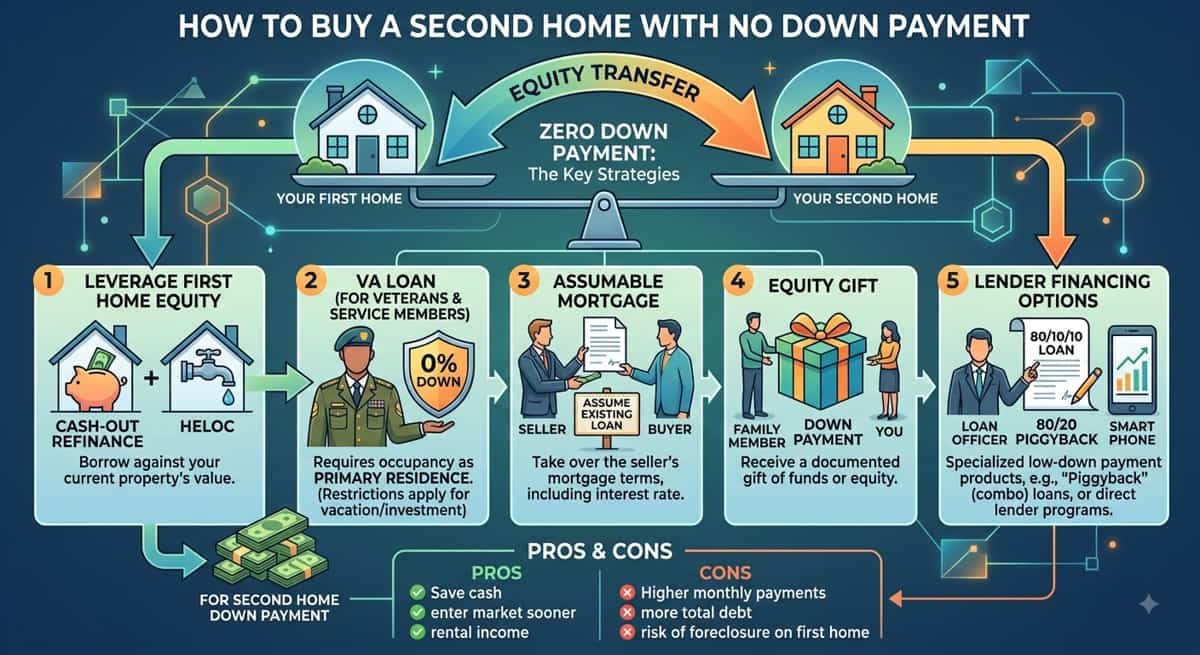
Here are the main paths people actually use to buy a second home without pulling new cash from savings.
Home Equity Loan or HELOC on Your Primary Residence
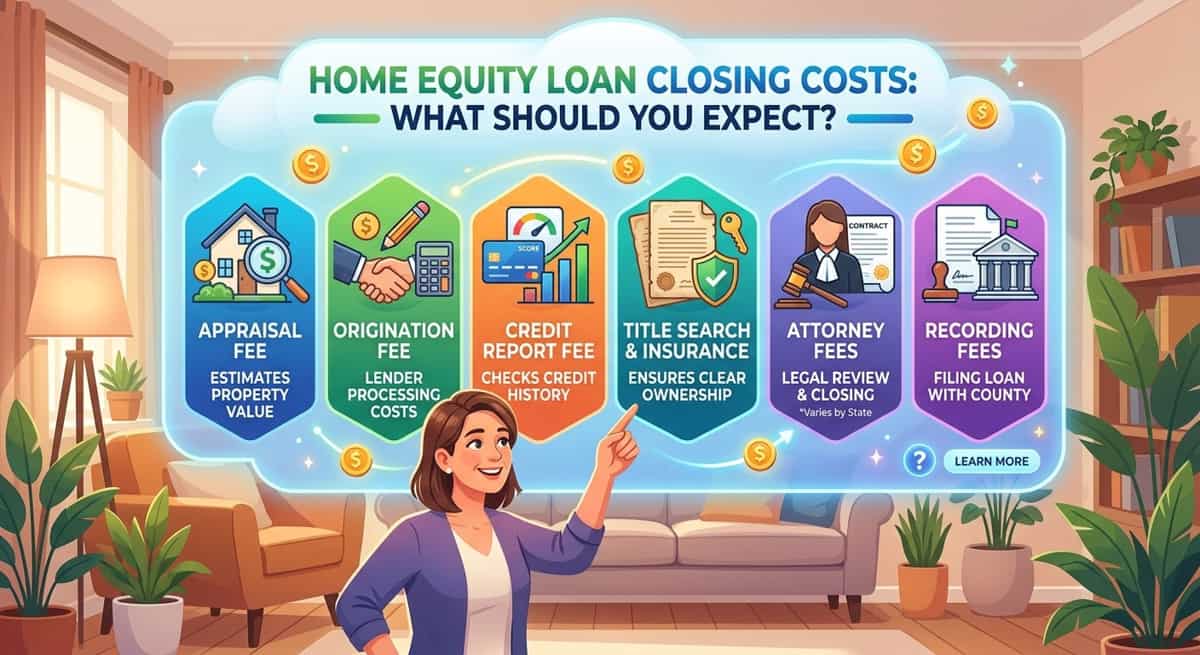
If you've owned your current home for a while, you've probably built up equity the difference between what your home is worth and what you still owe. A home equity loan or a HELOC (home equity line of credit) lets you borrow against that value.
Here's how it works in practice: you take out a loan or line of credit against your primary home, then use that money as the down payment (or even the full purchase price) for your second home. It's still borrowed money, so you'll have a new payment, but it doesn't require fresh cash from your bank account.
Cash-Out Refinance on Your Current Home
A Cash-out refinancing replaces your mortgage with a new, larger one, and you pocket the difference in cash. If your home has grown in value or you've paid down a good chunk of your loan, this can free up a meaningful amount of money to put toward your second property.
The upside is you may also lock in different loan terms on your primary home while you're at it. The downside is you're resetting the clock on that mortgage, so it's worth running the numbers carefully.
VA Loans and Second or Vacation Homes
If you're a veteran or active-duty service member, a Veterans Affairs loan is one of the few mortgage options that can require no down payment at all. VA loans are typically meant for a primary residence, but there are situations where remaining entitlement (the amount of VA loan benefit you haven't used yet) can be applied toward a second property, especially if your first home was also bought with a VA loan and you're relocating.
This one has real nuance to it, so it's worth having a loan officer look at your specific entitlement and eligibility before assuming it'll work for your plans.
Assumable Mortgages
Sometimes a seller has an existing mortgage with a great, low rate and depending on the loan type, a buyer may be able to "assume" that mortgage instead of getting a brand-new one. If the seller has built up equity, you may still need to cover that gap, but it can significantly lower the cash you need on hand, and locks you into a rate that might be far better than what's currently available.
Seller Financing (Owner Carry)
In some cases, especially with smaller or rural properties, the seller acts as the bank. You make payments directly to them instead of a mortgage lender, under terms you both agree on. This can mean a smaller (or no) down payment if the seller is motivated to sell and willing to be flexible. It's less common, but worth asking about, especially for properties that have been sitting on the market a while.
Down Payment Assistance and Bridge Loans
It's worth knowing upfront: most down payment assistance programs are designed for primary residences, not second homes, so this path won't apply to most buyers here. A short-term bridge loan (borrowing against your current home while you wait to sell it or refinance) can sometimes help cover a gap in timing, but it's a short-term tool, not a long-term financing plan, and it comes with its own costs.
A Real-Life Example: How This Might Look for You
Let's say you and your spouse bought your home eight years ago for $280,000. Since then, you've paid down the balance and the local market has grown, so your home is now worth $420,000, with about $190,000 still owed. That leaves you with roughly $230,000 in equity.
You've found a cozy three-bedroom cabin near the mountains for $250,000 that you'd love to use on weekends and holidays, with hopes of retiring there someday. Instead of pulling money from savings or your retirement account, you talk to a loan officer about a HELOC on your current home. Based on your equity and credit profile, you're approved for a $100,000 line of credit. You use $50,000 of that as your down payment on the cabin, keeping the rest available for unexpected repairs or emergencies, and finance the remainder of the cabin with a standard second-home mortgage.
Your monthly budget now includes your original mortgage payment, a new second-home mortgage payment, and a HELOC payment. It's more than you were paying before, but because you planned ahead and checked your numbers with a loan officer first, you know it fits comfortably within your income. That's the kind of clarity you want before you sign anything, and it's exactly what a pre-approval conversation is designed to give you.
Every household's version of this story looks a little different, but the core idea stays the same: use what you've already built to move forward, without stretching yourself thin in the process.
How Much Equity Do You Actually Need?
If your plan involves tapping equity from your current home, lenders will look at something called your loan-to-value ratio, or LTV. In plain terms, this compares how much you owe on your home to what it's currently worth. You can easily estimate your available equity using our home equity calculator tool.
Let's say your home is worth $400,000 and you owe $250,000 on it. That means you have $150,000 in equity. Most lenders will let you borrow up to somewhere around 80-85% of your home's value when you combine your current mortgage and a new home equity loan or HELOC. In this example, that could free up roughly $70,000-$90,000 to put toward your second home, depending on the lender and your credit profile.
The more equity you've built, the more flexibility you'll have. If you bought your home years ago or made a large down payment, you may have more room to work with than you think.
Qualifying Requirements Lenders Will Evaluate
Even if you're not writing a check for a down payment, lenders still want to know you can comfortably handle two properties. Here's what they'll typically look at:
Credit score – Second home loans usually call for a higher credit score than a primary residence purchase, often in the high 600s to 700s range depending on the loan type.
Debt-to-income ratio (DTI) – This compares your monthly debt payments to your monthly income. Lenders want to see that adding a second mortgage payment won't stretch you too thin.
Cash reserves – Many lenders want to see a few months' worth of mortgage payments in savings, even if you're not using savings for the down payment itself.
Income and employment verification – Steady, verifiable income matters more here, since you're taking on two housing payments.
Occupancy plans – Be ready to explain honestly how you'll use the property.
Pros and Cons of Buying a Second Home With No Money Down
The upside:
You don't have to drain your savings to make the purchase happen
You can act on an opportunity sooner rather than waiting years to save
You may be able to lock in current property prices or interest rates before they rise
The trade-offs:
You're increasing your overall debt, which means more monthly payments
If your home's value drops, you could end up owing more than your properties are worth
Two mortgage payments (or a mortgage plus a home equity loan) can strain your budget if anything unexpected happens, like a job change or repair bill
Interest rates on these financing paths can sometimes be higher than a standard primary mortgage, so be sure to compare current mortgage rates across loan types before locking in.
None of this means it's a bad idea plenty of people do this successfully. It just means it deserves the same careful thought you'd put into any big financial decision.
Step-by-Step: How to Buy a Second Home With No Down Payment
Check your current home's equity. Get a rough idea of your home's value and compare it to what you still owe.
Review your credit and monthly debt. Knowing where you stand helps you understand which loan options are realistic.
Get pre-approved. A loan officer can tell you exactly how much you could borrow and which financing path fits your situation.
Compare your financing options. HELOC, cash-out refinance, VA entitlement, or another route see which one actually makes sense for your goals and budget.
Talk with a licensed loan officer. This is the step that turns "maybe someday" into an actual plan, with real numbers instead of guesswork.
Shop for your second home with a clear budget and pre-approval in hand.
Make your offer and close. Once you're under contract, your loan officer will guide you through the final steps to closing day.
Common Mistakes to Avoid
Over-borrowing against your primary home. Just because you can access a large amount of equity doesn't mean you should use all of it.
Misclassifying the property. Be honest with your lender about how you'll actually use the home.
Skipping pre-approval. Falling in love with a property before knowing your real budget can lead to disappointment.
Forgetting about ongoing costs. Property taxes, insurance, maintenance, and possibly HOA fees add up fast on a second property.
Not planning for the unexpected. Make sure you could still cover both payments even if your income changed temporarily.
Talk to a Licensed Mortgage Loan Officer About Your Second Home Options
Every homeowner's situation looks a little different. The amount of equity you've built, your credit profile, your income, and your long-term goals all shape which path makes the most sense for you. A licensed loan officer can look at your actual numbers, walk you through real options, and help you understand exactly what you'd qualify for.
If a second home has been on your mind, there's no harm in having that conversation early, even if you're just exploring the idea. Reach out today to talk through your options and find out what's realistically possible for you.