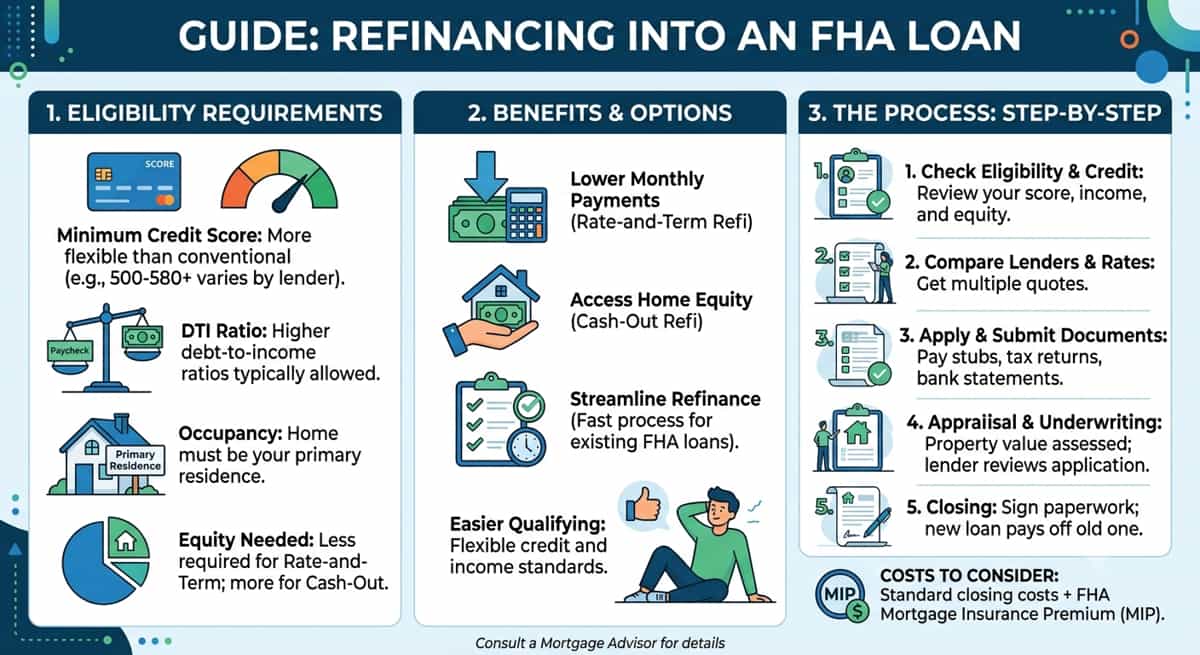
If you already have a mortgage, refinancing into an FHA loan can help you to lower your monthly payments, lock in another interest rate or get the advantages of a government-backed loan. Most people think FHA loans are only available to first time homebuyers when in fact these options can be used to refinance an existing mortgage as long as you meet the program criteria. If you are financially tight, an FHA refinance can provide exciting mortgages at better interest rates and set guidelines to be eligible than other offer conventional refinance choices.
But first, you need to know who is eligible, the types of FHA refinance programs offered and the costs before deciding whether it is right for you. This guide will cover your options to refinance into an FHA loan and whether or not you qualify, the biggest benefits, possible drawbacks, and everything you need to know in order to determine if this is the best refinancing option for you.
What Is an FHA Refinance, Exactly?
An FHA refinance is when you replace your current mortgage with a new loan that's insured by the Federal Housing Administration (FHA), a part of the U.S. Department of Housing and Urban Development (HUD). This insurance is what allows lenders to offer more flexible qualifying requirements than a typical conventional loan.
It's easy to confuse this with an FHA purchase loan, but they're different things. A purchase loan helps you buy a home. A refinance replaces the mortgage on a home you already own, whether that current mortgage is conventional, FHA, or something else. You're not buying anything new here you're restructuring what you already have.
Can You Refinance a Conventional Loan Into FHA?
This is actually one of the more common refinance moves homeowners make, and there are a few reasons why.
Maybe your credit score has dropped since you got your original loan, and you're having trouble qualifying for the best conventional rates now. Maybe your debt-to-income ratio has crept up because of a car loan, student loans, or other obligations, and FHA's more forgiving guidelines give you room that conventional lenders won't. Or maybe you simply want to lower your monthly payment or change your loan term, and an FHA loan turns out to offer the better deal for your specific numbers.
The point is, switching from conventional to FHA isn't unusual or a step backward. For a lot of people, it's simply the loan that fits where they are right now.
FHA Refinance Options — Which One Fits Your Situation?
Not all FHA refinances work the same way. Here's a breakdown of the main types, so you can see which one lines up with what you're trying to accomplish.
FHA Rate-and-Term Refinance
This is the most straightforward option. You're refinancing to get a better interest rate, change your loan term (30-year to a 15-year term), or both. You're not pulling any cash out you're just restructuring the loan itself, usually to lower your monthly payment or pay off your home faster.
FHA Cash-Out Refinance
If you've built up equity in your home and want to turn some of it into usable cash, an FHA Cash-Out Refinance lets you replace your current mortgage with a larger FHA loan and receive the difference in cash. The funds can be used for home improvements, debt consolidation, or other major expenses. Because you're borrowing more than you currently owe, you'll need sufficient home equity and must meet the lender's qualification requirements. It generally requires a bit more equity and a slightly stronger financial profile than a standard rate-and-term refinance.
FHA Streamline Refinance
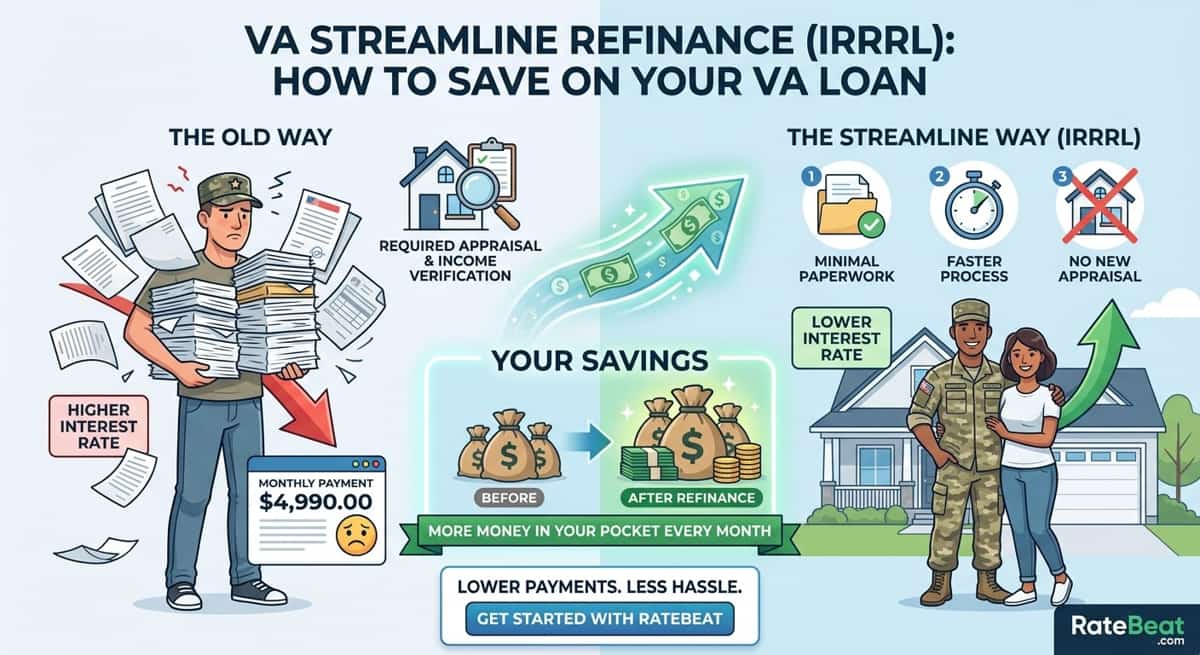
This one's designed for people who already have an FHA loan and want to refinance into another FHA loan, typically to lower their rate or payment. It's called "streamline" because it usually requires less documentation and, in many cases, no new home appraisal which can make the process faster and less stressful.
FHA Simple Refinance
This is similar to the streamline option but with slightly more documentation involved. It's generally used when a homeowner wants to refinance an existing FHA loan into a new one without pulling cash out, but doesn't qualify for or want the full streamline process.
Eligibility Requirements for an FHA Refinance
Before you get too far into comparing rates, it helps to know where you actually stand. Here's what lenders typically look at.
Minimum Credit Score
FHA loans are known for being more flexible with credit than conventional loans. While exact requirements can vary by lender, FHA guidelines generally allow lower credit scores than you'd need for a conventional refinance which is exactly why so many people consider this route after a rough financial stretch.
Debt-to-Income (DTI) Ratio
This is the percentage of your monthly income that goes toward debt payments. FHA loans tend to allow higher DTI ratios than conventional loans, which gives you more breathing room if you're carrying a car payment, student loans, or credit card debt alongside your mortgage.
Occupancy Requirements
FHA loans are meant for primary residences. This means the home you're refinancing generally needs to be the place you actually live in day to day, not a rental or vacation property.
Loan-to-Value (LTV) / Equity Needed
LTV compares how much you owe on your home to what it's worth. Rate-and-term refinances tend to allow higher LTV (meaning you can have less equity), while cash-out refinances usually require you to keep more equity in the home after the transaction.
Mortgage Insurance & Payment History
Lenders will look at your track record of on-time mortgage payments, and they'll also factor in FHA's mortgage insurance requirements, which apply regardless of your credit score or down payment size. More on that below.
Benefits of Refinancing Into an FHA Loan
There's a reason this option appeals to so many homeowners:
Lower credit barrier. You may qualify even if your score has taken a hit since your original loan.
Competitive rates. FHA-backed loans often come with rates that are on par with, or better than, conventional options especially for borrowers with less-than-perfect credit.
Streamline option. If you already have an FHA loan, the streamline refinance can mean less paperwork and a faster path to a better payment.
Cash-out flexibility. If you need access to your home's equity, the cash-out option gives you a way to use it for renovations, debt payoff, or other big expenses.
Drawbacks and Costs to Weigh
It's not all upside, and I think it's important to be straight with you about that.
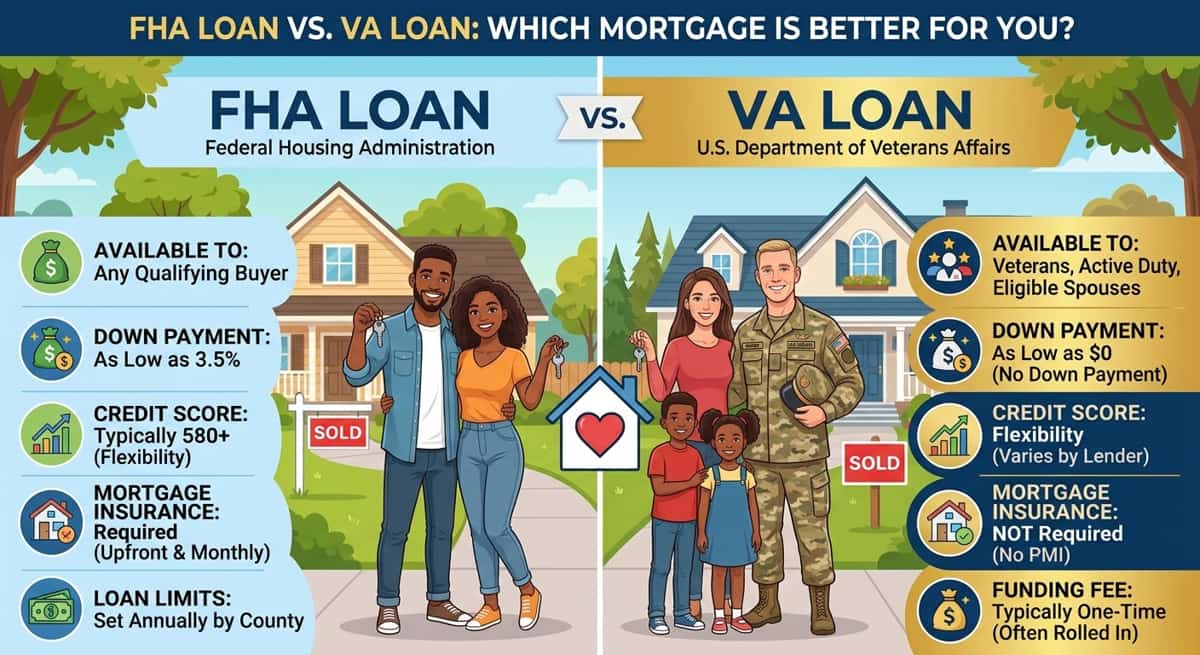
The biggest one is mortgage insurance. FHA loans require an upfront mortgage insurance premium (MIP), which is usually rolled into your loan amount, plus an annual MIP that gets paid monthly for most or all of the life of the loan depending on your down payment and loan term. Unlike conventional loans, where private mortgage insurance (PMI) can eventually be removed once you hit enough equity, FHA's MIP often sticks around much longer, sometimes for the entire loan term.
On top of that, you'll have standard closing costs, similar to what you paid on your original mortgage. And if you're comparing FHA to conventional refinancing, it's worth running the numbers on both, because the lower qualifying bar of FHA can come with a real ongoing cost in the form of that insurance.
FHA Refinance vs. Conventional Refinance: Which Is Better?
There's no universal answer here it depends on your credit, your equity, and your goals. Here's a side-by-side to help you compare:
Factor | FHA Refinance | Conventional Refinance |
Credit Score | More flexible, lower minimums | Generally requires higher scores |
DTI Ratio | More forgiving | Stricter limits |
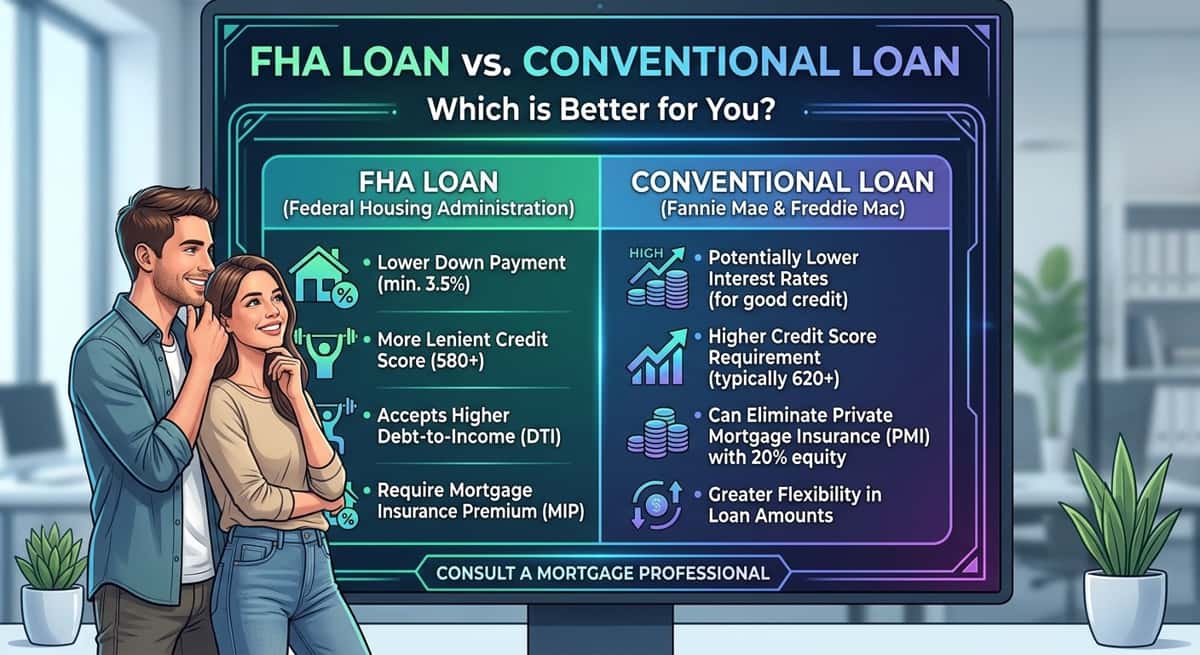
Mortgage Insurance | MIP required, often for life of loan | PMI can often be removed once equity builds |
LTV Limits | Allows less equity in some cases | Usually requires more equity for best terms |
Best Fit For | Borrowers with lower credit or higher DTI | Borrowers with strong credit and solid equity |
If your credit and equity are both strong, conventional refinancing may save you money long-term by avoiding lifelong mortgage insurance. If your credit has dipped or your DTI is on the higher side, FHA may be the more realistic and accessible path.
Step-by-Step FHA Refinance Process
Here's what the process generally looks like from start to finish:
Check your eligibility and credit. Get a sense of your credit score, current DTI, and how much equity you have before you start shopping.
Compare lenders and rates. Rates and fees vary between lenders, so it's worth getting a few quotes rather than going with the first offer.
Submit your application and documents. This typically includes pay stubs, tax returns, bank statements, and information about your current mortgage.
Home appraisal (if required). Depending on the type of FHA refinance, you may need a new appraisal to confirm your home's current value.
Underwriting. The lender reviews everything your income, credit, debts, and the appraisal to make a final lending decision.
Closing. You sign the final paperwork, your new loan pays off your old one, and your new terms take effect.
How Much Does an FHA Refinance Cost?
Costs will vary based on your loan amount, lender, and location, but generally you're looking at typical closing costs similar to what you paid when you first got your mortgage, plus the FHA upfront mortgage insurance premium. The good news is that in many cases, this upfront premium can be rolled into your new loan amount rather than paid out of pocket at closing, which helps keep your immediate cash needs lower.
When Does It Make Sense to Refinance Into FHA?
A few real-life scenarios where this move tends to make sense:
Your credit score has dropped since your original loan, and you're struggling to qualify for competitive conventional rates.
You want to tap into your home's equity through a cash-out refinance, but your credit or DTI doesn't quite meet conventional standards.
You already have an FHA loan and want a faster, simpler way to lower your rate through the streamline option, without a full new appraisal.
Talk to a Licensed Mortgage Advisor About Your Options
Refinancing into an FHA loan is the best choice for homeowners who needs lower monthly payments, a more stable mortgage or you find it easier to qualify for FHA than conventional refinance. FHA refinancing can be a great path to homeownership with helpful features like reasonable credit standards and comparatively rapid loan approval, but weigh your mortgage insurance premiums and closing costs before proceeding.
Looking at your options and reassessing your financial objectives can help determine if an FHA refinance is right for you. Engaging an experienced mortgage professional can also guide you and present the right refinance solution that best supports your long-term financial goals.