If you're trying to buy a home and you've started looking into your loan options, you've probably run into these two names over and over: FHA and VA loans. Both are popular because they make homeownership more reachable than a typical conventional loan but they're built for different people and different situations.
So which one is actually better? Honestly, there's no single right answer. It depends on things like whether you've served in the military, how much you've saved for a down payment, and where your credit stands right now. A VA loan tends to win on cost if you qualify for one, since it can let you buy with $0 down and skip monthly mortgage insurance. An FHA loan, on the other hand, is open to almost anyone and is more forgiving if your credit isn't perfect.
What Is an FHA Loan?
An FHA loan is a mortgage backed by the Federal Housing Administration, a government agency. The FHA doesn't actually lend you the money a regular bank, credit union, or mortgage lender does, but the government backs the loan, which means the lender takes on less risk. Because of that safety net, lenders are willing to approve buyers who might not qualify for a conventional loan. You can explore FHA home loan programs to see how accessible low down payment options can be.
This program was created decades ago with one goal in mind: help more Americans become homeowners, especially people who don't have a lot of cash saved up or who have some bumps in their credit history. That's still exactly what it does today.
You can typically qualify for an FHA loan with a credit score as low as 580 if you're putting down 3.5%. Even scores in the 500–579 range can sometimes work, though you'd need to put down 10% instead. There's no requirement to have served in the military. This loan is available to basically anyone who meets the income, credit, and property requirements.
In practice, FHA loans tend to be the go-to option for first-time buyers, people rebuilding their credit, or anyone who simply hasn't had years to save up a large down payment.
What Is a VA Loan?
A VA loan is a mortgage guaranteed by the U.S. Department of Veterans Affairs. Specially designed VA loans for military members and veterans offer incredible benefits, including $0 down payment options and no monthly PMI.
Like the FHA program, the VA doesn't hand you the loan directly. A private lender does that, and the VA guarantees a portion of it, which gives lenders the confidence to offer better terms, namely, no down payment requirement at all in most cases, and no monthly mortgage insurance, ever.
To use a VA loan, you'll need to prove your eligibility through called a Certificate of Eligibility, (COE). This document confirms your service history meets the VA's requirements generally 90 consecutive days of active duty during wartime, 181 days during peacetime, or six years in the National Guard or Reserves, though the exact rules vary by situation.
If you're eligible, a VA loan is often the strongest deal on the table. It's especially valuable for buyers who want to keep more cash in their pocket at closing instead of tying it up in a down payment.
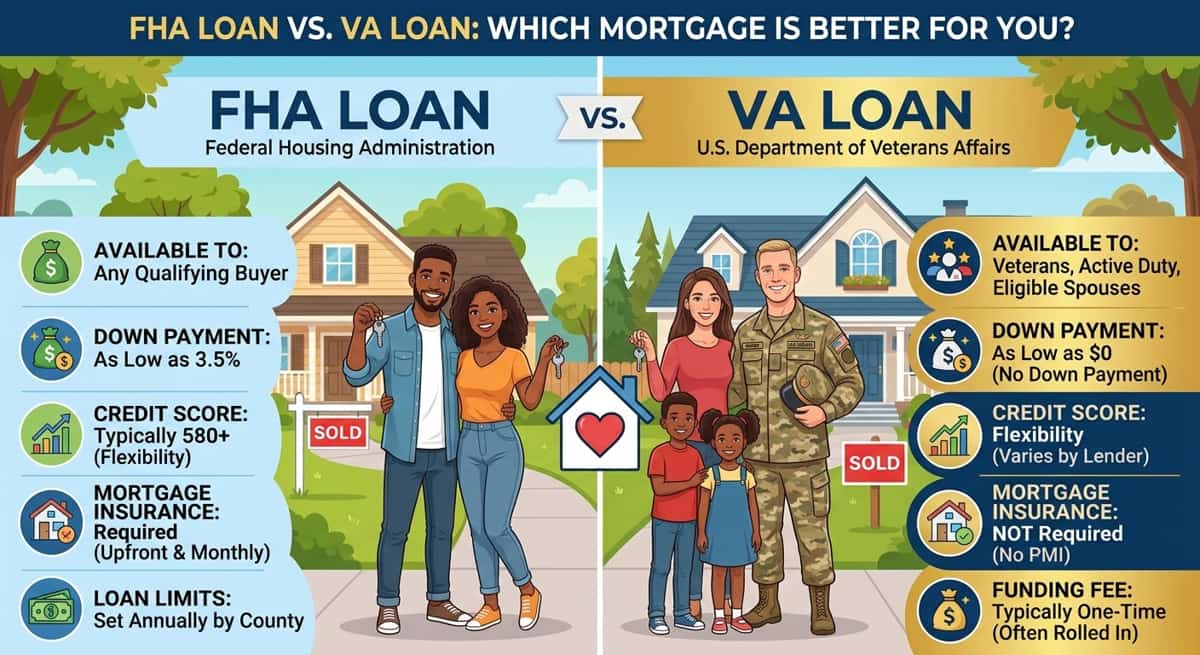
FHA vs. VA Loan: Key Differences at a Glance
The biggest differences between these two loans come down to who can use them, how much you need upfront, and how much you'll pay for mortgage insurance. Here's a side-by-side look:
Feature | FHA Loan | VA Loan |
Who can use it | Any qualifying buyer | Veterans, active-duty service members, eligible surviving spouses |
Down payment | As low as 3.5% | As low as $0 |
Credit score | 580+ typically (500–579 possible with 10% down) | No official minimum lenders set their own bar |
Mortgage insurance | Required (upfront + monthly) | None |
Upfront fee | Upfront mortgage insurance premium | VA funding fee (waived for some disabled veterans) |
Loan limits | Set annually by county | Typically no cap if you have full entitlement |
Can you reuse it? | Yes, on future homes | Yes- entitlement can be restored |
Property use | Must be your primary home | Must be your primary home |
At a glance, the VA loan looks like the clear winner and cost-wise, it often is, if you qualify. But eligibility is the real dividing line here. If you haven't served in the military, this decision is already made for you: FHA (or another loan type) is your path.
FHA Loan Eligibility Requirements Explained
To qualify for an FHA loan, lenders will generally want to see:
A credit score of at least 580 to get the 3.5% down payment option. If your score falls between 500 and 579, you can still qualify, but you'll need to put down 10% instead.
A manageable debt-to-income ratio. This compares your monthly debts to your monthly income. Most lenders like to see this fall under roughly 43–50%, though some flexibility exists depending on your overall financial picture.
Steady, verifiable income. You'll need to show pay stubs, tax returns, or other proof that you can reliably make your monthly payments.
The home must be your primary residence. FHA loans aren't for investment properties or vacation homes you have to actually live there.
None of these requirements are about military service. FHA is genuinely open to anyone who can show they're a reasonable, responsible borrower, even if their credit history isn't spotless.
VA Loan Eligibility Requirements Explained
VA loan eligibility is centered around your service record rather than your finances. Generally, you'll qualify if you meet one of these:
90 consecutive days of active duty during a wartime period
181 days of active duty during peacetime
Six years of service in the National Guard or Reserves
You're the surviving spouse of a service member who died in the line of duty or from a service-connected disability
You'll confirm your eligibility with a Certificate of Eligibility, which your lender can usually help you pull.
Here's something people don't always realize: the VA doesn't set an official minimum credit score. That said, individual lenders often set their own internal minimums commonly somewhere around 580–620 so "no minimum" doesn't mean "no standards." The VA also looks closely at what is called residual income, which is basically how much money you have left over each month after covering your debts and everyday living costs. It's a slightly different way of evaluating whether you can comfortably afford the loan.
Just like FHA, the home you're financing with a VA loan has to be your primary residence, no investment properties or second homes.
Down Payment and Mortgage Insurance Compared
This is where the two loans really start to separate financially.
With a VA loan, if you qualify, you can finance the entire purchase price of the home with no down payment required. And because the VA guarantees the loan, you'll never pay monthly mortgage insurance. That's a real, ongoing savings that adds up significantly over the years you own the home.
With an FHA loan, you'll need at least 3.5% down, and you'll also pay mortgage insurance both an upfront premium (which can often be rolled into the loan) and a monthly premium that gets added to your payment. Depending on your loan terms, that monthly insurance can stick around for the life of the loan or drop off once you hit a certain amount of equity.
Here's the thing to keep in mind: VA loans do come with an upfront funding fee instead of monthly mortgage insurance. It's a one-time cost (which can also be rolled into your loan), and it's often waived entirely for veterans with a service-connected disability. So while VA loans usually come out ahead cost-wise, it's worth running the actual numbers using an online mortgage calculator rather than assuming a good loan officer can show you the real dollar difference over 5, 10, or 30 years.
Interest Rates, Closing Costs, and Fees
VA loans tend to carry slightly lower average interest rates than FHA loans, mostly because the government guarantee reduces the lender's risk. But your actual rate will always come down to your credit, your lender, and what's happening in the market at the time you apply so it's not something we'll pin down with exact numbers here, since rates shift regularly. The best move is to check today's mortgage rates or ask a licensed loan officer for personalized quotes based on your specific profile.
Both loan types allow the seller to help cover your closing costs, which can be a huge relief if you're short on cash after your down payment (or lack thereof, in the VA's case). The exact amount a seller can contribute depends on the loan program and your purchase agreement.
As for the VA funding fee it varies based on whether this is your first time using a VA loan or a repeat use, and how much (if anything) you're putting down. First-time users typically pay a lower percentage than those using their VA benefit again. Veterans receiving VA disability compensation are often exempt from this fee altogether.
Which Loan Is Better for Your Situation?
Instead of asking "which loan is better" in general, it helps to ask "which loan is better for me." Here's how that tends to break down in real life:
If you're short on savings, a VA loan (if you're eligible) is usually the stronger choice, since it can eliminate the down payment entirely. If VA isn't an option for you, FHA's 3.5% down requirement is still one of the lowest available.
If your credit has some dings, FHA is often more forgiving here, with a clear, published minimum score. VA loans don't have an official minimum, but individual lenders may still hold a higher bar than they'd like to admit upfront.
If you're an eligible veteran or service member with strong entitlement, VA is almost always the better financial choice, thanks to no down payment and no monthly mortgage insurance.
If you're a veteran using your benefit again It's still worth exploring, but be aware the funding fee is typically higher on subsequent uses, so it's worth comparing the numbers against FHA in some cases.
If you want to avoid paying mortgage insurance long-term VA is the clear winner. FHA's mortgage insurance can stick around for years and adds real cost over time.
At the end of the day, if you're eligible for a VA loan, it's very often the better deal. If you're not eligible, FHA remains one of the most accessible and buyer-friendly options out there.
Can You Use Both an FHA and VA Loan?
Technically, an eligible veteran could use an FHA loan for one home purchase and a VA loan for another, at different points in time. It's also fairly common for someone to buy their first home with an FHA loan and later refinance into a VA loan once they discover they're eligible, or vice versa.
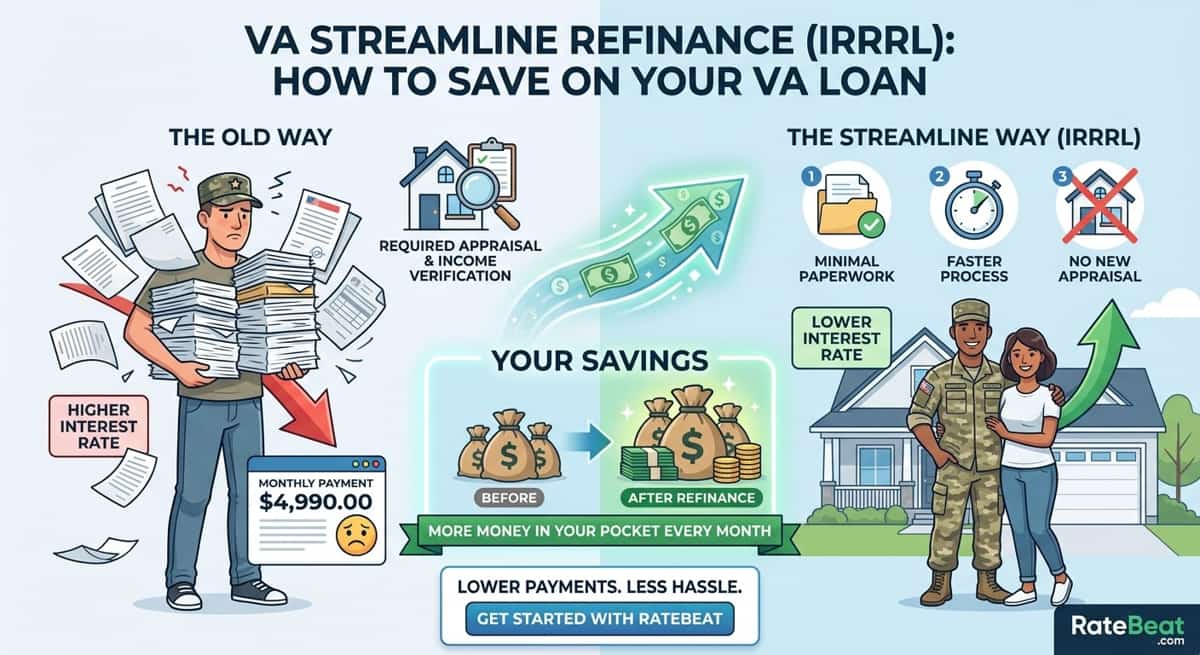
If refinancing comes up down the road, exploring home refinancing options like the VA IRRRL or FHA Streamline Refinance can help you lower your interest rate or monthly payment down the line. Both are designed to make refinancing simpler and faster if you're already in that loan program and just want to lower your rate or adjust your terms.
Common Mistakes to Avoid When Choosing Between FHA and VA Loans
A few missteps come up again and again when buyers are weighing these two options:
Assuming VA is automatically cheaper without checking the real numbers. It usually is, but not always it depends on your specific fees, credit, and how long you plan to stay in the home.
Not checking VA eligibility before ruling it out. Some people assume they don't qualify simply because they didn't serve in a combat role or don't remember the exact rules. It's always worth double-checking.
Picking a lender without asking about their internal requirements. Two lenders can both offer "FHA loans" or "VA loans" and still have very different credit score minimums or approval standards. Shop around.
Ignoring the long-term cost of mortgage insurance. A slightly lower monthly payment today with FHA insurance attached can cost more over the years than a VA loan with no insurance at all.
Not getting pre-approved for both, when eligible. If you qualify for VA, it rarely hurts to compare a real pre-approval for both loan types side by side before deciding.
How a Licensed Mortgage Loan Officer Can Help You Decide
Reading about FHA and VA loans online is a great starting point, but nothing beats sitting down with a licensed mortgage loan officer who can look at your actual credit, income, and goals. A good loan officer can run real numbers for both loan types, check your VA eligibility if it applies to you, and flag any lender-specific requirements that might affect your approval.
Over years of helping buyers work through exactly this decision, one thing becomes clear: the "right" loan almost never comes down to which one sounds better on paper it comes down to your numbers. A loan officer's job is to translate all these rules and requirements into a clear answer for your specific situation, not a generic one.
If you're ready to see what you actually qualify for, reach out to a licensed mortgage loan officer for a no-pressure conversation about your options. (Always confirm you're working with someone properly licensed; you can look up any loan officer's NMLS number to verify their credentials before you start the process.)
Bottom Line: Choosing the Right Loan for You
If you're eligible for a VA loan, it's usually hard to beat no down payment, no monthly mortgage insurance, and often a lower rate. If you don't have military service in your background, FHA remains one of the most accessible ways to buy a home, especially if your credit or savings aren't quite where you'd like them to be.
Either way, the smartest next step is the same: talk to a licensed mortgage loan officer who can look at your real numbers and tell you exactly where you stand. That conversation costs you nothing, and it's the fastest way to turn "which loan is better" into "here's the loan that's right for me."