Buying a home is a major financial decision, and choosing the right mortgage can affect your monthly payments and long-term costs. Two of the most common options for homebuyers are FHA loans and conventional loans. FHA loans are backed by the Federal Housing Administration and can be easier to qualify for, especially if you have a lower credit score or limited savings for a down payment.
Conventional loans, meanwhile, may provide greater flexibility and lower costs for borrowers with stronger credit and finances. The better option depends on your financial situation, home-buying goals, and ability to meet each loan’s requirements. Understanding the differences between FHA and conventional loans can help you choose a mortgage that fits your needs. In this guide, we’ll compare their credit requirements, down payments, mortgage insurance, interest rates, and overall costs to help you make a confident decision.
What Is an FHA Loan?
An FHA loan is a mortgage that's insured by the Federal Housing Administration, a part of the U.S. Department of Housing and Urban Development (HUD). Here's the thing to understand: the FHA doesn't actually lend you the money. A regular bank or mortgage lender does that. What the FHA does is guarantee part of the loan, so the lender takes on less risk. Because the lender is protected, they're able to say yes to buyers who might not qualify for a typical loan, people with a lower credit score, a thinner credit history, or less cash saved up for a down payment.
This is exactly why FHA loans have become so popular with first-time home buyers. You don't need perfect credit or a big nest egg to get one. You do, however, pay for that flexibility through mortgage insurance, which we'll cover in a bit.
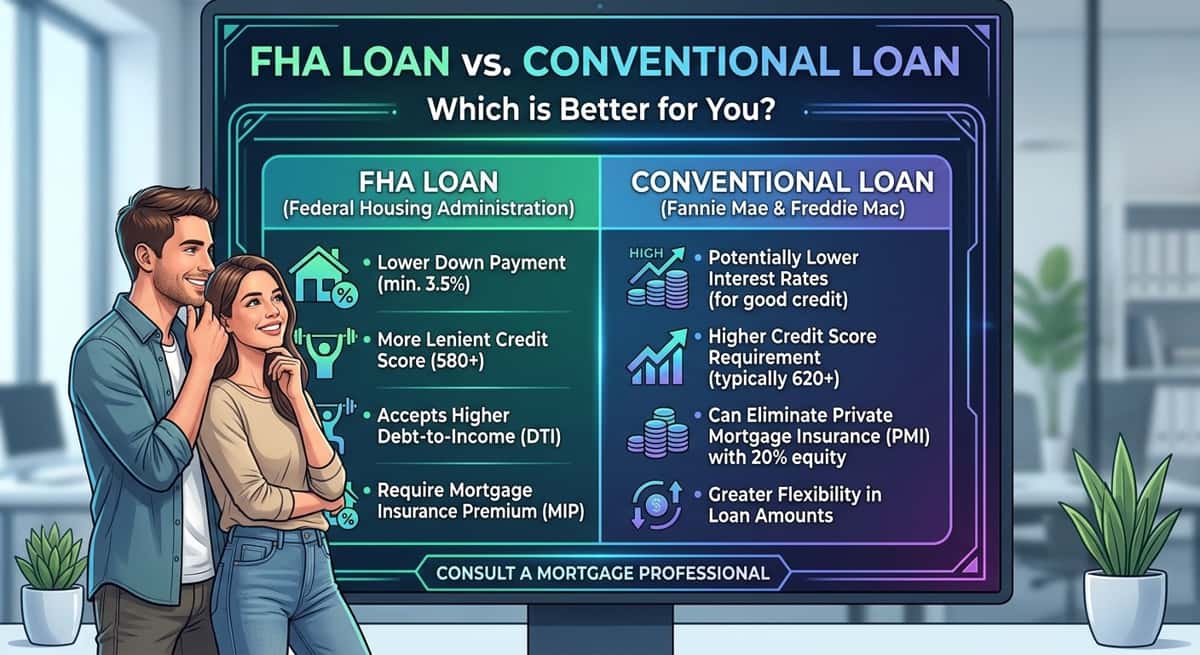
FHA loans are built for buyers who need a lower credit score or a smaller down payment to get into a home.
Key FHA Loan Requirements at a Glance
Minimum credit score: as low as 500–580, depending on your down payment
Minimum down payment: 3.5% (with a 580+ credit score)
Debt-to-income ratio: generally up to around 43%, sometimes higher with strong compensating factors
Occupancy: must be your primary residence no investment properties or vacation homes
Mortgage insurance: required upfront and annually, in most cases for the life of the loan
What Is a Conventional Loan?
A conventional loan is a mortgage that isn't insured or guaranteed by the government. Instead, it follows guidelines set by Fannie Mae and Freddie Mac, two organizations that buy mortgages from lenders and package them for investors. Because there's no government backing, lenders take on more of the risk themselves which is why conventional loans generally ask for a stronger credit profile.
If your loan amount fits within the yearly limits set by Fannie Mae and Freddie Mac, it's called a "conforming" loan. Need to borrow more than that (say, for a pricier home in an expensive market)? You'd be looking at a "jumbo" loan, which is a type of conventional loan with its own separate rules.
Conventional loans tend to appeal to buyers with good credit, steady income, and at least a little bit saved for a down payment. They're also more flexible than FHA loans when it comes to what you can buy: primary homes, second homes, and even investment properties are all fair game.
Conventional loans are built for buyers with stronger credit who want more flexibility and the option to drop mortgage insurance down the road.
Key Conventional Loan Requirements at a Glance
Minimum credit score: typically 620, though the best rates go to scores of 680 and up
Minimum down payment: as low as 3% for qualified first-time buyers, more commonly 5–20%
Debt-to-income ratio: generally up to around 45%, sometimes higher case by case
Occupancy: primary residences, second homes, and investment properties all allowed
Mortgage insurance: required if you put down less than 20%, but it can be cancelled once you reach roughly 20–22% equity
FHA vs. Conventional Loan: Side-by-Side Comparison
Sometimes it's easiest to just see the numbers next to each other. Here's how the two loan types stack up on the things that matter most:
Feature | FHA Loan | Conventional Loan |
Minimum credit score | 500–580 | 620 (680+ for best rates) |
Minimum down payment | 3.5% | 3–5% typical |
Mortgage insurance | MIP - often for the life of the loan | PMI - cancellable around 20–22% equity |
Debt-to-income limit | Up to ~43% (flexible) | Up to ~45% (flexible) |
Loan limits | Set by county (lower in most areas) | Higher conforming limits, set by FHFA |
Property types allowed | Primary residence only | Primary, second home, investment |
Seller-paid closing costs | Up to 6% of purchase price | Up to 3–9%, depending on down payment |
Best fit for | Lower credit, smaller down payment | Stronger credit, more savings |
What does this actually mean for you? If your credit score needs some work or you haven't been able to save much, FHA gives you a real path to homeownership that a conventional loan might not. If your credit is solid and you can put a little more down, a conventional loan will likely save you money every month and give you more flexibility down the road especially if you ever want to buy a second home or rental property.
Credit Score Requirements: FHA vs. Conventional
Your credit score plays a bigger role than almost anything else in this decision, so let's slow down here for a second.
With an FHA loan, you can qualify with a credit score as low as 500, but you'll need to put down 10%. Get your score up to 580, and the down payment drops to just 3.5%. This is a big reason FHA loans exist to give people with a shorter or bumpier credit history a real shot at buying a home.
Conventional loans usually start at a 620 minimum, though that number can vary a bit by lender. Where conventional loans really shine is once your score climbs into the high 600s and above better credit unlocks noticeably better interest rates and lower mortgage insurance costs. So even between two conventional loans, a 30-point difference in credit score can change your monthly payment.
The takeaway here: your credit score doesn't just decide whether you qualify. It decides how much your loan actually costs you every month, for years. That's exactly the kind of thing a licensed loan officer can pull up for you with a quick credit check no guessing required.
Down Payment Comparison: How Much Do You Really Need?
There's a popular myth that you need 20% down to buy a house. That's just not true and it stops a lot of people from even starting the process.
With an FHA loan, you can get in with just 3.5% down, as long as your credit score is 580 or higher. On a $300,000 home, that's $10,500 a lot more manageable than $60,000.
Conventional loans can go even lower in some cases. Certain first-time buyer programs allow as little as 3% down. That said, most conventional buyers put down somewhere between 5% and 20%, depending on their savings and how much they want their monthly payment to be.
Here's what the 20% number actually means: it's the threshold where you can skip mortgage insurance on a conventional loan, not a requirement to qualify. If you don't have that much saved yet, you're not stuck, you're just planning around a different set of costs, which we'll cover next.
One more thing worth knowing: many states and local housing agencies offer down payment assistance programs, some designed to pair with FHA loans specifically. A licensed loan officer will usually know which ones you might qualify for based on where you live and your income.
Mortgage Insurance: MIP vs. PMI Explained
This is where FHA and conventional loans really part ways and it's often the deciding factor for buyers who are torn between the two.
FHA loans come with MIP (Mortgage Insurance Premium). You pay an upfront premium at closing, plus an ongoing annual premium built into your monthly payment. Here's the part that surprises people: on most FHA loans today, MIP sticks around for the entire life of the loan. The only way to get rid of it is to refinance into a different loan once you have enough equity.
Conventional loans use PMI (Private Mortgage Insurance), and it works differently. You only pay PMI if your down payment is less than 20%. The cost varies based on your credit score and down payment size. Better credit generally means cheaper PMI. And unlike MIP, PMI isn't permanent. Once your loan balance drops to around 78–80% of your home's value, you can request that it be removed.
Did you know? Two buyers with the exact same loan amount can end up paying very different amounts for mortgage insurance, sometimes hundreds of dollars apart per year just based on which loan type and credit score they have.
Because these numbers shift depending on your specific credit profile and loan size, it's worth getting an exact quote rather than relying on averages. A licensed loan officer can run both scenarios side by side using your real numbers.
Loan Limits: How Much Can You Borrow?
Both FHA and conventional loans cap how much you can borrow, and those caps change every year and change by location, too.
FHA loan limits are set annually by HUD and vary by county, based on local home prices. In lower-cost areas, the limit is smaller. In expensive markets, it's higher. You can look up your exact county's limit on HUD's website.
Conventional loan limits (called conforming loan limits) are set annually by the Federal Housing Finance Agency, and they're typically higher than FHA limits in most areas. If you need to borrow more than the conforming limit, you'd move into jumbo loan territory, which has its own credit and down payment requirements.
Because these limits vary so much by county, it's a good idea to check the specific numbers for where you're buying or simply ask your loan officer, who deals with these limits daily.
Who Should Choose an FHA Loan?
An FHA loan tends to be the better fit if you fall into one or more of these categories:
You're a first-time home buyer without a long credit history
Your credit score is below 620
You haven't been able to save much for a down payment
Your monthly debts are a bit higher relative to your income
You've had past credit challenges, like a bankruptcy or foreclosure, but you're now within FHA's required waiting period
One more thing to keep in mind: FHA loans require the home to meet certain safety and condition standards during the appraisal. If you're eyeing a fixer-upper, this is worth discussing with your loan officer before you make an offer.
Who Should Choose a Conventional Loan?
A conventional loan is likely the better fit if:
Your credit score is 680 or higher
You have steady income and manageable monthly debts
You can comfortably put down 5% or more
You want the option to drop mortgage insurance once you build equity
You're buying a second home or investment property, which FHA doesn't allow
You're purchasing in a higher-priced market and need a loan amount above FHA's limit
Can You Switch or Refinance Between FHA and Conventional?
You're not locked into one loan type forever. It's actually pretty common to start with an FHA loan and later refinance into a conventional one.
Why would you do that? The most common reason is to get rid of FHA's mortgage insurance once you've built up enough equity something that isn't possible while you keep the FHA loan itself. There's also the FHA Streamline Refinance, which lets existing FHA borrowers refinance with less paperwork, often to snag a lower rate.
It's worth thinking about this as a longer-term plan, not just a one-time decision. Starting with FHA to get into a home sooner, then refinancing into a conventional loan a few years down the road, is a completely normal path for a lot of homeowners.
FHA vs. Conventional: 5 Questions to Ask Your Loan Officer
Reading about loan types online only gets you so far at some point, the numbers need to be about you. Here are five questions worth bringing to your next conversation with a loan officer:
Based on my credit score, which loan gets me a better rate?
How much will mortgage insurance actually cost me each month and over the life of the loan with each option?
Is there a break-even point where switching loan types later would save me money?
Do I qualify for any down payment assistance programs in my state?
Which loan type fits the type of property and location I'm considering?
Your answers will look different from your neighbor's, your coworker's, or the numbers you see in an online calculator. That's normal, this decision is personal, and it deserves personal numbers.
How a Licensed Mortgage Loan Officer Helps You Decide
Everything you've read so far gives you the general rules. A licensed loan officer takes those rules and applies them to your actual credit report, income, and goals which is really the only way to know which loan will cost you less and get approved faster.
Here's what that actually looks like in practice: they'll pull your credit and calculate your real debt-to-income ratio, match you with the loan programs (FHA, conventional, or state assistance programs) you genuinely qualify for, and map out a pre-approval strategy so you know your budget before you start house hunting.
It also matters that the person you're working with is licensed. Every legitimate loan officer has an NMLS number, which you can look up on NMLS Consumer Access to confirm their license is active and see their history. It's a simple way to make sure you're working with someone accountable the same way you'd check a doctor's license before a major decision about your health.
The Bottom Line
There's no single "better" loan, there's only the better loan for your credit, your savings, and your plans. If your credit needs a bit more time to build or you're working with a smaller down payment, FHA gives you a real, proven path into homeownership. If your credit is strong and you can put more down, a conventional loan will likely save you money month to month and give you more flexibility for the future.