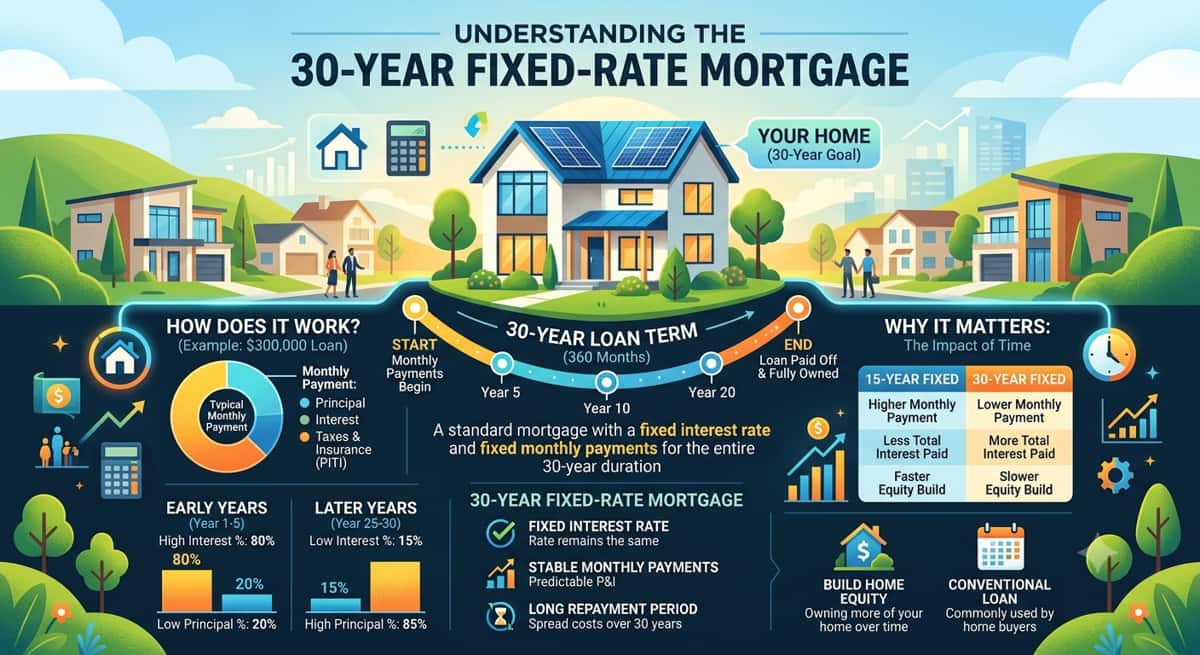
If you think of a 30-year fixed-rate mortgage as an agreement between you and your lender to use one interest rate at closing and not change it for the next 30 years, Fixed: the rate itself never moves. 30-year simply means that you can pay the loan off in full just not right away.
Unlike a loan where the rate can fluctuate over time. For a fixed-rate loan, your principal and interest payment (the bulk of your monthly mortgage payment) will be identical every month, whether it is the first month or the 360th month. That predictability is a major factor of why people go with it you can plan out your monthly budget years in the future without worrying about something raising your payment abruptly.
How Does a 30-Year Fixed-Rate Mortgage Work?
The simple premise is you take out a pre-determined amount of money (the loan amount) to purchase your home, and the lender charges you interest for borrowing it. That loan amount combined with interest is then spread out over 360 evenly spaced monthly payments. 30 years times 12 months.
In addition to the loan itself, many homeowners also include property taxes and homeowners insurance in their mortgage payment. Typically, this is done through what is referred to as an escrow account where the lender collects a small amount more than your monthly payment and then pays your tax and insurance bills on your behalf when they come due. In other words, based on many factors your overall monthly mortgage payment is typically more than just paying back the loan but at least the loan portion stays stagnant.
Amortization Schedule Explained
Each 30-year mortgage loan is followed by some process called an amortization schedule. This is essentially a breakdown month by month of how much goes to interest, and then how much goes toward paying off your loan (the principal).
Now this is where gets a little surprising for a lot of people: during the early stages of your mortgage most of that payment you send to the bank goes to interest NOT principal. As time goes on, that balance slowly shifts, and a larger portion of every payment begins to eat into what you really owe. It starts off slow but you will pick up the pace as it goes on. When you are closing on your loan, ask your lender or advisor for your amortization scheduleit is a handy document to have going forward.
How Your Interest Rate Is Determined
Your specific interest rate isn't pulled out of thin air it's based on a mix of factors. Your credit score plays a big role: generally, the higher your score, the better rate you're likely to qualify for. Your down payment matters too, since a bigger down payment usually means less risk for the lender. Lenders also look at your debt-to-income ratio (how much of your monthly income already goes toward debt) and the type of loan you're getting.
On top of your personal factors, there's also the bigger picture: overall mortgage rates move up and down based on the broader economy, and lenders often reference benchmarks like Freddie Mac's weekly mortgage rate survey to see where average rates stand.
30-Year Fixed-Rate Mortgage vs. Other Loan Terms
A 30-year fixed isn't the only option out there, and it's worth understanding how it stacks up against two other common choices: a 15-year fixed mortgage and an adjustable-rate mortgage (ARM).
30-Year vs. 15-Year Fixed Mortgage
A 15-year and a 30-year fixed-rate mortgage function work the same basic way: your interest rate stays locked for the entire loan term. The main difference is that a 15-year mortgage is paid off in half the time, which typically means higher monthly payments but less interest paid overall. That means a greater monthly payment since you are compressing the same amount of loan into fewer payments. The plus side is you'll pay much lower total interest on the life of the loan and own your home free and clear in a much shorter period.
For instance on the same amount for loans, a 15-year mortgage could have monthly payment several hundreds of dollars higher than a 30-year but total interest costs over the life of the loan would be tens of thousands lower. The best answer comes down to whether you prefer to make a lower monthly payment today or pay less interest over the loan.
30-Year Fixed vs. Adjustable-Rate Mortgage (ARM)
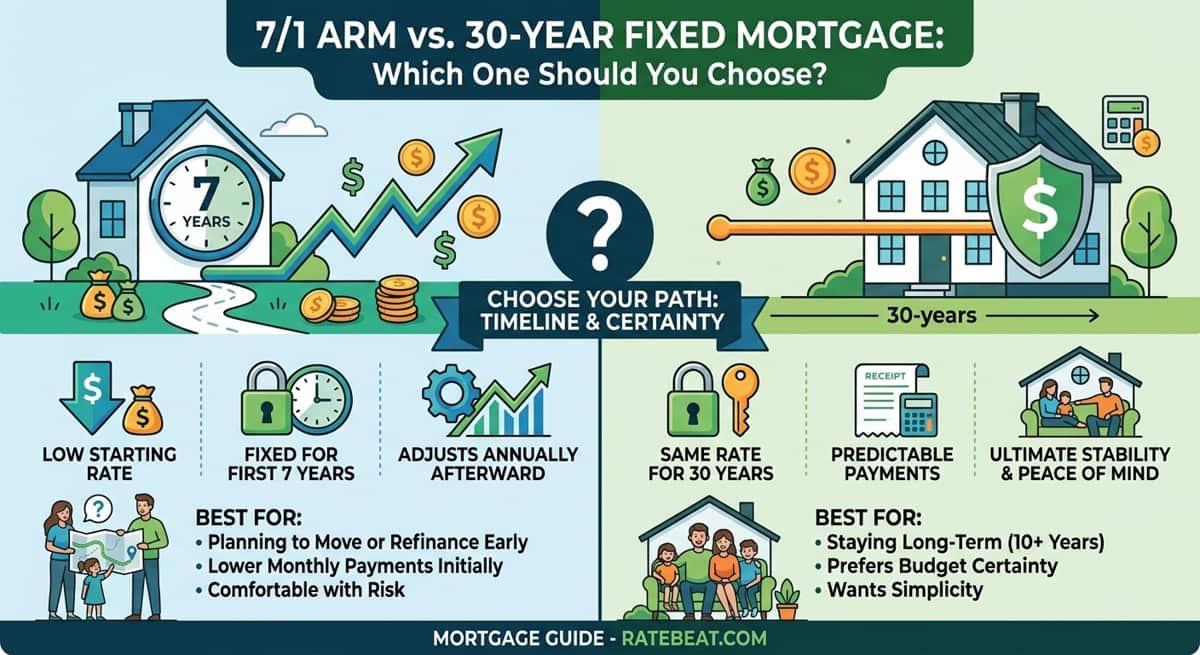
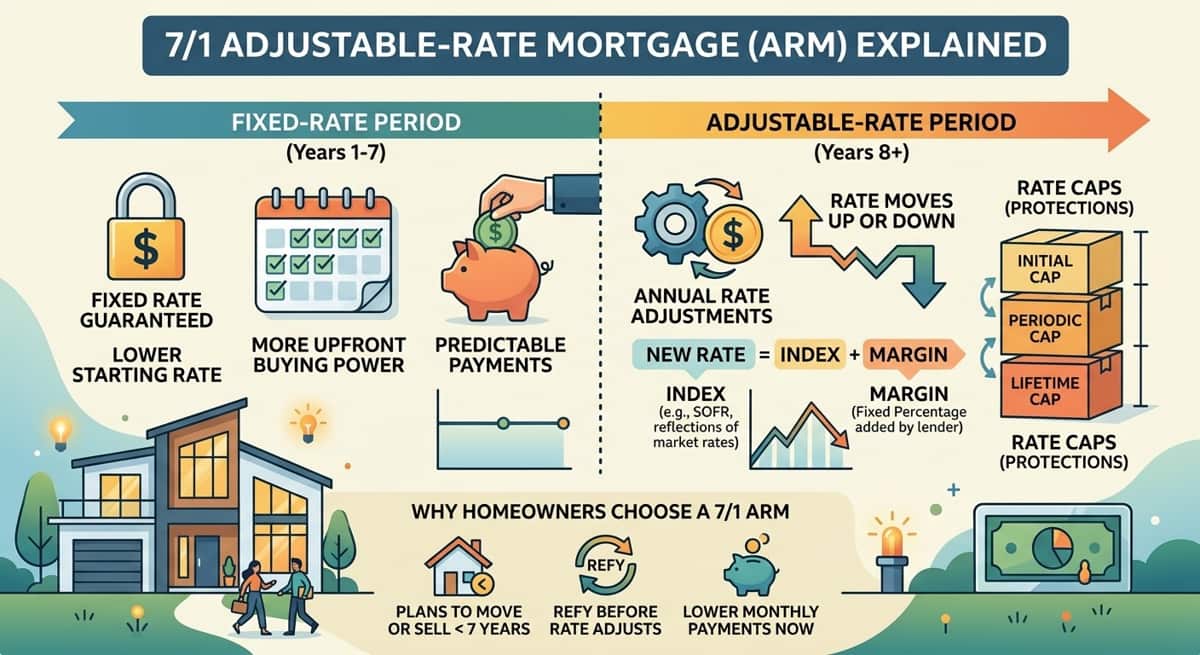
Most ARMs start with a lower rate than a 30-year fixed, so the first few years can be cheaper. But one kicker: after a teaser period (usually 5, 7 or 10 years), the rate can flex up or down as market conditions change. In other words, there is no cap on how much higher your monthly payment could rise.
An investor buys that longer duration by trading the lower initial rate of the 30-year fixed mortgage. For example, a fixed rate is typically the safest bet if you're going to be in your home for many years and want to avoid payment shock down the line (and assuming interest rates are not out of wack with long term average rates). An ARM might save you money in the short term (if you already know you're going to move or refinance by the time the adjustable period starts), but it carries more risk.
Pros and Cons of a 30-Year Fixed-Rate Mortgage
The upsides:
Your monthly payment stays exactly the same for the life of the loan, making budgeting simple
Lower monthly payments compared to shorter loan terms, since you're spreading the cost over more years
Easier to qualify for, since the lower payment can help your debt-to-income ratio
Protection from rising interest rates if rates go up nationally, yours won't
Extra room in your monthly budget for savings, home improvements, or other goals
The trade-offs:
You'll pay significantly more total interest over 30 years compared to a shorter loan term
Equity (the part of the home you actually own) builds more slowly in the early years
It takes longer to pay off your home entirely
If rates drop significantly after you close, you'd need to refinance to take advantage of the lower rate
What Affects 30-Year Fixed Mortgage Rates Today
Mortgage rates move for a lot of reasons that have nothing to do with you personally. Big-picture factors like Federal Reserve policy, inflation, and activity in the bond market all influence where average rates land on any given day or week.
Then there are the personal factors that affect the rate you're offered: your credit score, how much you're putting down, the size of your loan compared to the home's value, and the type of property you're buying. Because rates can shift daily, the number you see in a headline or ad isn't necessarily what you'll be offered the only way to know your real rate is to get a personalized quote based on your actual financial picture.
Who Should Consider home equity a 30-Year Fixed-Rate Mortgage?
A 30-year fixed mortgage tends to be a great fit if you're a first-time buyer trying to keep your monthly payment as manageable as possible. It's also a solid choice if you plan to stay in your home for a long time and want the peace of mind of knowing your payment will never change, no matter what happens with interest rates in the news.
It can also make sense if you'd rather have lower monthly payments and use the extra breathing room in your budget for other priorities building an emergency fund, saving for retirement, or paying down other debt instead of putting every extra dollar toward your house.
How to Qualify for a 30-Year Fixed-Rate Mortgage
Every lender has slightly different requirements, but here's generally what they'll look at:
Credit score: Conventional loans typically look for a credit score in the mid-600s or higher, while government-backed loans like FHA loans may allow lower scores.
Debt-to-income ratio: Lenders want to see that your monthly debts (including your new mortgage payment) don't eat up too much of your monthly income.
Down payment: This can range from as low as 3% for certain conventional loans, to 3.5% for FHA loans, up to 20% or more if you want to avoid extra costs like mortgage insurance.
Documentation: Be ready to provide proof of income (pay stubs, tax returns), bank statements, and information about your debts and assets.
If any of this feels overwhelming, that's completely normal a mortgage advisor can walk you through exactly where you stand and what loan programs you might qualify for based on your specific situation.
How a 30-Year Fixed-Rate Mortgage Affects Refinancing and Home Equity
Payments in the early years of a 30-year mortgage go mostly toward interest, your home equity the portion of your home you truly own builds up slowly at first. This is one of the biggest things people don't realize until a few years into homeownership.
This is where refinancing and home equity strategies come into play. If rates drop significantly after you've closed on your loan, refinancing into a new 30-year fixed mortgage at a lower rate could lower your monthly payment. On the other hand, if you've built up enough equity and need funds for something like home renovations, debt consolidation, or major expenses, a cash-out refinance lets you tap into that equity while still keeping a fixed rate.
Deciding whether refinancing makes sense and whether a cash-out refinance is the right move really depends on your current rate, how much equity you've built, and your long-term goals. This is exactly the kind of decision that benefits from sitting down with an advisor who can run the real numbers for your specific situation, rather than relying on a generic online calculator.
Common Mistakes to Avoid With a 30-Year Fixed-Rate Mortgage
Only checking one lender's rate. Rates and fees can vary meaningfully from lender to lender, so it pays to compare.
Forgetting about PMI removal. If you put down less than 20%, you're likely paying private mortgage insurance but you may be able to have it removed once you've built enough equity. Don't assume it just goes away on its own.
Not considering extra principal payments. Even small additional payments toward your principal can shave years off your loan and save you thousands in interest, without needing to refinance.
Ignoring how long you plan to stay. If you might move in a few years, it's worth comparing whether a 30-year fixed is really the best fit compared to other options.
Talk to a Licensed Mortgage Advisor About Your Options
There's no single "best" loan term the right choice depends on your goals, how long you plan to stay in your home, and how you want to balance your monthly payment against long-term savings. A 30-year fixed-rate mortgage might be the right fit for your situation, or it might make more sense to explore a shorter term, refinancing, or a home equity option.
If you'd like to talk through your specific numbers and figure out the best path forward, reach out for a personalized consultation. We're happy to walk you through your options with no pressure and no guesswork.