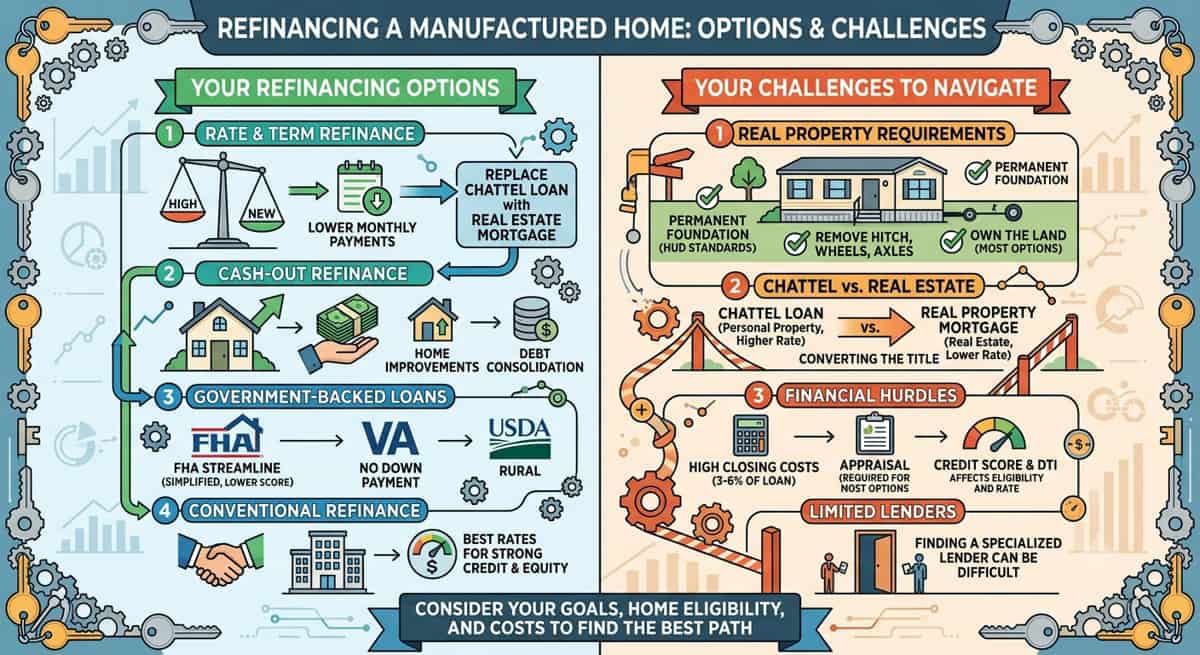
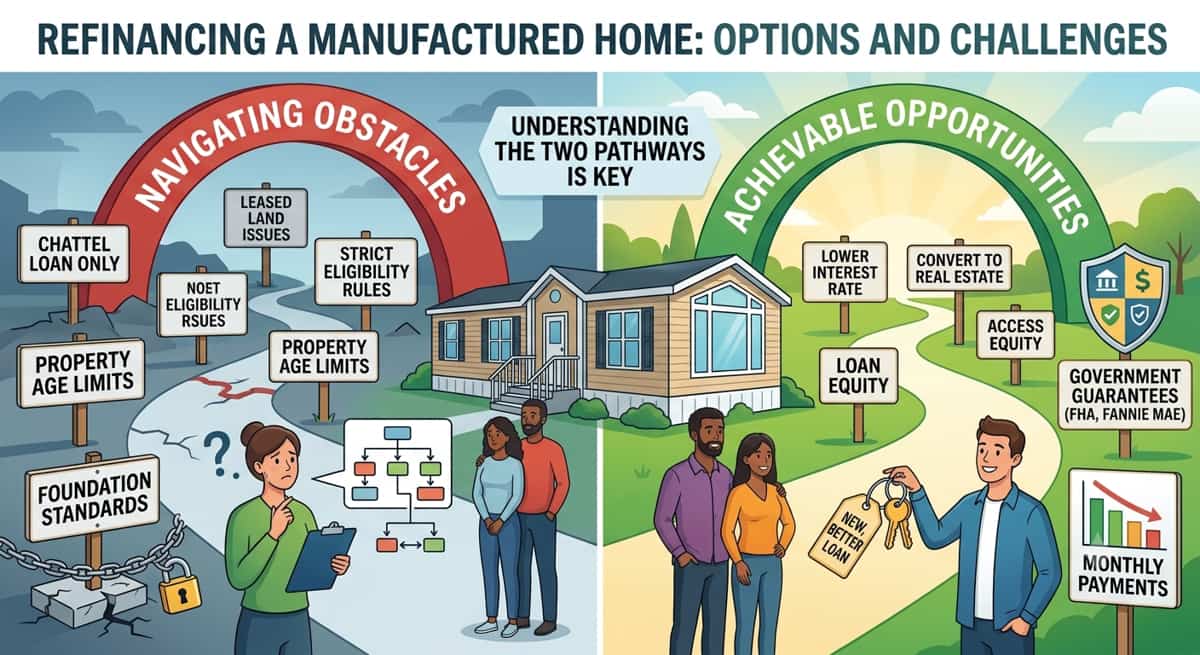
For homeowners who want to reduce their monthly payments, secure a better interest rate, or access equity in the home they have gained over time, refinancing a manufactured home can be a useful strategy. But this process differs greatly from the process of refinancing a traditional site-built home.
The key consideration is the legal title of the property: whether your home resides on a piece of land that you own (real property) or if your residence is titled as personal property (a chattel loan). Lenders typically have stricter requirements, shorter repayment windows and interest rates on homes on leased land or those under chattel financing. On the flip side, if you classify or convert it from chattel to real estate, then you have access to standard mortgages and government guarantees (like FHA, Fannie Mae or Freddie Mac) with much more favorable terms.
There are very real obstacles in the form of strict eligibility rules, foundation standards and property age limits, but understanding these pathways is what makes obtaining a better loan very achievable.
What Is an Adjustable-Rate Mortgage (ARM)?
An adjustable-rate mortgage loan where your interest rate stays the same for a set period at the beginning, then changes periodically after that. Compare that to a fixed-rate mortgage, where your rate and your monthly payment stays exactly the same for the entire life of the loan, whether that's 15 years or 30.
With an ARM, you get two phases. First, there's the "fixed" phase, where your rate is locked in and usually lower than what you'd get with a fixed-rate loan. Then comes the "adjustable" phase, where your rate can go up or down based on market conditions.
That adjustment isn't random. It's tied to two things: an index, which is basically a benchmark interest rate that moves with the broader economy, and a margin, which is a fixed percentage your lender adds on top of that index. Add them together, and that's your new rate each time it adjusts. Once you understand those two pieces, the rest of how an ARM works starts to make a lot more sense.
How ARM Rate Adjustments Actually Work
Initial Fixed-Rate Period (5/1, 7/1, 10/1 Explained)
You'll often see ARMs labeled with numbers like 5/1, 7/1, or 10/1. The first number tells you how many years your rate stays fixed. The second number tells you how often it can adjust after that in most cases, once a year.
So a 7/1 ARM means your rate is locked in for the first seven years, then can change once a year after that. A 5/1 ARM locks your rate for five years before the annual adjustments begin. The longer that fixed period, the more it starts to feel like a regular fixed-rate loan just usually with a slightly better starting rate.
Rate Caps — Initial, Periodic, and Lifetime
This is the part that eases a lot of people's minds once they understand it: ARMs come with built-in limits on how much your rate can jump, called rate caps. There are typically three of them working together.
The initial cap limits how much your rate can increase the very first time it adjusts. The periodic cap limits how much it can change at each adjustment after that. And the lifetime cap sets the absolute ceiling no matter what happens in the market, your rate can never go higher than that number for the life of the loan.
These caps mean an ARM isn't a blank check for your lender to raise your rate as high as they want. Before you sign anything, ask your lender to spell out all three numbers in plain terms, so you know exactly what your worst-case payment could look like.
Who Should Choose an Adjustable-Rate Mortgage?
An ARM isn't the right fit for everyone, but for the right person, it can genuinely save money. Here's who tends to come out ahead.
Buyers Who Plan to Move or Refinance Within 5–10 Years
If you already know you won't be in this home forever maybe it's a starter home, a job relocation is likely, or you're planning to upsize once your family grows an ARM can make a lot of sense. You get the benefit of a lower rate during the years you're actually living there, and you sell or refinance before the adjustable phase ever kicks in. In this scenario, you're getting all the upside with none of the long-term risk.
Homeowners Expecting Higher Future Income
Maybe you're early in your career, finishing a degree, or waiting on a promotion you know is coming. If your income is realistically going to grow in the next few years, a lower payment now with the flexibility to handle a higher one later can free up cash for other priorities today, like paying down debt or building savings.
Buyers Prioritizing Lower Initial Monthly Payments
Sometimes it's simply about what you can afford right now. A lower introductory rate means a lower monthly payment, which can make the difference between qualifying for the home you want or having to settle for less. If you're stretching your budget in the short term but have a clear plan for the years ahead, this lower entry point can be a real advantage.
Borrowers Comfortable with Interest Rate Risk
Some people simply aren't bothered by not knowing exactly what their payment will look like in year eight. If you have a financial cushion, a flexible budget, or just a higher tolerance for the unknown, the potential savings of an ARM might outweigh the discomfort of uncertainty for you.
Who Should Avoid an ARM?
Just as important as knowing who benefits from an ARM is knowing who probably shouldn't take one on. Here's when a fixed-rate loan is usually the safer, smarter choice.
Buyers Planning to Stay Long-Term
If this is your forever home the one you plan to raise a family in, retire in, or simply never move from a fixed-rate mortgage gives you something an ARM can't: certainty for the entire life of the loan. Once your adjustable period ends, you're exposed to rate changes for potentially decades. For a long-term stay, that risk usually isn't worth the short-term savings.
Homeowners on a Fixed or Tight Budget
If your monthly budget is already tight, or your income doesn't have much room to flex, an ARM can put you in a tough spot down the line. A payment increase that might feel manageable for someone with financial breathing room could be genuinely stressful or unaffordable for someone living paycheck to paycheck. In this case, predictability is worth more than a lower starting rate.
Risk-Averse Borrowers
Some people simply sleep better at night knowing their payment will never change. That's completely reasonable, and it's not a small thing money stress affects real life, not just spreadsheets. If the thought of an unknown future payment would keep you up at night, that discomfort itself is a good enough reason to choose a fixed-rate mortgage instead.
ARM Pros and Cons at a Glance
Adjustable-Rate Mortgage (ARM) | |
Pros | Lower initial interest rate |
Lower initial monthly payments | |
Rate could decrease if the market shifts | |
Rate caps limit worst-case increases | |
Cons | Payment can increase after the fixed period |
Harder to budget for the long term | |
Possible "payment shock" if rates rise sharply | |
More complex terms to fully understand upfront |
The short version: ARMs trade certainty for potential savings. Whether that trade makes sense depends entirely on your personal situation.
Adjustable-Rate Mortgage vs. Fixed-Rate Mortgage
The core difference comes down to one word: predictability. A fixed-rate mortgage locks in the same rate and payment for the entire loan term, which makes budgeting simple and removes any guesswork. An ARM offers a lower starting rate in exchange for the possibility of change later on.
Over the long run, the "right" choice often comes down to something called the break-even point basically, how many years it would take for the savings from your ARM's lower initial rate to be outweighed by a potential rate increase later. If you're planning to sell or refinance before you'd hit that break-even point, an ARM often works in your favor. If you're staying well past it, a fixed rate is usually the safer bet.
It's also worth remembering that ARMs aren't a one-way street. You always have the option to refinance out of an ARM into a fixed-rate loan before your adjustable period begins, giving you flexibility to reassess as your life and the market change.
How ARMs Fit Into Refinancing and Home Equity Strategies
Refinancing Out of an ARM Before Adjustment
One of the smartest moves I walk clients through is planning their refinance timeline before they even close on their ARM. If your fixed period is coming to an end and rates have moved in a way that makes a fixed-rate loan more attractive, refinancing before your first adjustment can lock in stability without you ever feeling the effects of a rate increase. The key is not waiting until the last minute start that conversation with your advisor at least six months before your rate is set to adjust.
Using Home Equity Strategically with an ARM
If you already have equity built up in your home, an ARM can sometimes be part of a bigger financial strategy not just a way to buy a house. For example, some homeowners use a lower ARM payment to free up monthly cash flow, then apply those savings toward paying down higher-interest debt or building an emergency fund. Others use a cash-out refinance into an ARM to access equity for a renovation, knowing they plan to sell or refinance again before the rate ever adjusts. The important part is having a clear plan, not just a lower payment for its own sake.
The Bottom Line
Choosing between an ARM and a fixed-rate mortgage really comes down to three things: how long you plan to stay in the home, how much risk you're comfortable carrying, and how much flexibility your budget has. Neither option is universally better they're just built for different situations.
If you're still not sure which path fits your life, that's exactly the kind of conversation worth having before you commit. I'd be glad to walk through your specific numbers, timeline, and goals together, so you can move forward with a decision that actually fits not just one that looked good on a rate sheet.