Home equity loans can help you to finance money for home improvements, paying off debt, financing medical bills & a number of other meaningful purposes that require cash today. Rather than based solely upon your credit score, this loan allows you to pull money from the equity you've accumulated in your home. Qualifying can be a little bit harder if you have bad credit, but it's not impossible! Lenders also usually consider other aspects of your application like the loan-to-value (LTV) ratio, debt-to-income (DTI) ratio and whether you have a steady job and can afford to make monthly payments on time. Having a significant amount of home equity can be useful in some circumstances as well since it can help mitigate the impact of a low credit score.
Knowing what to expect from lenders and how to improve your financial profile before you apply is the key to being approved. But you can do a few things to help improve your chances of qualifying for the loan terms that help include: improving your credit score, reducing existing debt and verifying your income before applying and comparing offers from multiple lenders. This step-by-step guide walks you through how to qualify for a home equity loan with bad credit, documents needed, common mistakes made and what to do if your application is denied other funding options available as well. When you spend the time preparing and understanding your options, it makes the borrowing decision much easier, resulting in a loan that works best with your long-term financial plan.
What Counts as "Bad Credit" for a Home Equity Loan?
Bad credit isn't one fixed number it depends on who you ask. Most lenders consider a FICO score below 620 to be in the "poor" or "bad credit" range, while scores between 620 and 679 usually fall into the "fair" category. If your score sits somewhere in there, you're not alone. Life happens medical bills, a job loss, a rough stretch after a divorce and plenty of homeowners find themselves rebuilding credit while still needing access to funds.
Here's something that surprises a lot of people: the credit score you need for a home equity loan or a HELOC (home equity line of credit) is often different from what you'd need for a regular mortgage to buy a home. Some lenders will work with scores in the low 600s, or even high 500s, especially if your equity position is strong. It varies a lot from lender to lender, so it's worth shopping around instead of assuming one "no" means the door is closed everywhere.
Why Home Equity Lending Is More Forgiving Than Other Credit
Think of it this way: when a lender approves a home equity loan, your house itself is the safety net. That's different from something like a credit card or personal loan, where the lender is basically trusting your word that you'll pay it back. Because your home backs the loan, lenders are often more willing to look past a lower credit score as long as you have enough equity and can show you can afford the monthly payment. That's the trade-off that makes this path possible even when your credit report isn't perfect.
Can You Get a Home Equity Loan With Bad Credit?
Yes it's possible, though it comes with some trade-offs. You should expect a higher interest rate than someone with strong credit, since the lender is taking on more risk. You may also be limited in how much you can borrow, since lenders typically cap how much of your home's value you can tap into when your credit is lower. In some cases, especially if your income or debt situation is tight, a lender might ask for a co-signer to strengthen the application. None of this means you're stuck it just means going in prepared, knowing what to expect, and being ready to shop around for the best fit.
Step-by-Step: How to Qualify for a Home Equity Loan With Bad Credit
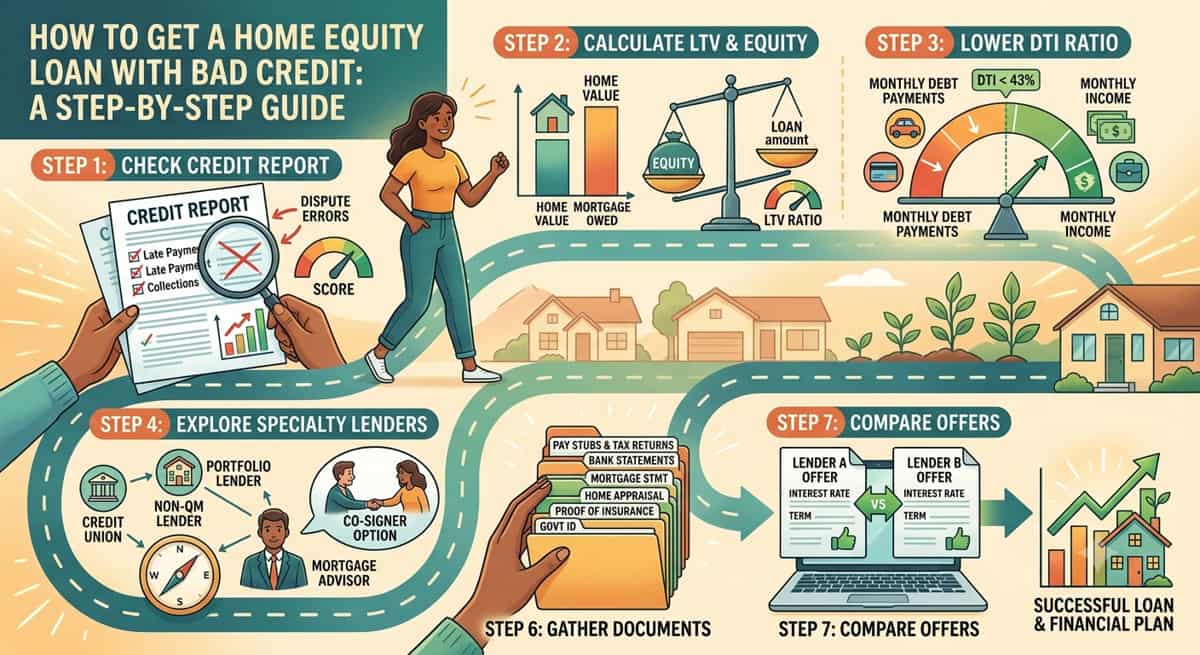
Step 1 – Check and Understand Your Credit Report
Before you apply anywhere, pull your credit report and actually read through it. You can get a free copy from all three bureaus at Annual Credit Report. Look for errors a late payment that was actually on time, an account that isn't yours, or an old debt that should have dropped off. Mistakes on credit reports are more common than people realize, and disputing an error can sometimes bump your score up within a few weeks. Give yourself time here; even small corrections can change what offers you qualify for.
Step 2 – Calculate Your Home Equity and LTV Ratio
Your equity is simply the difference between what your home is worth and what you still owe on it. Lenders talk about this using something called loan-to-value ratio, or LTV. Here's a simple example: if your home is worth $350,000 and you owe $200,000 on your mortgage, you have $150,000 in equity about 57% of the home's value. Most lenders want your total borrowing (existing mortgage plus the new loan) to stay under 80-85% of your home's value, though this can shift depending on your credit. The more equity you have, the more comfortable a lender will feel taking a chance on you, even with a lower score.
Step 3 – Lower Your Debt-to-Income (DTI) Ratio Before Applying
Your debt-to-income ratio how much of your monthly income goes toward debt payments matters just as much as your credit score, sometimes more. Most lenders want to see this at 43-50% or lower. If you're close to that ceiling, paying down a credit card balance or a car loan before you apply can make a real difference. It's one of the few things in this process you have direct, fast control over, so it's worth tackling first if your DTI is running high.
Step 4 – Explore Lenders Who Specialize in Bad-Credit Home Equity Loans
Not every lender treats credit the same way. Big national banks tend to have the strictest requirements, while credit unions, community banks, and portfolio lenders (lenders that keep loans on their own books instead of selling them off) often have more flexibility. There are also non-QM lenders who work outside standard loan guidelines who specialize in borrowers who don't fit the typical mold. This is also where working with a mortgage advisor can save you a lot of time and frustration. Instead of applying to lender after lender and collecting rejections, an advisor who knows which lenders are actually working with lower credit scores right now can point you in the right direction from the start.
Step 5 – Consider a Co-Signer or Co-Borrower
If your application is borderline, adding a co-signer or co-borrower with stronger credit can tip things in your favor. This might be a spouse, a family member, or a partner who's willing to share responsibility for the loan. Keep in mind this is a real commitment for them too if payments are missed, it affects their credit as well as yours. It's worth having an honest conversation about that before asking.
Step 6 – Gather Documentation Lenders Will Require
Being organized upfront speeds everything up. Most lenders will ask for:
Recent pay stubs or proof of income (tax returns if you're self-employed)
Bank statements from the last two to three months
Your current mortgage statement
A recent home appraisal or the lender's own appraisal
Proof of homeowners insurance
A government-issued ID
Having these ready before you apply can shave days off the process and shows the lender you're a serious, prepared borrower.
Step 7 – Get Pre-Qualified and Compare Offers
Before you commit to a full application, ask about pre-qualification. Most lenders can give you a rough idea of what you'd qualify for using a soft credit pull, which doesn't affect your credit score. This lets you compare a few offers side by side before choosing one. Once you're ready to move forward with a specific lender, they'll do a hard credit pull as part of the official application this can cause a small, temporary dip in your score, so it's smart to do your comparison shopping first and narrow it down before that step.
Interest Rates and Terms to Expect With Bad Credit
Rates change constantly, so rather than quoting a specific number that will be outdated by the time you read this, here's what matters: expect to pay a noticeably higher rate than someone with excellent credit, and expect your borrowing limit to be more conservative. The exact gap depends on your credit score, your equity, your income, and which lender you go with which is exactly why getting a few real quotes matters more than any average you'll find online. A mortgage advisor can pull current, personalized numbers for your specific situation rather than a generic range that may not apply to you.
Alternatives If You Don't Qualify for a Traditional Home Equity Loan
FHA Title I Loans
These are loans backed by the Federal Housing Administration, designed for home improvements rather than large cash withdrawals. They tend to have more flexible credit requirements, though loan amounts are usually smaller.
Government/State Homeowner Assistance Programs
Many states offer homeowner assistance programs, especially for those who've faced financial hardship. These vary widely by state and sometimes by county, so it's worth checking what's available where you live some programs offer grants or low-interest loans you might not know exist.
Personal Loans or Secured Credit Cards as a Bridge Strategy
If you need funds now but aren't ready for a home equity loan, a personal loan or secured credit card can serve as a short-term bridge while you work on your credit. These usually come with their own trade-offs often higher rates and lower limits but they can help you handle an immediate need without touching your home's equity.
Rebuilding Credit First, Then Reapplying
Sometimes the smartest move is to wait. Paying down balances, catching up on any late payments, and letting a few months pass can genuinely improve your options. This isn't the answer anyone wants to hear when they need money now, but if your timeline allows it, even a 20-30 point score increase can open up better rates and terms.
Risks of Taking a Home Equity Loan With Bad Credit
It's important to go into this with clear eyes. Because your home is the collateral, missing payments puts your house at risk this isn't like defaulting on a credit card. Higher interest rates also mean a bigger portion of your payment goes toward interest rather than paying down what you owe, which can make the loan more expensive over time than it might first appear. And because approval can feel hard-won when your credit isn't great, it's tempting to borrow more than you actually need just because you finally got the offer. Resist that urge. Borrow what solves your actual problem, not the maximum you're approved for.
How a Mortgage Advisor Can Help You Navigate Bad-Credit Home Equity Options
A good mortgage advisor does more than hand you a list of lenders. They look at your full financial picture your credit, your equity, your income, your goals and match you with lenders who are actually a realistic fit, instead of you guessing and collecting denials along the way. They can help you understand the difference between offers that look similar on the surface but have very different long-term costs. They can also help you build a short-term strategy if you're not quite ready to qualify yet, so you're not just waiting and hoping you're working toward something specific. If you're dealing with less-than-perfect credit, having someone in your corner who does this every day can make the difference between feeling stuck and finding a path forward.
Getting Approved Starts With the Right Strategy
Bad credit doesn't have to mean the end of your home equity plans it just means you need a more thoughtful approach. Start by understanding exactly where you stand, tighten up what you can control, and shop around instead of settling for the first offer. If it feels overwhelming to navigate alone, that's exactly what a mortgage advisor is there for to help you find a realistic, honest path forward without overpromising what your situation can deliver.