Applying for an adjustable-rate mortgage (ARM) is more than just about initially getting the best interest rate at that time it is factoring in how long that rate will be around and what your monthly payment could potentially look like later on over a specified period of time. 5/1 ARM, 7/1 and 10/1 ARM are common types ARM, which provides a fixed interest rate for five, seven and ten years respectively before resetting to market conditions. At a glance, these loan types may appear similar, but the differences can have a huge effect on your borrowing costs, the flexibility of your finances and how you plan for the long term.
The ideal ARM for you depends on your personal objective and risk aversion and whether you are buying your first home, you're pondering moving in a couple of years or maybe anticipating that your salary should increase. A short fixed-rate period can also give you a lower introductory rate, whereas products with longer fixed periods may provide better payment stability before adjustments are made.
The Difference in One Glance
Here's the short version before we go deeper:
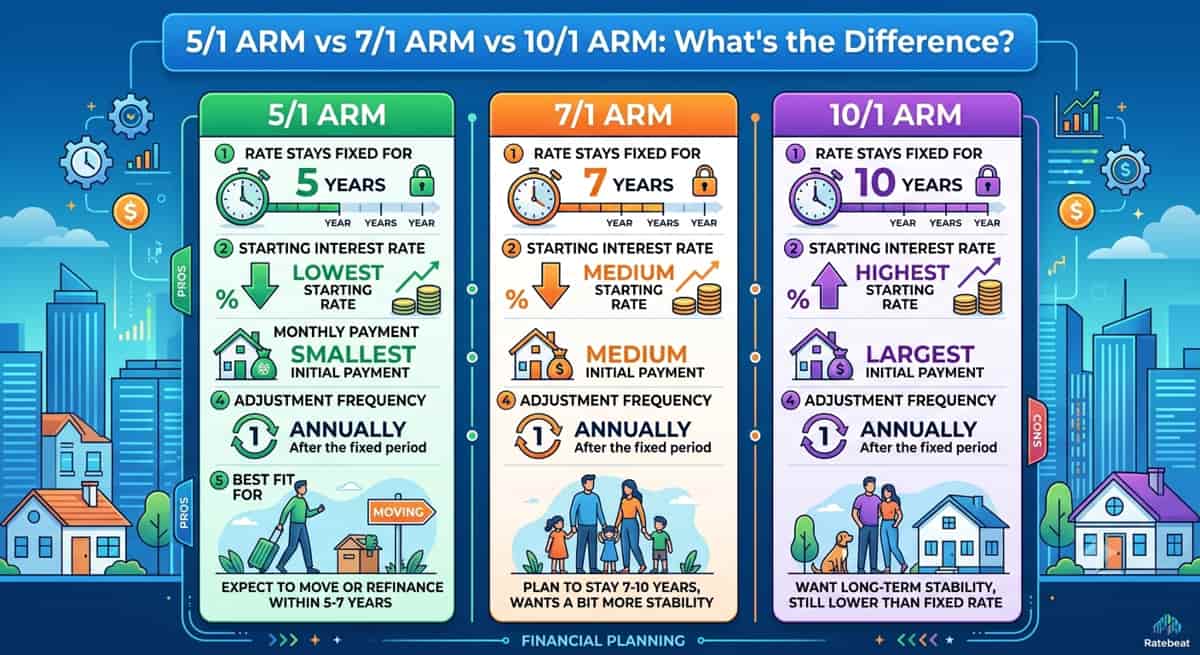
Loan Type | Rate Stays Fixed For | First Possible Adjustment | Best Fit For |
5/1 ARM | 5 years | Start of year 6 | Homeowners who expect to move, sell, or refinance within 5–7 years |
7/1 ARM | 7 years | Start of year 8 | Homeowners who expect to stay 7–10 years |
10/1 ARM | 10 years | Start of year 11 | Homeowners who want more long-term stability but still like a lower starting rate than a 30-year fixed |
The first number tells you how many years your rate is locked in. The second number tells you how often it can change after that (in all three cases, once a year). That's really the whole naming system in a nutshell.
What Is an Adjustable-Rate Mortgage (ARM)?
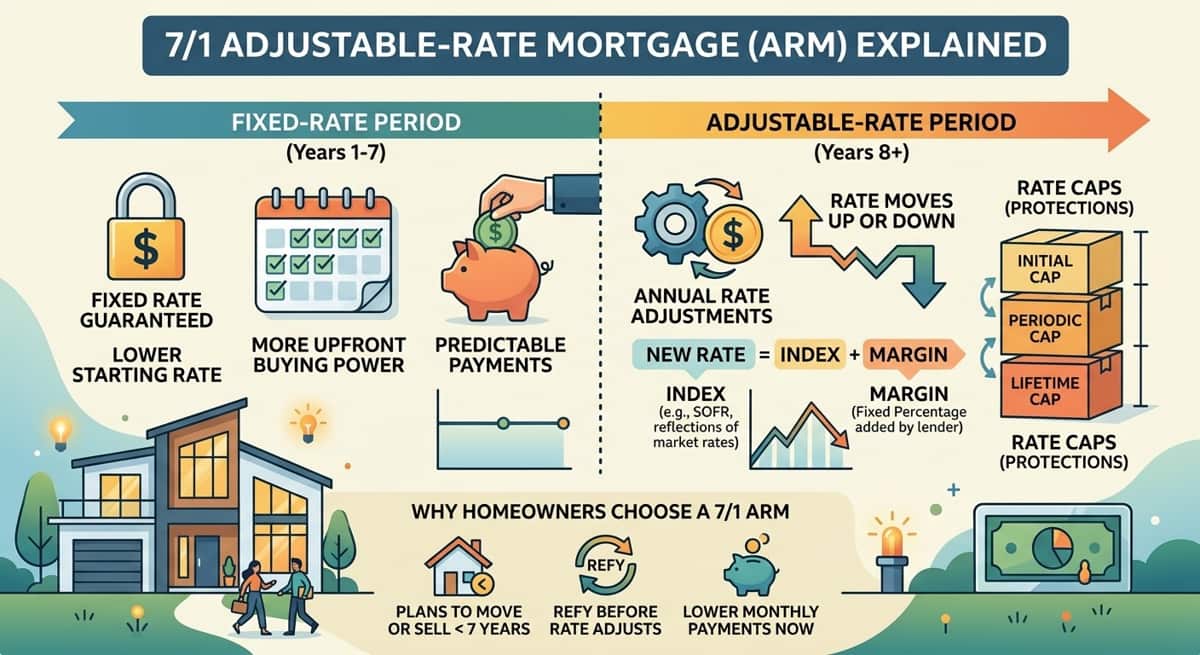
A fixed-rate mortgage keeps the same interest rate for the entire life of the loan usually 15 or 30 years. An ARM does something different: it locks in a rate for a set number of years, then switches to a rate that can move up or down after that, based on market conditions.
That's where the "X/Y" name comes from. The first number is how many years your rate is frozen. The second number is how often it can adjust once that period ends. So a 5/1 ARM is fixed for 5 years, then can adjust once a year after that. A 7/1 works the same way, just with a 7-year fixed period. A 10/1 gives you 10 years before anything changes.
Why would someone choose this over a regular fixed-rate loan? Usually because ARMs come with a lower starting interest rate, which means a lower monthly payment, at least for that initial stretch of years.
How a 5/1 ARM Works
With a 5/1 ARM, your interest rate and monthly payment stay exactly the same for the first 5 years. Starting in year 6, the rate can adjust once every year based on current market rates, within limits set by your loan agreement.
This option tends to make the most sense if:
You're planning to sell the home before year 5 is up
You expect to refinance again within that window (say, buying a starter home before moving up)
You want the lowest possible starting rate and monthly payment, and you're comfortable with some uncertainty down the road
Like most ARMs, a 5/1 loan has built-in limits on how much your rate can jump. There's usually a cap on the very first adjustment, a cap on each adjustment after that, and a cap on how high the rate can ever go over the life of the loan. For example, your loan might allow the rate to rise by up to 2% at the first adjustment, no more than 2% at each adjustment after that, and no more than 5% total above your starting rate. The exact numbers vary by lender, so it's worth asking to see them spelled out in writing before you sign anything.
How a 7/1 ARM Works
A 7/1 ARM gives you 7 years of a locked-in rate before anything can change. After that, it adjusts once a year, just like the 5/1.
This one tends to fit people who:
Are planning to stay put for a while, but not necessarily for 30 years
Have a family situation that might change in 7–10 years (kids heading to a new school district, a possible relocation, downsizing later on)
Want a bit more breathing room than a 5/1 ARM before facing a rate change, while still getting a lower starting rate than a fixed loan
The cap structure works the same way here an initial cap, a periodic cap for each future adjustment, and a lifetime cap. Because you have two extra years of a locked rate compared to a 5/1, you have more time to build equity, pay down your balance, or refinance on your own terms before any adjustment happens.
How a 10/1 ARM Works
A 10/1 ARM locks your rate in for a full 10 years nearly a third of a standard 30-year loan before it can adjust. After year 10, it moves once a year from there.
This tends to appeal to home lower starting interest rate ners who:
Want more predictability than a shorter-term ARM offers
Aren't planning to move anytime soon, but also don't want to commit to a 30-year fixed rate
Like the idea of a decade to build equity or refinance before ever facing a rate change
Ten years is a long time long enough that many homeowners either sell, pay off, or refinance the loan before the adjustable period even begins. That's part of the appeal: you get a lower starting rate than a fixed loan, with a much longer runway of stability than a 5/1 or 7/1.
Pros and Cons of Each ARM Type
5/1 ARM
Pros: Usually the lowest starting rate of the three, which means the lowest initial monthly payment
Cons: The shortest window before your rate can change, so it carries the most uncertainty if your plans shift
7/1 ARM
Pros: A solid middle ground a lower rate than a fixed loan, with more years of stability than a 5/1
Cons: Rate is typically a bit higher than a 5/1, and you'll still eventually face a possible adjustment
10/1 ARM
Pros: The longest stretch of rate stability among ARMs, good for people who want lower payments now without a short leash
Cons: The starting rate is usually the highest of the three ARM types (though still often lower than a 30-year fixed), and it may feel like less of a "deal" if you don't stay long enough to benefit
None of these is automatically the "best" choice it really depends on your own timeline and how much certainty you want versus how much you want to save on your rate today.
How Rate Adjustments Are Calculated (Index, Margin & Caps)
Once your fixed period ends, your new rate isn't random it's calculated using two pieces:
An index - a benchmark rate that moves with the broader market (most ARMs today use something called SOFR)
A margin - a fixed percentage your lender adds on top of that index, which stays the same for the life of your loan
Add those two together, and that's your new rate at each adjustment.
To keep things from swinging too wildly, ARMs come with caps:
Initial cap - the most your rate can jump at the very first adjustment
Periodic cap - the most it can move at each adjustment after that
Lifetime cap - the most your rate can ever rise above your original starting rate
Here's a simple example: say your 5/1 ARM starts at 6%, with a 2/2/5 cap structure. That means at year 6, your rate could rise by up to 2 percentage points (to a maximum of 8%). At any future adjustment, it could move by up to 2 more points. But no matter what happens in the market, your rate could never go higher than 11% (5 points above your original 6%) for the life of the loan.
Knowing these numbers ahead of time means you're never caught off guard you can actually calculate your worst-case monthly payment before you ever sign.
ARM vs. Fixed-Rate Mortgage: Which Should You Choose?
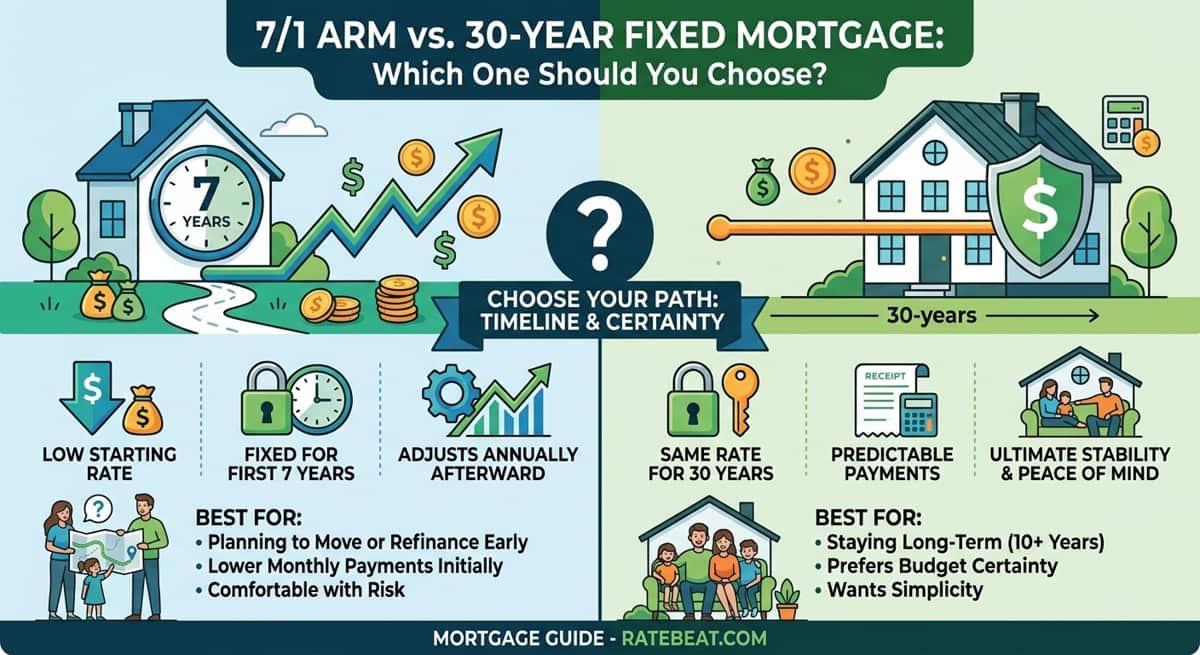
Perhaps one of the most significant decisions after applying for a home mortgage is whether to choose an Adjustable-Rate Mortgage (ARM) or lock in a fixed-rate mortgage. ARM vs. Fixed-Rate Mortgage options have significant differences in how they determine interest rates, monthly payments, and long-term borrowing costs. Although both loan types can help you achieve homeownership, they are designed for different financial situations. A fixed-rate mortgage offers stability because your interest rate and monthly principal and interest payments remain the same throughout the life of the loan, making it easier to budget and providing protection if interest rates rise.
An ARM, on the other hand, typically starts with a lower introductory interest rate for a fixed period such as 5, 7, or 10 years before adjusting periodically based on market conditions. This can result in lower initial monthly payments but also the possibility of higher payments if interest rates increase. Your choice depends on several factors, including how long you plan to stay in the home, the stability of your income, your tolerance for financial risk, and your expectations for future interest rates. For some borrowers, an ARM can save money if they plan to sell or refinance before the introductory period ends. However, if you prefer predictable payments and expect to stay in your home for many years, a fixed-rate mortgage may provide greater long-term peace of mind. Understanding the pros and cons of each option before making a decision is essential, as the right choice depends on your financial goals and homeownership plans.
When Does an ARM Make Sense for Refinancing or Tapping Home Equity?
ARMs aren't just for new home purchases they show up in refinancing and home equity decisions too, and this is where a lot of homeowners could use a second opinion.
A few real-world scenarios:
You're refinancing out of a higher fixed rate and only plan to stay in the home a few more years an ARM refinance could lower your payment without locking you into a 30-year commitment.
You're sitting on significant considering a home equity loan or HELOC alongside your primary mortgage understanding how your primary loan's rate behaves (fixed or adjustable) matters for how you structure the second loan.
You currently have an ARM that's approaching its adjustment period, and you're weighing whether to refinance into a new ARM, a fixed-rate loan, or use built-up equity to pay down the balance and lower your future payment.
These situations rarely have a one-size-fits-all answer. What works for a neighbor with a similar-looking house might not work for your actual numbers, timeline, or goals.
Common Mistakes Homeowners Make with ARMs
A few things worth watching out for:
Not planning for the day the rate can change. It's easy to enjoy the lower payment now and forget to think ahead to year 6, 8, or 11.
Ignoring the cap structure. Not all ARMs have the same caps always ask for the specific numbers on your loan, not just general assumptions.
Assuming rates will only go down. They might. They might not. It's safer to plan around your worst-case payment, not your best-case one.
Skipping the "what if I stay longer than planned" conversation. Life changes. If there's a real chance you'll stay past your fixed period, it's worth running the numbers both ways before you commit.
Talk to a Licensed Mortgage Advisor About Your ARM Options
Every homeowner's timeline, goals, and equity situation look a little different, and the "best" ARM on paper isn't always the best one for your actual life. If you're weighing a 5/1, 7/1, or 10/1 ARM whether for a new purchase, a refinance, or a home equity plan it helps to talk it through with someone who can run the real numbers for your situation. Reach out for a no-obligation conversation, and let's figure out together what actually makes sense for you.