Rates finally dropped, and you're wondering whether refinancing your mortgage is actually worth the paperwork and the closing costs that come with it. It's a fair question. A lower rate sounds great on paper, but refinancing isn't free, and the real answer to whether it pays off comes down to one number: your break-even point.
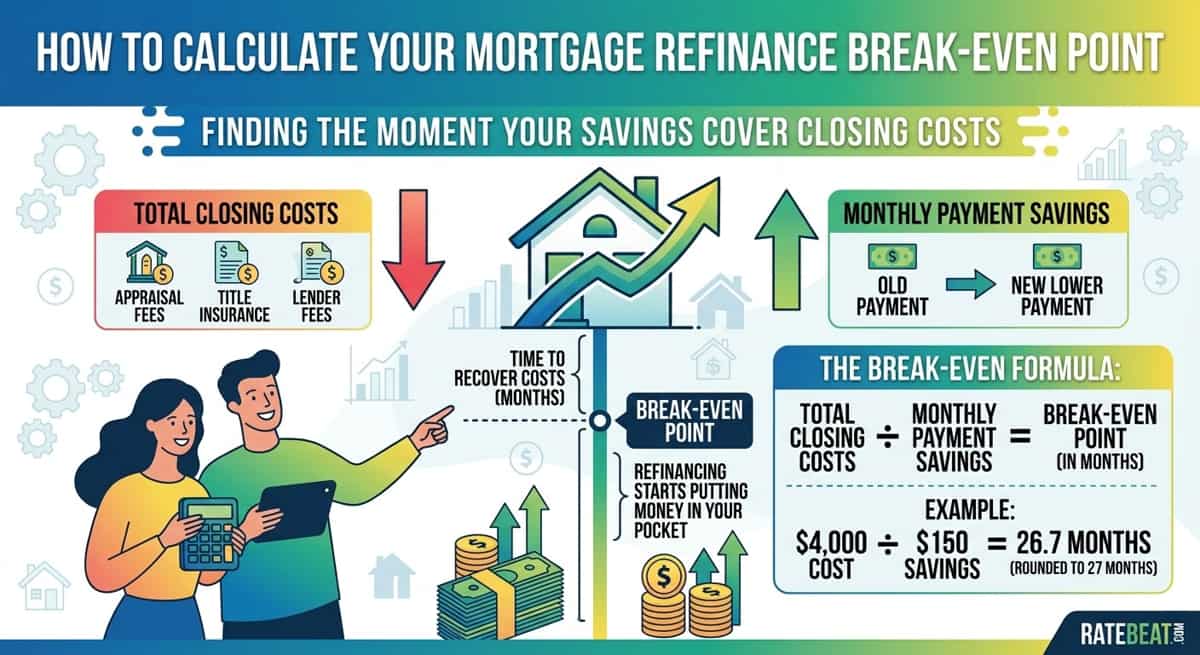
Your break-even point is simply the moment your monthly savings have fully repaid what you spent to refinance. Once you pass it, every dollar you save each month is money you wouldn't otherwise have had. Here's the simple version: break-even point (in months) = total closing costs ÷ monthly payment savings.
What Is a Mortgage Refinance Break-Even Point?
Refinancing isn't free. Between lender fees, appraisal costs, title work, and other closing costs, you're usually looking at a few thousand dollars out of pocket (or rolled into the loan) just to get the new mortgage in place. In exchange, you typically get a lower monthly payment.
Your break-even point is simply the answer to this question: how many months will it take for those monthly savings to add up to what I spent on closing costs?
Say your refinance costs $4,000 and saves you $150 a month. It would take you about 27 months, a little over two years to recover what you spent. After that, every dollar you save is money you wouldn't have had otherwise. Before that point, you're technically still "paying off" the refinance itself. That's why the break-even point matters more than the interest rate alone; it tells you whether the timing actually works in your favor.
The Break-Even Point Formula
The math behind this is refreshingly simple. You don't need a finance degree or a complicated spreadsheet with just two numbers.
Break-Even Point (in months) = Total Closing Costs ÷ Monthly Payment Savings
Total closing costs are everything you pay to get the new loan: origination fees, appraisal, title insurance, recording fees, and any other lender or third-party charges. You'll find these listed clearly on the Loan Estimate your lender is required to give you within three business days of applying. It's one of the most useful documents in the whole process, so don't skip past it.
Monthly payment savings is the difference between your current monthly principal-and-interest payment and your new one. This is just the loan payment itself not property taxes or homeowners insurance, since those don't usually change because you refinanced.
Divide the first number by the second, and you've got your break-even point in months.
Step-by-Step: How to Calculate Your Break-Even Point
Here's how to walk through it on your own, using your actual numbers.
Step 1: Get your total refinance closing costs. Pull this from your Loan Estimate. Add up lender fees, appraisal, title and settlement charges, recording fees, and any points you're paying to buy down the rate. If you're not sure whether something counts, ask your loan officer to point it out on the form they're used to walking people through line by line.
Step 2: Calculate your new monthly payment savings. Take your current monthly principal-and-interest payment and subtract your new one. If your current payment is $1,850 and your new one would be $1,700, your monthly savings is $150. Make sure you're comparing loan payment to loan payment, not the full amount that includes taxes and insurance, or the number will be off.
Step 3: Divide costs by savings to get your break-even month. Using the example above, $4,000 in closing costs divided by $150 in monthly savings comes out to about 26.7 months round up to 27, since you won't fully recover the cost until that payment lands.
Step 4: Compare that number to how long you plan to stay in the home. This is the step people skip, and it's the one that actually determines whether refinancing makes sense. A 27-month break-even point is a great deal if you're planning to stay put for the next ten years. It's a much closer call if you might sell or relocate in the next year or two.
Calculating a Real Break-Even Point
Let's put real numbers to it. (The figures below are for illustration only your actual costs, rate, and savings will depend on your loan, your lender, and current market conditions.)
Say you currently have a 30-year fixed mortgage with a $320,000 balance at 7.25%, and your principal-and-interest payment is $2,183 a month. Rates have dropped, check today's mortgage refinance rates to see current benchmarks and you're offered a refinance at 6.25% on the same 30-year term." Your new principal-and-interest payment would be about $1,970 a month. Your closing costs for the new loan come to $5,200.
Here's the math:
Monthly savings: $2,183 − $1,970 = $213
Break-even point: $5,200 ÷ $213 = about 24.4 months, rounded up to 25 months
So it would take a little over two years for your monthly savings to fully cover what you spent to refinance. If you're confident you'll be in the home past that two-year mark, this refinance is likely worth it. If you think there's a real chance you'll sell before then, that changes the calculation significantly which is exactly what the next section covers.
It's also worth noticing how sensitive this number is to closing costs. If that same refinance came with $7,500 in closing costs instead of $5,200 maybe because of a higher origination fee or discount points the break-even point would stretch out to about 35 months, nearly three years, even though the monthly savings stayed exactly the same. That's why comparing offers from more than one lender matters just as much as comparing rates: two lenders can offer the same 6.25% rate with meaningfully different closing costs, and that difference alone can push your break-even point out by close to a year.
The Hidden Variables Most Break-Even Calculators Miss
The basic formula gets you most of the way there, but a few real-world factors can shift the picture. These are worth thinking through before you make a final call.
The opportunity cost of your closing costs. If you pay your closing costs out of pocket, that's money that isn't sitting in savings, going toward debt consolidation, or invested elsewhere. . It's not necessarily a reason to skip refinancing, but it's worth asking yourself what else that money could be doing for you in the meantime especially if your break-even point is on the longer side.
Changes to your mortgage interest tax situation. A lower interest rate usually means a smaller mortgage interest deduction over time, which can matter depending on your tax situation. This isn't something a break-even formula accounts for, and it's genuinely case-by-case if you itemize deductions, it's worth a quick conversation with a tax professional rather than guessing.
Rolling closing costs into the loan vs. paying them upfront. Some lenders let you roll closing costs into the new loan balance instead of paying cash at closing. This gets you the lower rate without an upfront cost but it also means you're financing those costs over the life of the loan, which slightly increases your loan balance and the interest you'll pay over time. It's a real trade-off, not a shortcut, and it's worth running both scenarios side by side.
A shorter loan term changes the math. If you're exploring a 15-year vs 30-year mortgage refinancing option, your monthly payment might not drop much or could even go up even though you're getting a better rate and will pay far less interest overall. In this case, looking at your break-even point alone doesn't tell the full story; total interest saved over the life of the loan matters just as much.
Resetting the clock on your loan term. Even without shortening the term, refinancing into a new 30-year loan means you're starting the amortization schedule over. In the early years of any mortgage, more of your payment goes toward interest than principal. If you're eight years into your current loan and refinance into a brand-new 30-year term, you're effectively resetting to year one of that interest-heavy stretch even though your monthly payment is lower. This doesn't mean refinancing is a bad idea, but it's worth knowing that a lower payment and faster equity growth don't automatically go hand in hand. Some homeowners choose to refinance into a term that matches roughly how many years they have left, rather than defaulting back to 30, specifically to avoid this.
How Long Do You Need to Stay in Your Home to Make Refinancing Worth It?
This is where math meets real life. A break-even point on paper only means something once you compare it to how long you'll actually own the home.
If you're planning to stay for five, ten, or more years, even a break-even point of two to three years is usually a comfortable trade. You'll spend years enjoying the lower payment well after you've recovered your costs.
But life doesn't always go according to plan. Here's a scenario worth thinking through: a homeowner refinances with a 30-month break-even point, feeling confident about staying long-term. Eighteen months later, a job relocation comes up unexpectedly and they sell the home. They never reached their break-even point meaning the refinance ended up costing them money overall, even though the new rate was genuinely better. It's not that refinancing was a bad decision at the time; it's that the timeline didn't play out the way they expected.
That's why it's worth being honest with yourself about how likely you are to stay put, not just how long you plan to. If there's meaningful uncertainty (a possible job change, a growing family that might need more space, retirement plans on the horizon), factor that into your decision alongside the raw numbers.
A helpful exercise is to think in ranges rather than a single number. Instead of asking "will I be here in three years?", ask "what's the most likely range of time I'll stay two years, five years, ten?" Then check your break-even point against the lower end of that range, not just the number that feels most comfortable. If your break-even point still clears comfortably even under your more conservative estimate, that's a strong sign the refinance makes sense regardless of how life unfolds.
When a No-Closing-Cost Refinance Changes the Math
A no-closing-cost refinance doesn't actually make your closing costs disappear; it rolls them into a slightly higher interest rate instead of charging you upfront. Instead of paying $4,000 at closing, you might accept a rate that's a fraction of a percent higher.
This flips the break-even calculation on its head. Since you're not out any cash upfront, your "break-even point" effectively becomes zero if you start saving (or at least not losing money) from day one, assuming the new rate is still lower than what you currently have.
This option tends to make the most sense if you're not fully certain how long you'll stay in the home, or if you'd rather keep your cash available for other things. The trade-off is that your monthly savings will be smaller than they would be if you paid the closing costs upfront, since part of your rate is effectively "paying" for those costs over time. It's a reasonable option with just a different set of numbers to weigh.
Signs Refinancing May Not Be Worth It Yet
Refinancing isn't automatically the right move just because rates have dropped. A few signs it might be worth waiting:
You're planning to move within the next year or two. If your break-even point is longer than how long you expect to stay, you likely won't recoup your costs.
The rate improvement is small. A quarter-point drop might not generate enough monthly savings to justify the closing costs, depending on your loan size.
Your current loan has a prepayment penalty. Some older loans charge a fee for paying them off early, which effectively adds to your refinance costs and pushes your break-even point out further.
You're close to paying off your current loan. Restarting the clock on a new 30-year term can cost you more in total interest, even at a lower rate, if you're only a handful of years from being mortgage-free.
None of these rule out refinancing entirely; they're just reasons to run the numbers carefully, or wait for a better window, rather than moving on rate alone.
Talk to a Licensed Loan Officer Before You Decide
The formula above will get you a solid estimate, but your actual closing costs and savings depend on your specific loan, your credit profile, and current rates numbers that are worth confirming with an actual Loan Estimate rather than a rough guess. Speak with a licensed Ratebeat loan officer to run your real numbers, walk through scenarios like a no-closing-cost option, and see exactly where your break-even point lands before you commit. If you're weighing a refinance, it costs nothing to ask for a personalized comparison and see what the numbers actually look like for your situation.