A 7/1 ARM is a type of mortgage where your interest rate stays fixed for the first seven years, then adjusts once a year after that based on current market rates. The "7" refers to the number of years your rate is locked in, and the "1" means it can change every one year after that. It tends to appeal to homeowners who don't plan to stay in their home or keep the same loan much longer than seven years, since they can often get a lower starting rate than a traditional 30-year fixed mortgage in exchange for taking on some uncertainty later.
Why People Are Looking at ARMs Again
If you've been house hunting or refinancing lately, you've probably noticed that monthly payments can feel out of reach with a standard fixed-rate loan. That's led a lot of buyers to start asking their loan officer about alternatives and the 7/1 ARM often comes up in that conversation. It's not right for everyone, but for the right person, it can free up some breathing room in the budget, at least for a while.
This guide walks through exactly how a 7/1 ARM works, how it compares to other loan options, and who tends to benefit most from one. By the end, you should have a clear sense of whether it's worth a closer look for your situation and what questions to bring to a licensed loan officer when you do.
What Is a 7/1 ARM?
An adjustable-rate mortgage, or ARM, is simply a home loan where the interest rate isn't locked in for the entire life of the loan the way it is with a fixed-rate mortgage. Instead, your rate is fixed for an initial period, and then it starts to move up or down based on broader market conditions.
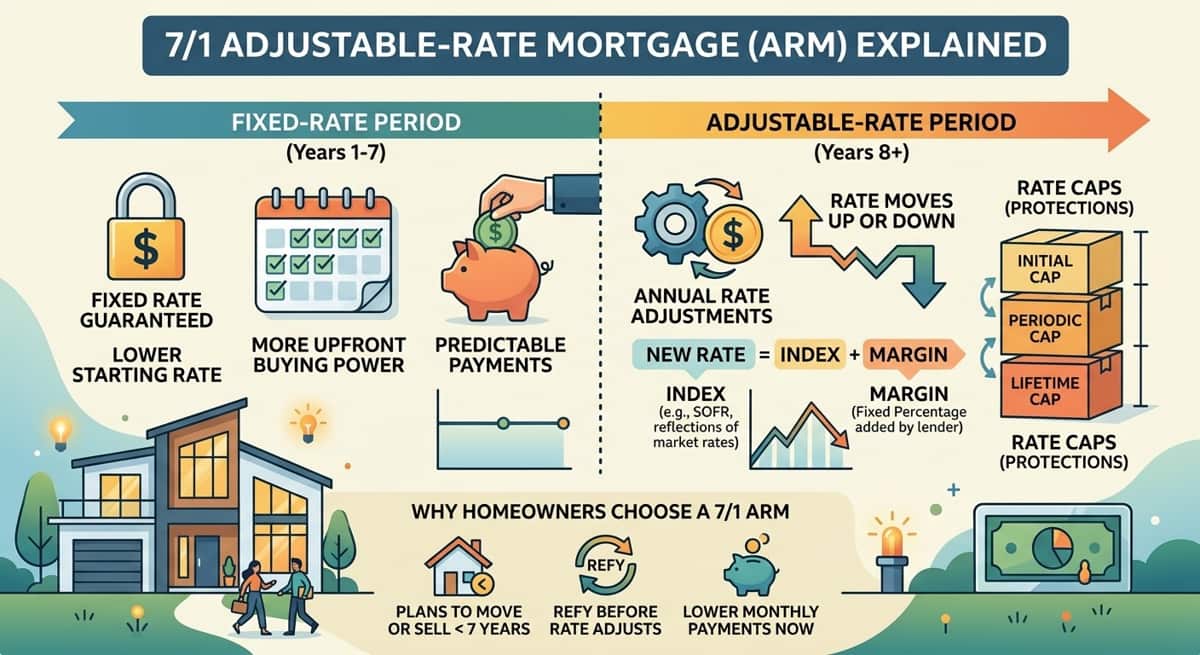
A 7/1 ARM is one specific version of this. The first number, 7, tells you how many years your rate is guaranteed to stay the same, no surprises, no changes, just like a fixed-rate loan during that stretch. The second number, 1, tells you how often the rate can change after that initial period ends. In this case, once every year.
So for the first seven years, a 7/1 ARM behaves exactly like a fixed-rate mortgage. It's really only in year eight and beyond that things start to look different. This is different from a straight fixed-rate mortgage, where your rate never changes at all, and it also has differences between from 5/1 or 10/1, which simply use a shorter or longer initial period before adjustments begin.
How Does a 7/1 ARM Work?
To really understand a 7/1 ARM, it helps to break it down into a few moving parts: the initial period, how the rate adjusts, what determines the new rate, and the limits that keep those adjustments from getting out of hand.
The Initial Fixed-Rate Period
For the first seven years of the loan, your interest rate and monthly payment stay exactly the same, no matter what's happening in the broader market. This is often the main selling point of a 7/1 ARM: lenders can usually offer a lower starting rate than a 30-year fixed loan, since they're only guaranteeing that rate for seven years instead of thirty. That lower rate can mean real savings on your monthly payment during this stretch.
How the Rate Adjusts After Year 7
Once you hit year eight, your rate is no longer locked in. It will recalculate once a year, based on current market conditions at that time. If rates have gone up since you closed on your loan, your payment could increase. If rates have gone down, it could actually decrease. This is the trade-off you're making in exchange for that lower rate up front the certainty just doesn't last forever.
Index and Margin, Explained
Your new rate after the fixed period isn't pulled out of thin air. It's based on two pieces: an index and a margin. The index is a benchmark that reflects general market rates, often tied to something like SOFR (the Secured Overnight Financing Rate), which lenders across the industry commonly use. The margin is a fixed percentage your lender adds on top of that index, and it stays the same for the life of your loan. Add the index and the margin together, and you get what's called your fully indexed rate, the actual rate you'll pay once adjustments begin.
Rate Caps: Initial, Periodic, and Lifetime
This is one of the most important parts of a 7/1 ARM, and one that's easy to overlook. Rate caps put a ceiling on how much your rate can jump, so you're never caught completely off guard.
There are usually three caps to know about:
Initial cap — the maximum your rate can increase the very first time it adjusts, after year seven
Periodic cap — the maximum it can increase at each adjustment after that, once a year
Lifetime cap — the maximum your rate can ever climb above your original starting rate, for as long as you have the loan
These caps are set in your loan agreement, so ask your loan officer to walk through the specific numbers on any ARM you're considering. It's one of the most important things to understand before you sign anything, according to guidance from the Consumer Financial Protection Bureau.
7/1 ARM vs. Fixed-Rate Mortgage
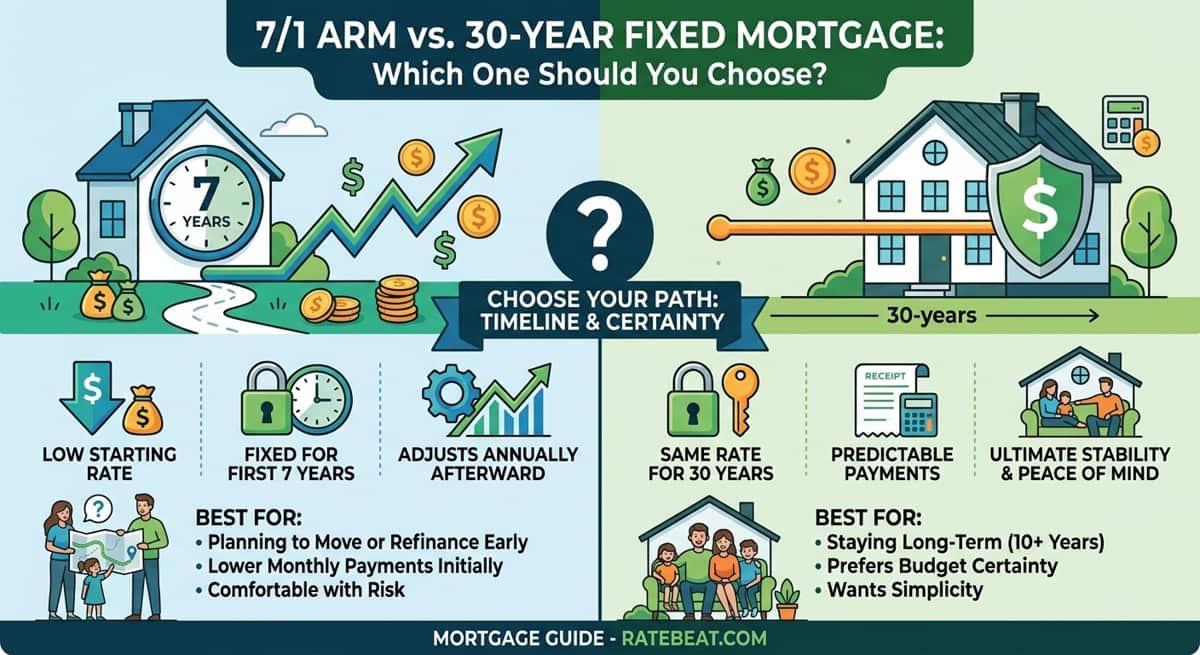
The core difference comes down to certainty versus flexibility. A fixed-rate mortgage locks in the same rate and payment for the entire loan term, whether that's a 15 or 30 year fixed-rate mortgage. You'll always know exactly what you owe each month, and you never have to think about market rates again once you've closed. A 7/1 ARM trades some of that long-term certainty for a lower rate during the first seven years.
7/1 ARM | Fixed-Rate Mortgage | |
Rate stability | Fixed for 7 years, then adjusts yearly | Fixed for the entire loan term |
Starting rate | Often lower | Typically higher |
Long-term predictability | Lower payment can change after year 7 | Higher payment never changes |
Best for | Shorter homeownership timelines | Staying long-term |
Which one makes more sense really comes down to how long you plan to keep the loan. If you expect to sell, refinance, or pay off the home well before year seven is up, the lower initial rate on a 7/1 ARM could save you real money without ever exposing you to an adjustment. If you plan to stay in the home for decades, the predictability of a fixed rate is usually worth more than the short-term savings.
7/1 ARM vs. 5/1 ARM (and Other ARM Terms)
ARMs come in a few common flavors, and the main difference between them is simply how long that initial fixed period lasts. A 5/1 ARM locks in your rate for five years before adjustments start; a 7/1 ARM locks it in for seven; a 10/1 ARM stretches that out to ten.
Generally speaking, the shorter the fixed period, the lower the starting rate tends to be but the sooner you're exposed to potential rate changes. A 5/1 ARM might offer a slightly better rate than a 7/1, but you're taking on adjustment risk two years sooner. A 10/1 ARM offers more years of stability than a 7/1, but usually at a somewhat higher starting rate.
There's no universally "best" option here; it really depends on how confident you are about your timeline. If you know you're relocating for work in four or five years, a 5/1 might make more sense. If you want a little more breathing room before rates can move, a 7/1 often strikes a nice middle ground.
Pros and Cons of a 7/1 ARM
Advantages
Lower starting rate compared to most fixed-rate loans, which can mean lower monthly payments during the initial period
More buying power up front, since a lower rate can help stretch your budget further
Predictable payments for seven full years, giving you time to plan, save, or reassess before anything changes
Good fit if you don't plan to stay long, letting you capture savings without ever facing an adjustment
Rate caps limit the downside, so increases are structured and predictable rather than unlimited
Risks and Drawbacks
Payments can increase after year seven if market rates have gone up
Budgeting gets harder further down the road, since your future payment isn't fully known today
Refinancing isn't guaranteed to be available or affordable when you need it, especially if rates or your financial situation change
Selling might not go as planned, and life circumstances (job changes, market conditions) can keep people in a home longer than expected
More moving parts to track, including your index, margin, and caps, compared to the simplicity of a fixed rate
Who Should Consider a 7/1 ARM?
A 7/1 ARM tends to make the most sense for people with a fairly clear sense of their timeline. A few common examples:
Buyers who expect to move again. If you know a job relocation, growing family, or lifestyle change is likely to have you selling within seven years, you may never actually experience a rate adjustment meaning you get the lower rate with none of the long-term risk.
Homeowners planning to refinance. Some buyers use a 7/1 ARM as a stepping stone, planning to refinance into a different loan before the fixed period ends, once their finances or the rate environment shift in their favor.
Buyers stretch their budget for a specific window. A lower initial payment can help some households manage a big financial season paying down other debt, building savings, or getting through a lower-income period with the plan to reassess before year seven.
People are comfortable with some uncertainty. If a future rate adjustment wouldn't derail your finances, and you understand the caps that protect you, a 7/1 ARM can be a reasonably calculated trade-off rather than a risky bet.
On the other hand, if you're buying your forever home, prefer knowing your exact payment for the next several decades, or would be financially strained by even a modest payment increase, a fixed-rate mortgage is likely the safer fit.
How to Qualify for a 7/1 ARM
Qualifying for a 7/1 ARM looks a lot like qualifying for any other mortgage, with a few extra considerations. Lenders will look at your credit history, income, employment, and debt-to-income ratio, just as they would for a fixed-rate loan. Because ARMs carry the possibility of future rate increases, some lenders may also evaluate whether you could still afford the loan at a higher stress-tested rate, not just the low initial rate, a safeguard meant to make sure you're not overextending yourself.
You'll also want to have documentation ready that shows stable income and a clear picture of your finances, the same as you would for any mortgage application. A licensed loan officer can walk you through exactly what's needed based on your specific situation, and let you know early on whether a 7/1 ARM is something you'd actually qualify for.
Is a 7/1 ARM Worth It Right Now?
Mortgage rates shift often, sometimes week to week, so it's tough to say definitively whether a 7/1 ARM is a good deal without looking at current numbers. Rather than relying on rates you might see quoted somewhere else which can go stale fast, the most reliable way to know where things stand is to check current mortgage rates directly with a licensed loan officer who can pull real, up-to-date rate options based on your credit profile, loan amount, and location. What made sense six months ago may not reflect what's available today, and a quick conversation can save you from making a decision based on outdated information.
Why Work with a Licensed Mortgage Loan Officer
Decisions like this come with real financial weight, and getting personalized guidance matters more than reading about general rules online. A licensed Mortgage Loan Officer is someone who has met state and federal requirements to originate home loans, including background checks, education, and testing through the Nationwide Multistate Licensing System (NMLS). That licensing exists specifically to protect consumers making one of the biggest financial decisions of their lives.
A good loan officer won't just quote you a rate, they'll walk you through your actual timeline, budget, and goals to help you figure out whether a 7/1 ARM, a fixed-rate loan, or something else entirely fits best. You can always verify anyone's license through NMLS Consumer Access before working with them, which is a simple way to make sure you're getting advice from someone properly qualified.
The Bottom Line
A 7/1 ARM can be a smart move for the right buyer, someone with a fairly clear timeline, a comfortable financial cushion, and a good understanding of how and when their rate could change. It's not the right fit for everyone, and that's okay. The best next step is a real conversation with a mortgage loan officer about your specific numbers, your plans, and what actually makes sense for your life.