Buying a home comes with a lot of decisions, but few feel as confusing as choosing between a 7/1 ARM and a 30-year fixed mortgage. Both loans get you to the same place of homeownership but they get you there in very different ways.
The right loan depends less on which one is "better" and more on how long you plan to stay in the home and how comfortable you are with the idea of your payment changing down the road. If you want a predictable payment for as long as you own the home, a 30-year fixed usually makes more sense. If you're planning to move, sell, or refinance within the next several years and want a lower payment in the meantime, a 7/1 ARM might be worth a closer look.
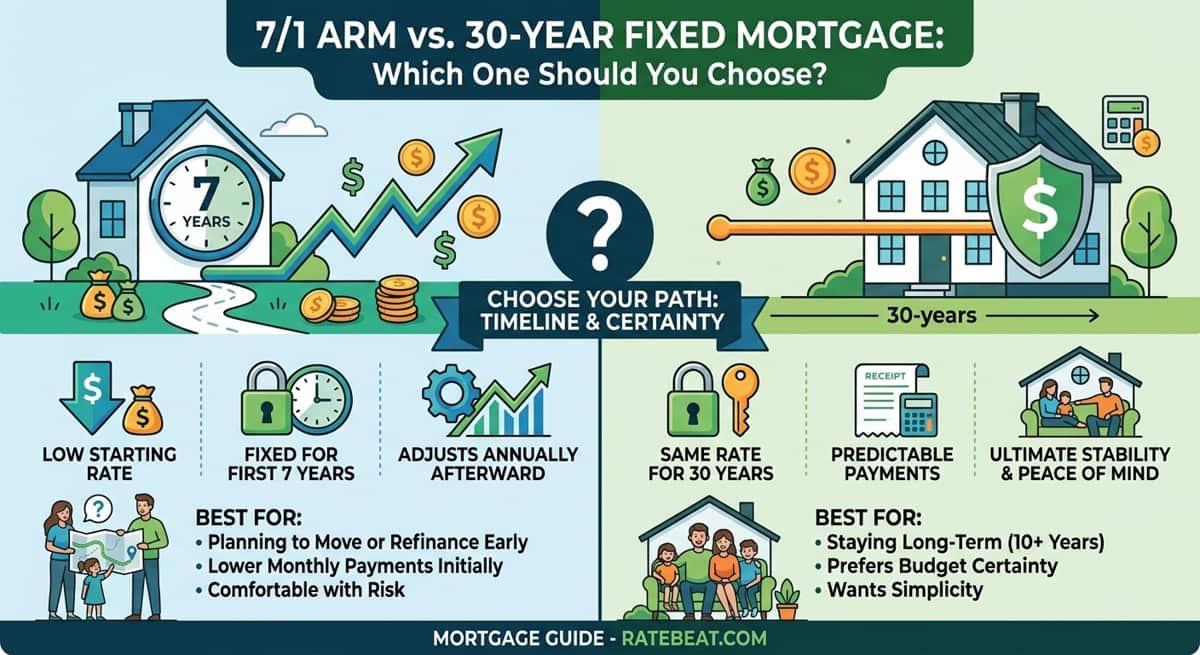
A 30-year fixed mortgage keeps the same interest rate and monthly payment for the entire 30 years, making it a solid choice if you want stability and plan to stay in your home long-term.
A 7/1 ARM offers a lower fixed rate for the first 7 years, then adjusts annually after that, which can work well if you expect to sell, refinance, or pay off the loan before the rate ever changes. There's no universal "best" option; it comes down to your timeline and how much certainty you want in your monthly budget.
What Is a 30-Year Fixed-Rate Mortgage?
A 30-year fixed-rate mortgage is a home loan where your interest rate is locked in on day one and never changes for the full 30 years. Whatever your principal and interest payment is in year one is the same amount you'll pay in year thirty, no matter what happens in the broader economy.
Because the rate never moves, your monthly payment stays predictable, which makes budgeting easier. Over the life of the loan, your payments gradually shift early on, more of your payment goes toward interest, and over time, more goes toward paying down the actual loan balance.This gradual shift is called amortization you can use home loan payment calculator to see how your balance shrinks and your interest shifts over 30 years.
This loan type has been the go-to choice for American homebuyers for decades, and it's easy to see why. It's straightforward, it's easy to plan around, and it removes the guesswork of "what if rates go up?" It tends to appeal most to people who plan to stay in their home for many years, families who want a steady housing cost they can count on, and buyers who simply prefer not to think about their mortgage once it's set.
What Is a 7/1 ARM?
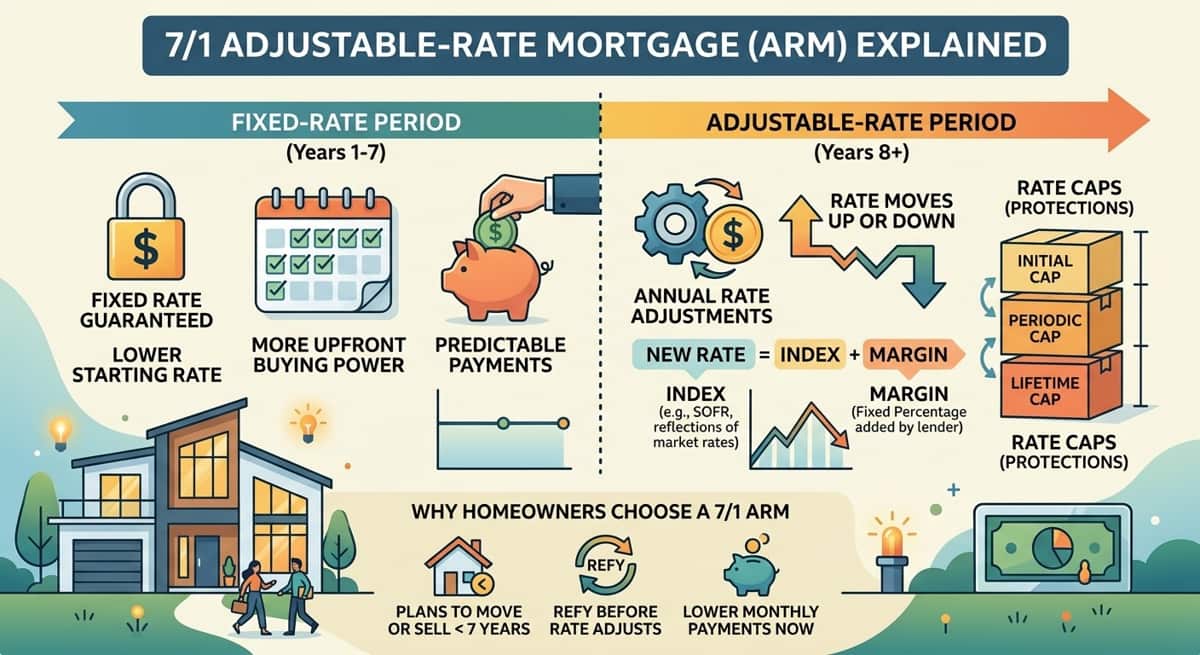
A 7/1 ARM (adjustable-rate mortgage) starts out a lot like a fixed-rate loan for the first 7 years, your interest rate stays exactly the same. After that 7-year period ends, the rate adjusts once every year for the remainder of the loan term. That's where the "7" and the "1" in the name come from: 7 years fixed, then adjusting every 1 year.
During the adjustable period, your new rate is calculated using two pieces: an index (a benchmark rate that moves with the broader market) and a margin (a fixed percentage your lender adds on top of the index). Together, those two numbers determine your new rate each time it adjusts.
To keep things from swinging too wildly, ARMs come with rate caps limits on how much your rate can increase. There's typically a cap on how much it can jump the first time it adjusts, a cap on how much it can move in any single year after that, and a lifetime cap on how high the rate can ever go over the full life of the loan. These caps exist specifically to protect borrowers from runaway payment increases, and understanding them is one of the most important parts of considering an ARM.
Key Differences: 7/1 ARM vs. 30-Year Fixed
Feature | 30-Year Fixed | 7/1 ARM |
Interest rate structure | Locked in for the full 30 years | Fixed for 7 years, then adjusts annually |
Starting rate | Typically higher than an ARM's intro rate | Often starts lower than a fixed rate |
Payment predictability | Fully predictable for the entire loan | Predictable for 7 years, then can change |
Best-fit timeline | Long-term homeownership | Shorter-term ownership (under 7 years) |
Refinance risk | Low no urgency to refinance | Worth watching as year 7 approaches |
Protection against rate increases | Not applicable rate never changes | Rate caps limit how much it can rise |
The table above sums up the trade-off pretty well: the 30-year fixed trades a potentially higher starting rate for total peace of mind, while the 7/1 ARM trades a bit of future uncertainty for a lower payment early on. Neither trade-off is automatically right or wrong; you can explore custom home loan options to compare how each program fits your financial goals.
Pros and Cons of Each Loan Type
Pros: 30-Year Fixed
Payment never changes, making budgeting simple
No surprises if market rates rise in the future
Easier to plan long-term finances around a known housing cost
Well understood, widely available, and simple to compare between lenders
Cons: 30-Year Fixed
Starting rate is often higher than an ARM's introductory rate
You pay more in total interest if you keep the loan the full 30 years without refinancing
Less flexibility if you're confident you'll move or refinance soon anyway
Pros: 7/1 ARM
Lower initial rate can mean a lower monthly payment for the first 7 years
Lower payment may help you qualify for a bit more home, or free up monthly cash flow
Rate caps limit how much your payment can jump when adjustments begin
A strong fit if you already expect to sell, move, or refinance before year 7
Cons: 7/1 ARM
Your rate and payment can increase after year 7
Harder to budget for the long term since future payments aren't fully known
If your plans change and you stay in the home longer than expected, you could end up paying more than you would have with a fixed rate
Requires more attention leading up to the adjustment period
Who Should Consider a 7/1 ARM?
A 7/1 ARM tends to make the most sense for homeowners who have a fairly clear sense that they won't be in this particular home forever. If you already know you'll likely move for a job, family changes, or upsizing within the next several years, the fixed 7-year period may line up perfectly with your plans meaning your rate could stay steady the entire time you own the home.
It can also work well for buyers who expect their income to grow. If you're early in your career and anticipate raises or a higher-earning path over the next few years, a lower starting payment now, paired with more room in your budget later, can feel like a reasonable trade-off.
Some buyers also choose a 7/1 ARM simply because the lower initial payment helps them qualify for the home they want, or frees up monthly cash flow for other goals.
That said, plans change. Life doesn't always go the way we expect, and a job that was supposed to relocate you might not, or a move you were planning might get delayed.If there's a real chance you'll still be in the home once the 7 years is up, it's worth exploring your future options for refinancing your mortgage and talking through those scenarios with a loan officer before you commit.
Who Should Consider a 30-Year Fix?
If you're buying a home you plan to raise a family in, retire in, or simply stay in for the long haul, a 30-year home loan with a fixed interest rate is usually the more comfortable choice. There's something valuable about knowing exactly what your housing payment will be every single month for as long as you own the home, no tracking rate indexes, no wondering what next year's adjustment might bring.
This loan also tends to suit buyers who value predictability more than they value getting the lowest possible starting rate. If unexpected changes to your monthly budget would cause real financial stress, the certainty of a fixed rate is often worth more than the short-term savings an ARM might offer.
First-time homebuyers, in particular, often lean toward the fixed-rate option. Buying a first home already comes with a lot of new expenses and unknowns, and locking in one predictable number for your mortgage payment can make everything else easier to manage.
Comparing the Numbers
Let's look at two different buyers to see how this plays out in real life.
The Relocating Family: Maria and her husband just found out his company will likely transfer them to a new city within the next 5 years. They're buying a home now but know there's a good chance they'll sell before that transfer happens. For them, a 7/1 ARM could make sense if they get a lower payment while they're in the home, and there's a strong chance they'll sell before the rate ever adjusts.
The Forever-Home Buyers: James and Priya just bought the home they plan to raise their kids in and stay in through retirement. They have no plans to move anytime soon, and predictability matters more to them than saving a little on their starting payment. For them, a 30-year fixed is the more comfortable fit; they'd rather know their payment today than gamble on what it might be in year 8.
The common thread in both scenarios isn't the interest rate itself, it's the timeline. Ask yourself honestly: how long do I realistically expect to be in this home? That single question does more to point you toward the right loan than almost anything else.
Current Mortgage Rate Environment: What to Know
Mortgage rates move constantly, influenced by inflation, the broader economy, and Federal Reserve policy, so any specific rate mentioned today could be outdated by next week. What's more useful to understand is the general relationship between the two loan types: ARMs typically start with a lower rate than fixed loans, though how much lower can shrink or grow depending on where the market stands at any given time.
Because market conditions shift daily, you can compare live mortgage rates on Ratebeat or check broader benchmark trends like Freddie Mac's survey before speaking with a loan officer for personalized rate quotes.
How a Licensed Mortgage Loan Officer Can Help You Decide
Reading about loan types is a great starting point, but every homebuyer's situation is different, and a licensed loan officer can help translate all of this into numbers that actually apply to you. A good loan officer will look at your credit profile, how long you realistically expect to stay in the home, your income trajectory, and how much certainty you personally need in your monthly budget.
They can also walk you through real payment comparisons side by side, explain exactly how your specific ARM's rate caps would work, and help you think through "what if" scenarios like what happens if your plans change and you stay in the home longer than expected.
Working with a licensed officer (someone with an active NMLS number, which you can always verify) also means you're getting guidance from someone accountable to real licensing and consumer protection standards, not just a generic online calculator.
Making the Right Choice for Your Situation
At the end of the day, choosing between a 7/1 ARM and a 30-year fixed mortgage really comes down to two things: how long you expect to stay in the home, and how much certainty you want in your monthly payment. Neither loan is universally better; they're simply built for different situations.
The best next step is a conversation, not a guess. A licensed loan officer can run the actual numbers for your credit profile and goals, walk you through what each option would really look like for you, and help you choose with confidence instead of uncertainty. Reach out today to talk through your options and find the mortgage that truly fits your life.