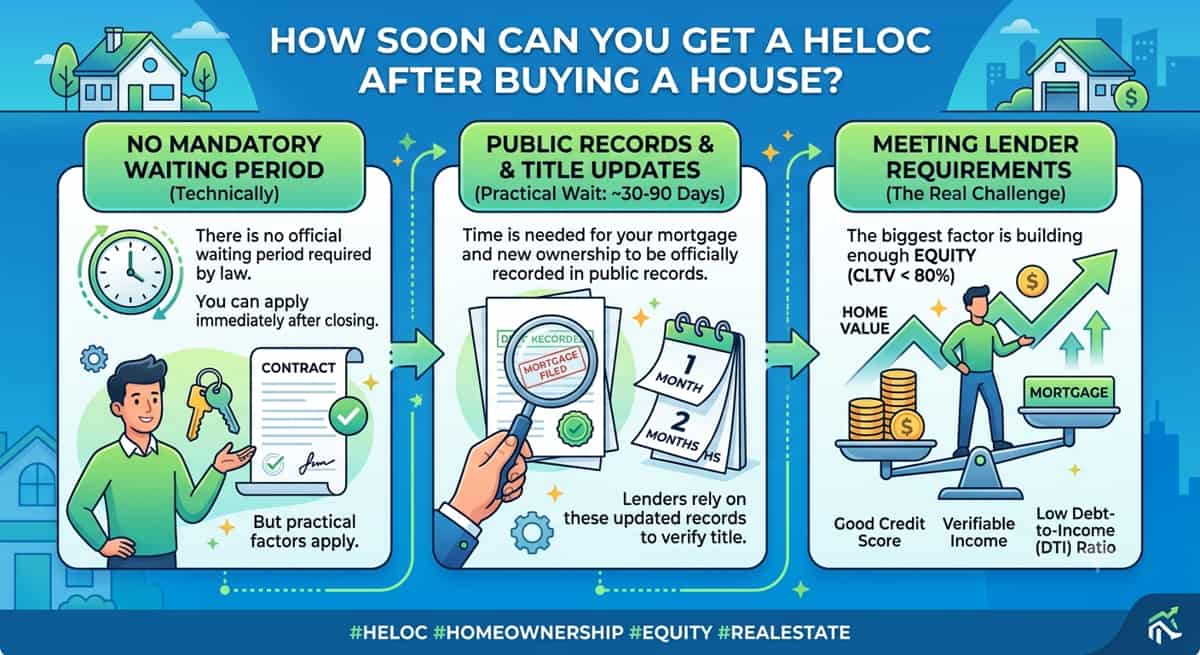
If you just bought a home and you're already eyeing a home equity line of credit to cover renovations, bills, or a big expense, you're probably wondering how long you actually have to wait. The short answer: most lenders want to see 6 to 12 months of ownership before they'll approve a HELOC, though the exact timeline depends on your lender, your equity, and your loan program. Here's what really determines your wait and how to shorten it.
Most homeowners need to wait somewhere between 6 months and a year after closing before a lender will approve a home equity line of credit. This waiting period exists because lenders want proof that you've actually built equity and that you can reliably make payments on your new mortgage. Some banks are stricter and ask for a full year of ownership. Others, especially online lenders, may work with you at the 6-month mark if your equity position is strong. The number that matters most isn't really "how long you've owned the home" it's how much equity you've built and how solid your payment history looks on paper. That's why two people who bought homes on the same day can end up with very different timelines.
What Is a HELOC Seasoning Period, and Why Does It Exist?
You'll hear the term "seasoning period" a lot when researching HELOCs, and it simply means the amount of time a lender requires you to own your home before they'll consider lending against it. Think of it like a probation period, but for your mortgage.
Lenders aren't being difficult on purpose. A few things are happening behind the scenes. First, they want to confirm your home's value is accurate and stable, not just based on an initial appraisal that could shift. Second, they want to see that you're paying your primary mortgage on time, since a HELOC adds a second loan on top of what you already owe. Third, this requirement traces back to lessons learned from the 2008 housing crash, when some homeowners borrowed against homes that hadn't actually gained real value, leaving both the homeowner and the lender exposed when prices dropped.
So the seasoning period isn't a random rule. It's a safety check that protects the lender and, honestly, protects you too. It stops you from borrowing against equity that might not really be there yet.
Minimum Requirements to Qualify for a HELOC After Buying
Waiting long enough is only part of the equation. Once you hit that window, lenders will still look closely at a few key numbers before saying yes.
Home Equity Threshold (Usually 15–20%)
Most lenders want you to have at least 15% to 20% equity in your home after the HELOC is factored in. This is often described as your combined loan-to-value ratio, or CLTV basically, how much you owe across both your mortgage and the new HELOC compared to what your home is worth. If your down payment was small, it may simply take longer for your equity to reach that threshold, regardless of how many months have passed.
Credit Score Minimums
Lenders typically look for a credit score in the high 600s to low 700s, though some want 700 or above for the best rates and terms. If your score dropped a bit during the home-buying process (which is common, since new mortgages and inquiries can ding your score temporarily), it's worth letting it recover before applying.
Debt-to-Income (DTI) Ratio
Your DTI compares your monthly debt payments to your monthly income. Most lenders want this at 43% or lower, though some allow a bit more room if your credit and equity are strong. Since you just took on a new mortgage payment, your DTI may be higher right now than it was before you bought your home another reason lenders like to see some time pass.
Owner-Occupancy Requirements
Most HELOC programs are built for homes you actually live in full-time. If your new house is a second home or an investment property, expect stricter requirements, higher equity thresholds, and in some cases, a longer seasoning period.
How Long Do Major Lender Types Require You to Wait?
Not all lenders play by the same rules. Where you apply can shift your timeline by months.
Traditional Banks and Credit Unions
Big banks and local credit unions tend to be the most conservative, often requiring 12 months of ownership before they'll even review a HELOC application. They also tend to want stronger credit and lower DTI in exchange for typically lower rates and more predictable terms.
Online/Fintech HELOC Lenders
Online lenders have shaken things up in recent years. Many will consider applications at the 6-month mark, and a handful advertise no seasoning requirement at all if your equity position is strong enough. The trade-off is usually a slightly higher rate or fewer relationship perks compared to a bank you already do business with.
Portfolio and Non-QM Lenders
These lenders keep loans on their own books instead of selling them off, which gives them more flexibility to bend the usual rules. If you have a strong income but an unconventional financial picture (self-employed, recent job change, etc.), a portfolio lender may work with you sooner than a traditional bank would.
Lender Type | Typical Seasoning | Min. Equity Required | Notes |
Traditional Banks/Credit Unions | 12 months | 15–20% | Lower rates, stricter approval |
Online/Fintech Lenders | 6 months (some sooner) | 15–20% | Faster process, slightly higher rates |
Portfolio/Non-QM Lenders | Varies, often flexible | Varies | Good for unique financial situations |
Factors That Can Shorten or Extend Your Wait Time
Your timeline isn't set in stone. A few real-world factors can move the needle in either direction.
How Much You Put Down at Purchase
If you made a large down payment, you started out with more built-in equity, which can make you eligible sooner since you're closer to that 15–20% threshold from day one.
Rising Home Values in Your Area
If home prices in your neighborhood have climbed since you closed, your equity may have grown faster than your mortgage payments alone would suggest. Some lenders will order a new appraisal to capture this, which can work in your favor.
Your Existing Mortgage Type (Conventional, FHA, VA)
FHA and VA loans often come with smaller down payments, meaning it may take longer to reach the equity threshold most HELOC lenders require. Conventional loans with a larger down payment tend to clear that bar faster.
Can You Get a HELOC Immediately After Closing?
While rare, it is possible to qualify sooner than 6 months in a few specific situations. If you made a very large down payment (30% or more), you may already have enough equity for certain lenders to work with you right away. Homeowners who paid cash for their house and later want to pull some equity out sometimes have more flexibility too, since there's no existing mortgage to factor in. A fresh appraisal showing your home has appreciated significantly can also help, especially with a portfolio lender willing to move faster than a traditional bank. These situations aren't the norm, but they do happen, and it's worth asking a lender directly about your specific numbers rather than assuming you're locked out.
HELOC vs. Cash-Out Refinance: Which Is Faster After Buying?
If you're weighing your options, it helps to know that a cash-out refinance often comes with similar seasoning requirements, typically 6 to 12 months, and sometimes longer depending on the loan type. The biggest difference isn't really speed it's structure. A HELOC gives you a flexible line of credit you draw from as needed, while a cash-out refinance replaces your entire mortgage with a new, larger one and hands you the difference in cash upfront. If you only need a smaller amount for an ongoing project, a HELOC is usually the simpler path. If you're also hoping to lower your interest rate or consolidate other debt, a cash-out refinance might make more sense. This is exactly the kind of decision where talking to an advisor who can run both scenarios side by side saves you from guessing.
How to Improve Your Approval Odds Before You're Eligible
While you wait out your seasoning period, there's plenty you can do to strengthen your application:
Monitor your credit regularly and dispute any errors that could be dragging your score down
Pay down existing debt to improve your debt-to-income ratio before applying
Keep records of home improvements, since upgrades can boost your appraised value
Track local home values so you know roughly where your equity stands before you apply
Avoid opening new credit accounts in the months leading up to your application
Make every mortgage payment on time, since this history is one of the first things underwriters check
State-Specific Considerations
Home equity lending rules aren't identical everywhere. Texas, for example, has unique protections under Section 50(a)(6) of its constitution that limit how much equity you can borrow against and add specific requirements for home equity loans and HELOCs on primary residences. Other states may have their own quirks around fees, disclosures, or rescission periods. If you're unsure how your state's rules affect your timeline, it's worth a quick conversation with a local advisor rather than relying on general information alone.
Common Mistakes Homeowners Make When Applying Too Early
After helping many homeowners through this process, a few patterns show up again and again. Some apply the moment they hit an arbitrary "6-month mark" without checking their actual equity, only to get denied and see a hard inquiry on their credit for nothing. Others assume their home's value has risen simply because the market seems hot, without any appraisal or comparable sales data to back it up. A common one is applying for a HELOC right after also financing a car or opening a new credit card, which quietly pushes DTI too high without the homeowner realizing it. And some homeowners don't realize that a HELOC application will look closely at their primary mortgage payment history, so even one late payment early on can delay approval far more than the seasoning period itself.
When Should You Talk to a Mortgage Advisor About Your HELOC Timeline?
A mortgage calculator can tell you a rough seasoning window, but it can't tell you your actual equity position, how your specific lender weighs your credit profile, or whether a HELOC even makes sense compared to other options for your goals. An advisor can pull your real numbers, check current home values in your area, and tell you honestly whether you're a few months away or already eligible. If you're not sure where you stand, that's usually the best sign it's time for a conversation rather than more searching.
Conclusion
Buying a home is a big milestone, and it's natural to start thinking about how to put your new equity to work not long after you move in. But as we've covered, the real question isn't just "how many months have passed" it's whether your equity, credit, and payment history are strong enough to support a HELOC yet. For most homeowners, that sweet spot lands somewhere between 6 months and a year, though a large down payment, a fast-appreciating neighborhood, or the right lender can move that timeline in your favor.
Rather than guessing or applying too soon and risking a denial on your credit report, take a little time to check where you actually stand. Pull your credit, get a sense of your home's current value, and pay attention to your monthly debt obligations. When those pieces line up, you'll be in a much stronger position to qualify and to get better terms when you do.
If you're unsure whether you're ready, that uncertainty is usually the clearest sign it's worth a conversation. A quick chat with a mortgage advisor can tell you exactly how close you are, and what steps, if any, would help you get there faster.