If you're thinking about borrowing against your home's equity, you've probably already looked at interest rates. But there's another number that catches a lot of people off guard: closing costs. These are the fees you pay to actually get the loan, and they can add up to a few thousand dollars depending on how much you're borrowing.
Maybe you're planning a kitchen renovation, consolidating higher-interest debt, or covering a big expense you'd rather not put on a credit card. Whatever the reason you're tapping into your home's equity, it helps to walk in knowing the full picture, not just the interest rate, but everything else that comes with it.
The good news is that closing costs on a home equity loan are fairly predictable once you know what goes into them. In this guide, we'll walk through what you can typically expect to pay, what each fee actually covers, and how to make sure you're not paying more than you need to. And if you'd rather skip the math and just get a real number for your situation, a licensed loan officer can pull that together for you in a few minutes.
What Are Home Equity Loan Closing Costs?
Closing costs are the fees you pay upfront to finalize your home equity loan. Think of them as the cost of doing the paperwork, verifying your home's value, and legally recording the loan separate from the interest rate you'll pay over time.
It's easy to mix these up with your interest rate or APR, but they're not the same thing. Your interest rate is what you pay to borrow the money, spread out over the life of the loan. Closing costs are a one-time expense, paid when the loan closes.
Most closing costs are due at signing, but you have options. Some lenders let you roll these costs into your loan balance instead of paying out of pocket. Others advertise "no closing cost" loans, which usually means the lender is covering the fees in exchange for a slightly higher interest rate. We'll get into that trade-off a little later.
Average Home Equity Loan Closing Costs
Here's the short answer: most home equity loan closing costs fall between 2% and 5% of your loan amount. On a $100,000 loan, that works out to somewhere between $2,000 and $5,000. On a $50,000 loan, you're typically looking at $1,000 to $2,500.
Some loans land outside that range. Smaller loans can carry a higher effective percentage, since some fees are flat dollar amounts rather than a percentage of the loan so they take a bigger bite out of a smaller loan. On the other end, a handful of lenders and loan types can push closing costs as high as 6%.
The exact number depends on a few things: which lender you use, where you live, your loan amount, and your credit profile. That's exactly why the range exists: no two loans cost exactly the same to close. The most reliable way to know your number is to get a personalized quote rather than relying on averages.
Breakdown of Common Home Equity Loan Closing Costs
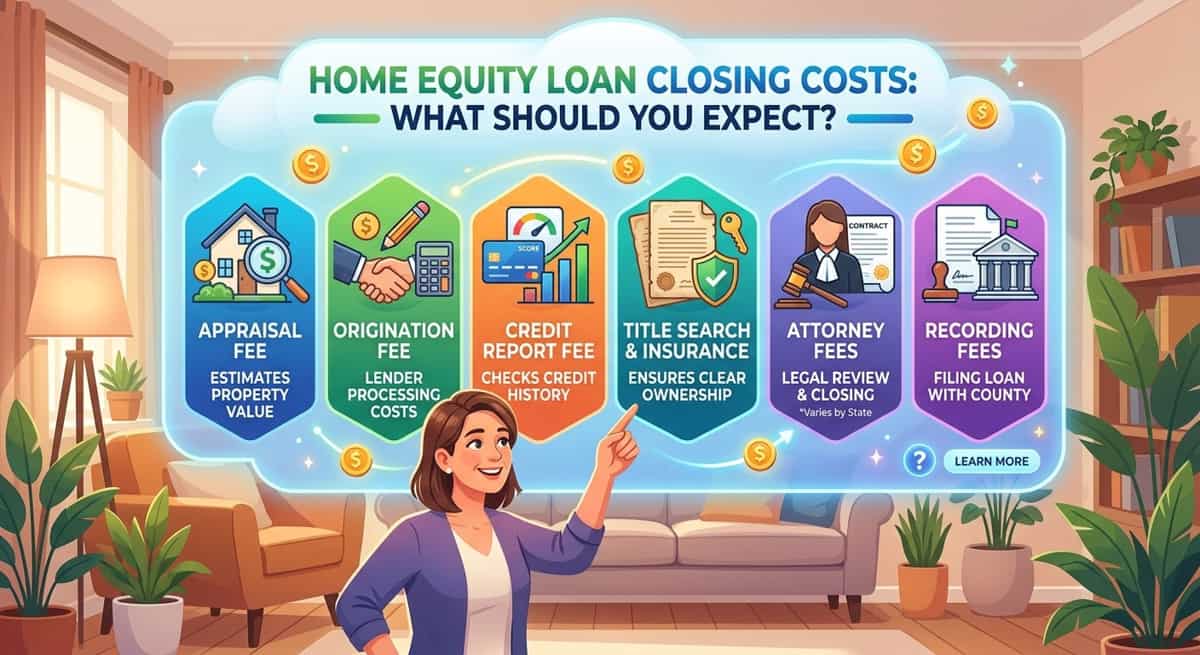
Closing costs aren't one single fee; they're a collection of smaller charges that cover different parts of getting your loan approved and recorded. Here's what typically shows up on your Loan Estimate.
Appraisal Fee
Before approving your loan, your lender needs to know what your home is currently worth. That's what the appraisal fee pays for. An in-person appraisal generally runs a few hundred dollars, though some lenders now use automated valuation tools instead of sending someone out, which can lower or eliminate this cost.
Loan Origination Fee
This is usually the single biggest line item. It covers the lender's cost of processing, underwriting, and preparing your loan. Origination fees are often charged as a percentage of your loan amount, commonly somewhere around 0.5% to 1%, though this varies quite a bit by lender which makes it one of the most important numbers to compare.
Title Search and Title Insurance
Your lender needs to confirm you actually own the home and that there are no outstanding liens or ownership disputes against it. A title company runs this search, and title insurance protects both you and the lender if a problem turns up later.
Credit Report Fee
Lenders pull your credit report and score to help decide your eligibility and rate. This fee is usually modest, but it's worth noting that credit report costs have been rising industry-wide, so don't be surprised if it's a bit higher than you'd expect.
Recording Fees
Once your loan closes, it needs to be filed with your local government to make it official. Recording fees cover that paperwork and typically run a relatively small, flat amount, though it varies by county and state.
Attorney or Settlement Fees
Some states require an attorney or licensed settlement agent to oversee the closing. Where this applies, you'll see a fee for their services. This is one of the more location-dependent costs on the list.
Document Preparation and Notary Fees
Preparing and legally finalizing your loan documents takes work, and some lenders charge separately for it. You may also see a smaller notary fee for witnessing your signatures.
Flood Certification Fee
Lenders check whether your property sits in a flood zone, since that affects insurance requirements. This is usually one of the smaller fees on your closing statement.
Discount Points (Optional)
Points aren't a required fee; they're an upfront payment you can choose to make in exchange for a lower interest rate. Whether they're worth it depends on how long you plan to keep the loan; a licensed loan officer can help you run that math.
Fee | Typical Range |
Appraisal | A few hundred dollars |
Origination fee | ~0.5%–1% of loan amount |
Title search & insurance | Varies by location |
Credit report | Modest, lender-dependent |
Recording fees | Small, flat amount |
Attorney/settlement fees | State-dependent |
Document prep & notary | Small, flat amount |
Flood certification | Small, flat amount |
Discount points | Optional, buyer's choice |
Home Equity Loan vs. HELOC: Do Closing Costs Differ?
In short sometimes, but not always by much. Both home equity loans and HELOCs (home equity lines of credit) draw from many of the same fee categories: appraisal, title work, credit checks, and origination.
Where they tend to diverge is after closing. HELOCs sometimes carry lower upfront costs, but they can come with ongoing fees a home equity loan won't have like annual maintenance fees or an early-closure fee if you pay off and close the line within the first few years. A home equity loan, since it's a fixed lump sum, tends to look more like a traditional mortgage in its closing cost structure and generally doesn't carry those recurring charges.
If you're torn between the two, that's a great question to bring to a licensed loan officer the "cheaper" option often depends less on the sticker price at closing and more on how you plan to use and pay off the money.
What Factors Affect Your Closing Costs?
A few key things push your closing costs up or down:
Loan amount — Percentage-based fees, like origination, scale with how much you borrow.
Property location — Recording fees, taxes, and attorney requirements vary significantly by state and even by county.
Credit profile — Borrowers with stronger credit or those tapping into closing cost and down payment assistance programs can save significantly upfront.
Lender type — Banks, credit unions, and online lenders don't all charge the same fees for the same services.
Property type — A primary residence, second home, or investment property can come with different requirements and costs.
Here's a real-world example of how this plays out: two borrowers in different states, each taking out a $75,000 home equity loan, can end up with closing costs that differ by several hundred dollars not because either lender did anything wrong, but because one state requires an attorney at closing and the other doesn't, and county recording fees aren't the same everywhere.
None of these factors are things you can't ask about directly. A loan officer can walk through your specific situation and tell you which of these is likely to move your number up or down, and in many cases, tell you roughly what to expect before you ever fill out a full application.
Can You Reduce or Avoid Closing Costs?
You have more control here than you might think.
"No closing cost" loans exist, but the name is a bit of a simplification. The lender typically isn't waiving the costs; they're rolling them into a higher interest rate or into your loan balance instead. That can make sense if you don't have cash on hand at closing, but it's worth knowing you're likely paying for it over time instead of upfront.
Lender credits and negotiation are also worth exploring. Some fees, like document prep or certain lender charges, have more wiggle room than others. It never hurts to ask.
Comparing Loan Estimates side by side is the most reliable way to find savings. Within three business days of applying, lenders are required to give you a standardized Loan Estimate that breaks down every fee. Lining up two or three of these documents makes it easy to spot where one lender is charging more than another for the exact same thing.
One caution worth keeping in mind: the lowest closing costs aren't automatically the best deal. A loan with low upfront fees but a higher rate can cost more over time, making it critical to compare current rates and options before committing . This is exactly the kind of trade-off a licensed loan officer can help you run the numbers on before you commit.
A simple way to think about it: if you plan to keep the loan for a long time, a slightly higher upfront cost paired with a lower rate often wins out. If you expect to pay off the loan quickly, say, within a couple of years, minimizing upfront costs may matter more, since you won't be around long enough for a lower rate to make up the difference. There's no universal right answer here, which is exactly why comparing the total cost over time, not just the cost at the closing table, matters so much.
Are Home Equity Loan Closing Costs Tax-Deductible?
This depends on how you use the loan proceeds and current IRS rules, so there isn't a one-size-fits-all answer. In general, some home equity loan costs may be deductible if the funds are used to buy, build, or substantially improve the home securing the loan, but the rules have specific conditions attached.
Because tax situations vary so much from person to person, this is one area where it's genuinely worth talking to a licensed tax professional rather than relying on a blog post including this one. They can tell you exactly what applies to your return.
How to Get an Accurate Closing Cost Estimate
The most reliable source of truth is your Loan Estimate, a standardized, three-page document lenders are required to give you shortly after you apply. It lays out your estimated interest rate, monthly payment, and every closing cost, all in the same format no matter which lender you're using.
When comparing Loan Estimates from different lenders, look closely at:
The origination fee and how it's calculated
Which third-party fees (appraisal, title, etc.) are included
Whether any costs are estimates versus fixed amounts
The total cash needed at closing
Averages are a helpful starting point, but they're still averages. The only way to know your real number is to request a personalized estimate based on your loan amount, location, and credit profile.
Why Work With a Licensed Mortgage Loan Officer
A licensed Mortgage Loan Officer is someone who has met state and federal requirements to originate home loans and is registered with the Nationwide Multistate Licensing System (NMLS). You can look up any loan officer's license status for free to confirm who you're working with.
Working with a licensed MLO gives you a few things a calculator or averages page can't: someone who knows the specific rules in your state, can pull a real-time, personalized closing cost estimate, and can help you decide whether a home equity loan, a HELOC, or a different structure entirely makes the most sense for your goals.
If you're ready to see actual numbers instead of ranges, reaching out to a licensed loan officer is the fastest way to get there.
The Bottom Line
Home equity loan closing costs typically land between 2% and 5% of your loan amount, but your exact number depends on your lender, your state, your credit, and how much you're borrowing. Knowing what goes into that number appraisal, origination, title work, and the rest means there won't be any surprises waiting for you at the closing table.
If you'd like a real, personalized estimate instead of a general range, reach out to a licensed Mortgage Loan Officer. It only takes a few minutes to find out exactly what your home equity loan would cost to close.