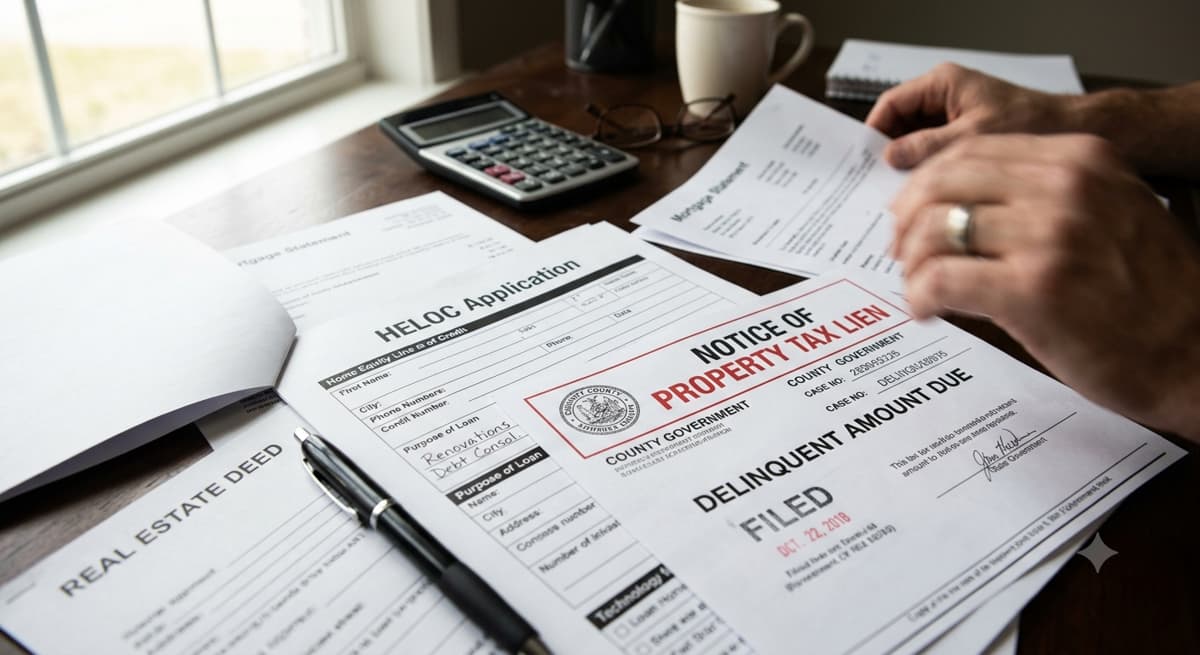
Accessing your home equity gives you the opportunity to access funds for renovations, debt consolidation and other unexpected expenses with a Home Equity Line of Credit (HELOC). But if your house has a tax lien, qualifying for a HELOC becomes more difficult. When someone fails to pay property taxes, the local government places a property tax lien on that home, which gives the taxing authority a legal right or claim against your home.
An existing tax lien may inhibit lenders from approving your application since they would typically want the first or second lien position. This doesn't mean you can never get a HELOC, keeping reading that may not always be the case, it just depends on how much you owe, your available home equity and your credit profile and what the individual lender is looking for. Here, we'll discuss why owning a property tax lien can make you ineligible for a HELOC, what alternatives might be available to you, and what steps you should take to increase the likelihood that your loan will get approved.
What Is a Property Tax Lien?
A property tax lien is what happens when you fall behind on the property taxes you owe your county or city. Instead of just sending you a bill, the local government places a legal claim on your home until that debt is paid. It's their way of making sure they eventually get what's owed to them, even if it takes a while.
This is different from your mortgage, which is a lien you agreed to when you took out your home loan. A property tax lien isn't something you sign up for it's placed on you automatically once your taxes go unpaid past a certain point, and the exact timeline for that varies by state and county. If you're not sure whether you have one, your county tax assessor's office can tell you exactly what's owed and when it was filed.
Does a Property Tax Lien Affect Your Ability to Get a HELOC?
Here's the part that surprises a lot of homeowners: property tax liens usually jump to the front of the line. Even though your mortgage lender loaned you hundreds of thousands of dollars, the county's tax lien typically outranks that loan if your home is ever sold or foreclosed on. That means if something went wrong, the county gets paid before your mortgage lender does.
This is exactly why lenders get nervous about tax liens. When you apply for a HELOC, they're looking at how much of your home's value they can safely lend against this is often called your loan-to-value ratio, or how your total debt compares to what your home is worth. A tax lien sitting on the title adds risk and uncertainty to that math, so most lenders want it resolved before they'll move forward.
Can You Get a HELOC With a Tax Lien?
So can you actually get approved? In most cases, yes but it usually comes down to one of two paths. Either you pay off the lien using part of your new loan's proceeds right at closing, or, if the lien is small enough, the county agrees to let your new mortgage take priority over it through what's called a subordination agreement.
Which path makes sense for you really depends on your specific lender, the loan program you're using, and how much you owe on the lien. A smaller, recently filed lien is usually much easier to work around than a large one that's been sitting unpaid for years. Every lender handles this a little differently, so it's worth having a direct conversation early rather than assuming you're automatically disqualified.
Lender Requirements When a Tax Lien Is on Title
Lien Payoff at Closing
The most common solution is simple: your title company pays off the lien directly out of your loan proceeds before any money reaches you. This happens as part of the closing process, the same way your title company would pay off any other debt tied to your home. Once that payment clears, the lien is released and your title comes back clean.
Subordination Agreements
Sometimes, instead of paying the lien off completely, your lender or title company can request that the county formally agree to step behind your new mortgage in priority. This is called subordination, and it basically tells everyone involved that your new lender now has the senior claim, even though the tax debt is still technically outstanding. Not every county allows this, and it can add extra time to your closing, so it's not always the fastest option.
Title Search & Clear Title Requirements
Before any HELOC closes, a title company runs a search to see exactly what's attached to your home. If a lien shows up and it's not addressed, most title insurers simply won't issue a policy and without title insurance, your lender won't fund the loan. This is really the step where everything gets caught, so it's better to know about a lien ahead of time than to be surprised by it mid-process.
Property Tax Lien vs. IRS Federal Tax Lien: Does It Matter?
People often lump these two together, but they're not the same thing, and they're handled differently. A property tax lien comes from your local county or city government because of unpaid property taxes. An IRS federal tax lien comes from the federal government because of unpaid income taxes, and it can attach to everything you own, not just your house.
If you have an IRS lien instead of (or in addition to) a property tax lien, resolving it usually involves a separate process with the IRS itself, including a specific subordination request (IRS Form 14134). This can take longer than dealing with a local property tax lien, so if you're not sure which type you're dealing with, that's one of the first things to sort out it can change your timeline significantly.
Steps to Get a HELOC Despite a Property Tax Lien
Get a current payoff statement from your county. This tells you exactly how much is owed today, since interest and penalties often keep adding up.
Talk to a mortgage advisor before you formally apply. A quick conversation can save you from wasted time or a denial you didn't need to get.
Figure out whether payoff or subordination makes more sense. Your advisor can help you weigh cost, speed, and whether your county even allows subordination.
Gather your documentation. Have your tax bill, payoff statement, and any payment history ready to go.
Disclose the lien upfront when you apply. Lenders find liens during the title search anyway bringing it up early keeps the process moving instead of stalling it later.
What If You Don't Qualify? Alternative Options
If a HELOC doesn't end up working out, you still have options.
Home Equity Loan
A home equity loan provides a one-time lump sum instead of a revolving credit line. While lenders usually apply similar tax lien requirements, it's still worth exploring. Learn more in our guide on home equity loan vs. HELOC.
Cash-Out Refinance
A cash-out refinance pays off your current mortgage while replacing it with a new loan for more money, allowing the excess to pay off the lien on your property during closing. It may also allow you to obtain a lower interest rate or other more favorable terms of the loan based on current market conditions.
County Payment Plan
Several counties provide payment plans that allow homeowners to pay property taxes due over a period of time. Although the lien can make qualifying for a HELOC more difficult, once it is resolved, qualifying may be significantly easier. Find your local tax office and ask what types of payment options are available to whom.
Personal Loan
But if your tax lien is small, a personal loan might be able to get you the money you need to pay it off. This can help pave the path before applying for a HELOC. Interest rates and repayment terms vary; so, before borrowing, use lenders loan comparison.
Property Tax Relief Programs
Hardship assistance, payment deferrals or tax relief programs are available in some states and counties for qualified homeowners. They can ease the financial burden and assist you in settling your pre-existing tax liabilities more affordably.
How to Resolve a Property Tax Lien Before You Apply
If you'd rather clear the lien before you even start the loan process, here's generally how that goes: start by calling your county tax office and asking for your exact payoff amount, since it can change as interest accrues. If you can't pay it all at once, ask about a payment plan many counties offer one. Once it's paid, request written proof of the lien release, and keep that document on hand for your lender. Just know that liens don't disappear the moment you pay processing the release can take a few weeks, so it's smart to start early if you're planning to apply for a HELOC soon.
Real-World Scenario: How This Plays Out in Underwriting
To make this more concrete, here's a composite example based on how these situations typically unfold. A homeowner came to us wanting to tap into their equity for a kitchen renovation. During the title search, we discovered a small property tax lien from a missed payment two years earlier about $2,400, plus some accrued interest. Because the amount was relatively small, we were able to have it paid directly out of the new loan's proceeds at closing, and the whole process added only about a week to their timeline.
In another case, a homeowner had a larger, older lien from a multi-year tax dispute. Paying it off outright wasn't realistic given their loan amount, so instead we worked with the county to get a subordination agreement in place. That process took longer and required more documentation, but it ultimately allowed the loan to close without the homeowner having to pay off years of back taxes in one lump sum. Every situation is a little different, which is exactly why it helps to talk through your specific numbers with an advisor before assuming either outcome.
Talk to a Licensed Mortgage Advisor About Your Options
While obtaining a HELOC with a property tax lien can be difficult, it is not impossible. Whether you will qualify is based on the size of the lien, your amount of equity in your home, your credit profile and lender guidelines. Typically, your odds of being approved are better if you resolve the tax lien or take steps like lien subordination.
HELOC not suitable for your purposes, other financing options can still provide you the cash you need. Delegating comes back in a big way because every homeowner is different from the other when it comes to financial hardships, and thus having someone help you through either an agent or an attorney outlining what was needed sends clarity. A chat with a licensed mortgage advisor can open your eyes to possibilities, solutions you didn't consider and mistakes you'll wish you hadn't made. This means following a smart plan that allows you to work toward your financial goals while safeguarding the equity you've created in your home.