
When most homeowners track mortgage trends, they look toward the Federal Reserve. However, as a mortgage consultant, I can tell you that the Fed doesn’t set your daily interest rate; the secondary mortgage market does. This complex ecosystem—the "engine room" of American housing is where Government-Sponsored Enterprises (GSEs) like Fannie Mae and Freddie Mac operate.
These entities don't lend money directly to you. Instead, they buy mortgages from lenders, package them into Mortgage-Backed Securities (MBS), and sell them to global investors. The price these investors are willing to pay fluctuates every second based on interest rate volatility and economic data. When the secondary market shifts, your daily quote moves in tandem. Understanding this relationship is vital for anyone considering a refinance or accessing home equity, as it explains why a rate you see at breakfast might vanish by lunch.
Defining the "Big Players": Who are Fannie Mae and Freddie Mac?
To understand your mortgage rate, you must first understand the two giants standing behind nearly every conventional loan in America: the Federal National Mortgage Association (FNMA), known as Fannie Mae, and the Federal Home Loan Mortgage Corporation (FHLMC), known as Freddie Mac.
The Mandate: Ensuring Liquidity
Fannie and Freddie are Government-Sponsored Enterprises (GSEs). Their primary mandate is to provide liquidity to the U.S. housing market. Imagine if your local bank only had $10 million to lend. Once they issued 20 mortgages of $500,000 each, they would be "out of money" and unable to help the next family.
To prevent this, the GSEs step in to buy those loans from the bank. This "reloads" the bank’s vault, allowing them to turn around and lend to you. By creating a continuous cycle of buying and selling, Fannie and Freddie ensure that mortgage money is always available, even during economic downturns.
Primary vs. Secondary: Where Your Loan Lives
As your Mortgage Consultant, I operate in the primary market. This is where we sit down, review your credit, and "originate" your loan. It is the personal side of the transaction where the mortgage is born.
The secondary market is where your loan lives after closing. Once your papers are signed, your lender typically sells the loan to Fannie or Freddie. They then bundle your mortgage with thousands of others into Mortgage-Backed Securities (MBS). These bundles are sold to global investors—pension funds, insurance companies, and even sovereign wealth funds.
Because these investors demand a certain "yield" (return) to buy these bundles, the prices they pay in the secondary market are what ultimately dictate the interest rate I can offer you in the primary market.
The Mechanics: How the Secondary Market Dictates Your Refinance Rate
When you call me for a refinance quote, the number I give you isn't pulled out of thin air. It is a direct reflection of real-time trading on Wall Street. To understand why your rate is what it is, we have to look at the "Aggregator" model and the behavior of the bond market.
The Aggregator Model and MBS
Lenders function as "aggregators." After I help you close your refinance, the lender doesn't typically keep that loan in a vault. Instead, they bundle your loan with hundreds of others that have similar characteristics—such as credit scores and loan-to-value ratios. These bundles are transformed into Mortgage-Backed Securities (MBS).
Investors buy these MBS because they provide a steady stream of monthly interest payments. However, because these securities are traded like stocks or bonds, their value fluctuates every second that the market is open.
The Inverse Relationship: Prices vs. Rates
The most critical concept to grasp in mortgage pricing is the inverse relationship between bond prices and interest rates.
Think of it as a seesaw:
- When MBS prices go UP: Interest rates go DOWN.
- When MBS prices go DOWN: Interest rates go UP.
When investors are confident and buying MBS, the high demand drives prices up, allowing lenders to offer lower interest rates to borrowers. Conversely, if economic data suggests inflation is rising, investors may sell off their bonds, causing prices to drop and forcing lenders to raise rates to remain competitive.
The "Par Rate" and Hourly Volatility
In the industry, we track what is known as the par rate the standard interest rate a borrower can receive without paying "points" or receiving a lender credit. Because MBS trade on live floors, the par rate is a moving target.
On a volatile day, the secondary market can "reprice" several times. This is why you might see a "mid-day reprice for the worse." If a major economic report like the Consumer Price Index (CPI) or the monthly Jobs Report comes out at 8:30 AM, the secondary market reacts instantly. By 10:00 AM, the rate I could have locked for you at breakfast may no longer exist.
This is why "locking" a rate is such a pivotal moment in the refinancing process. When you lock, your lender is essentially placing a bet in the secondary market on your behalf, guaranteeing that price regardless of how much bond traders fluctuate the market before your loan officially closes.
Why This Matters for Home Equity and Cash-Out Refinancing
When you decide to leverage your home equity, the secondary market plays an even more aggressive role in determining your cost of borrowing. If you are seeking a cash-out refinance rather than a standard "rate-and-term" refinance, you will notice that the interest rates are almost always higher. This isn't your lender being difficult; it is a direct result of Risk-Based Pricing mandates set by Fannie Mae and Freddie Mac.
The Impact of Loan-Level Price Adjustments (LLPAs)
The secondary market views cash-out transactions as higher risk. To account for this, the GSEs apply Loan-Level Price Adjustments (LLPAs). Think of these as "delivery fees" that lenders must pay to Fannie or Freddie when they sell the loan.
These fees are determined by two primary factors:
- Credit Score: The lower your score, the higher the risk premium.
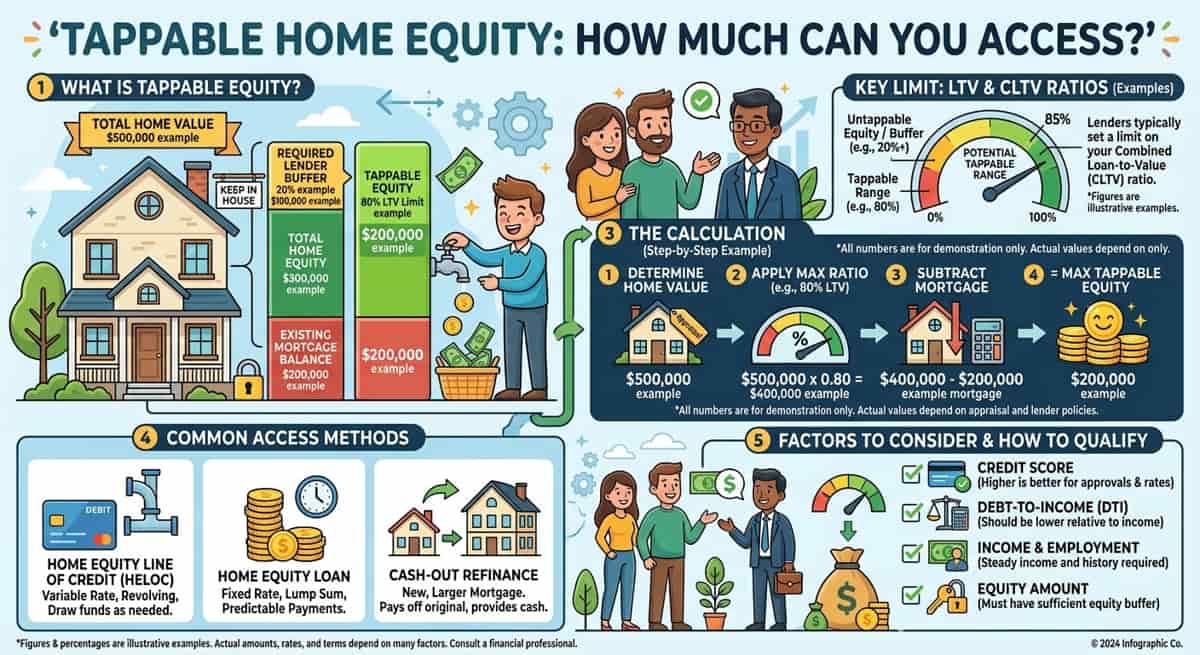
- Loan-to-Value (LTV) Ratio: The more equity you extract (and the closer you get to that 80% LTV ceiling), the higher the fee.
Why Equity Extraction Costs More
In a "rate-and-term" refinance, you are simply lowering your rate or changing the length of the loan. The secondary market sees this as "low risk" because your debt remains the same or even decreases.
However, in a cash-out refinance, you are increasing your total debt and reducing your equity cushion. If the housing market were to dip, a loan with 80% LTV is much more likely to result in a loss for the investor than a loan with 60% LTV. To compensate for this "default risk," investors demand a higher yield.
Navigating the Costs
Because LLPAs are cumulative, they can significantly impact your "par rate." For example, a homeowner with a 680 credit score taking out 80% of their equity might face a price adjustment that is 1.00% to 2.00% higher in fees than someone with a 780 score.
As your advisor, my goal is to help you "price out" these adjustments. Sometimes, it makes more sense to keep your current low-rate first mortgage and use a Home Equity Line of Credit (HELOC) instead of a full cash-out refinance. Understanding how the secondary market tiers these risks allows us to build a strategy that protects your wealth while giving you the liquidity you need.
The "Spread": Why Mortgage Rates Aren’t the Same as the 10-Year Treasury
A common misconception in the housing market is that mortgage rates move in lockstep with the Federal Reserve’s overnight rate. In reality, the most reliable "north star" for mortgage pricing is the 10-Year Treasury Note. However, if you look at the charts, you’ll notice that mortgage rates are always higher than Treasury yields. This gap is known as the "spread."
Understanding the Benchmark
The 10-Year Treasury is considered a "risk-free" asset because it is backed by the U.S. government.Mortgages, while highly secure, carry two specific risks that government bonds do not:
Default Risk: The slight possibility that a borrower stops making payments.
- Prepayment Risk: The risk that you will refinance your loan when rates drop, depriving the investor of future interest payments.
Because of these factors, investors demand a higher yield to purchase mortgage debt. Historically, the "normal" spread has averaged about 170 to 200 basis points (1.7% to 2.0%) above the 10-Year Treasury.
When the Market Gets "Jittery"
The spread is not fixed; it expands and contracts based on secondary market sentiment.When the economy is stable, the spread narrows, and mortgage rates sit closer to Treasury yields. However, when the market becomes volatile—due to high inflation or uncertainty about the yield curve—the spread "widens."
In recent years, we have seen spreads balloon to over 300 basis points. When the secondary market becomes "jittery," investors pull back on buying Mortgage-Backed Securities (MBS) or demand a much higher "term premium" to offset the uncertainty. This explains why your mortgage rate might stay high even if you see the 10-Year Treasury yield falling.
As your consultant, I monitor this spread daily. When the spread is wide, it often signals that the market is overreacting to news, which can create unique "buy-the-dip" opportunities for savvy borrowers ready to lock in a rate before the secondary market stabilizes and the spread compresses.
Daily Volatility: Why Your Quote Might Change Between Breakfast and Lunch
If you have ever received a mortgage quote in the morning only to find it has increased by the afternoon, you have experienced market volatility firsthand. To the average borrower, this feels like "bait and switch" tactics, but in reality, it is a reflection of the secondary market’s pricing engine updating in real-time.
As a professional mortgage consultant, I don’t rely on the evening news to see where rates are headed. I use institutional tools like MBS Highway and real-time Live Charts that track the movement of Mortgage-Backed Securities minute-by-minute. These charts show us exactly when "candle sticks" turn red, signaling a sell-off in the bond market that will inevitably lead to a lender price increase.
The Impact of Economic Indicators
The secondary market is hyper-sensitive to "data dumps." Every month, specific economic indicators act as catalysts for volatility:
- Consumer Price Index (CPI): If inflation is higher than expected, bond prices drop and rates jump.
- Jobs Report (Non-Farm Payrolls): A "strong" labor market often leads the secondary market to price in higher future rates.
- Fed Minutes: Even a single word change in the Federal Reserve's report can cause bond traders to pivot.
To Lock or to Float?
This volatility is why the "lock vs. float" conversation is the most important one we will have. If we are in a "downward trend" but a major CPI report is due tomorrow, I may advise you to rate lock today to protect your home equity strategy from a potential spike. Conversely, if the market is "oversold," we might float for 24 hours to catch a recovery. Understanding the secondary market's "intra-day" behavior allows us to move from guessing to strategic planning.
How to Navigate Secondary Market Shifts: A Mortgage Advisor’s Strategy
In a market where the secondary market dictates the rules, your success depends on agility rather than just "shopping around." Navigating these shifts requires a shift in mindset: you aren't just looking for a loan; you are managing a significant financial liability.
Timing the Market vs. Time in the Market
Many homeowners try to "time the bottom" of the secondary market. However, because MBS trades so quickly, the "bottom" is often a window that lasts only a few hours. A more effective strategy is focusing on your specific financial goals—such as debt consolidation or lowering your debt-to-income (DTI) ratio—and identifying a "target rate" that makes the math work for your family.
The "Ready-to-Go" File
The secondary market rewards the prepared. When a dip in rates occurs, lenders are often flooded with applications, which can cause "operational lag" and slower turn times. By having your full documentation—tax returns, bank statements, and pay stubs—already reviewed and approved, we can hit the "lock" button the moment the secondary market presents a favorable window.
Credit Score Optimization
Since Fannie and Freddie use Loan Level Price Adjustments (LLPAs), your credit score is the primary lever you can pull to fight back against secondary market costs. Even a 20-point increase in your score can move you into a different "pricing bucket," potentially saving you thousands of dollars over the life of the loan.
Amortization and Equity Strategy
Finally, consider the long-term impact of amortization. If the secondary market is volatile, you might opt for a shorter-term fixed rate or a strategic "buy-down" using points. As your advisor, I look at the "break-even point"—the moment where the cost of the higher rate or the cost of the points is neutralized by your monthly savings. By aligning your home equity goals with the current state of the MBS market, we ensure that your refinance isn't just a transaction, but a tool for long-term wealth building.
How to Navigate Secondary Market Shifts: A Mortgage Advisor’s Strategy
In a marketplace where the secondary market dictates the rules, your success depends on agility rather than just "shopping around." Navigating these shifts requires a strategic mindset: you aren't just looking for a loan; you are managing a significant financial liability.
Timing the Market vs. Time in the Market
Many homeowners try to "time the bottom" of the secondary market perfectly. However, because Mortgage-Backed Securities (MBS) trade with lightning speed, the "bottom" is often a window that lasts only a few hours. A more effective financial planning strategy is identifying a "target rate" that makes the math work for your specific goals—whether that is debt consolidation or lowering your monthly debt-to-income (DTI) ratio. If the numbers provide a clear benefit, waiting for a further 0.125% drop that may never come is often a losing game.
The "Ready-to-Go" File
The secondary market rewards the prepared. When a favorable dip in rates occurs, lenders are often flooded with applications, which can cause "operational lag" and slower turn times. By having your full documentation—tax returns, bank statements, and pay stubs—already reviewed and approved in my system, we can hit the "lock" button the moment the secondary market presents a favorable window. In this environment, being "pre-underwritten" is your greatest competitive advantage.
Credit Score Optimization
Since Fannie Mae and Freddie Mac utilize Loan Level Price Adjustments (LLPAs), your credit score is the primary lever you can pull to fight back against secondary market costs. Even a 20-point increase in your score can move you into a different "pricing bucket," potentially saving you thousands of dollars over the life of the loan. Credit score optimization is often the most profitable work a borrower can do before entering the market.
Using Home Equity Wisely During Volatility
Finally, consider the long-term impact of amortization. If the secondary market is showing high volatility, you might opt for a shorter-term fixed rate or a strategic "buy-down" using discount points to stabilize your payment. As your advisor, I look at the "break-even point"—the moment where the cost of the points is neutralized by your monthly savings. By aligning your home equity goals with the current state of the MBS market, we ensure that your refinance isn't just a transaction, but a tool for long-term wealth building.
Conclusion: Leveraging Expert Guidance in a Complex Market
Navigating the mortgage landscape can feel like a daunting task when you realize that your monthly payment is influenced by global bond traders and the internal policies of Fannie Mae and Freddie Mac. However, understanding the role of the secondary market shifts the power back into your hands. By recognizing that rates are dynamic and influenced by specific risk-based adjustments, you can move away from the "sticker shock" of daily headlines and toward a proactive financial strategy.
In a world of hourly price changes and complex "delivery fees" for home equity, having a partner who monitors the MBS market in real-time is your greatest asset. Whether you are looking to lower your rate, consolidate high-interest debt, or tap into your equity for a major project, the goal is to make the secondary market work for you, not against you.
Don't leave your home equity to chance. The difference between a "good" lock and a "great" lock often comes down to timing and preparation.
Ready to see how the current market impacts your specific goals? Contact US today for a personalized equity review and refinance consultation to ensure you are positioned to capture the best the market has to offer.