
The landscape of the American housing market has shifted significantly as we move through 2026. After several years of economic adjustment and fluctuating figures, we have finally entered a period of post-inflationary stabilization. For homeowners, this means the frantic unpredictability of the previous years has been replaced by a more predictable, steady environment. As a professional mortgage consultant with years of experience helping families navigate these exact cycles, I’ve seen firsthand how these shifts create unique windows of opportunity for those ready to take action.
If you are looking at your current mortgage and wondering if the "right time" has finally arrived, you aren't alone. Just two years ago, many homeowners felt locked into their rates, hesitant to move or change their financial structure due to high peak interest costs. Today, the conversation has changed. We are seeing a healthy balance between housing supply and buyer demand, which has brought a much-needed sense of stability to home values across the country.
Refinancing today looks very different than it did in the recent past. We are transitioning away from a period where homeowners simply "held on" to a time of active equity management. Whether your goal is to reduce your monthly overhead, switch from an adjustable rate to the security of a fixed payment, or finally tap into the value you’ve built in your home to fund other life goals, the 2026 market is offering more favorable paths to get there.
Navigating this transition requires looking beyond just the headline numbers. It’s about understanding how current opportunities align with your long-term financial health. In the following sections, we will break down the practical steps and modern strategies available to you right now, ensuring you have the clarity needed to decide if a refinance is the smartest move for your household this year.
Understanding Your "Why": Identifying Your Refinance Intent
Before diving into paperwork, the most important step is defining exactly what you want your mortgage to do for you. Refinancing isn’t a "one size fits all" decision; it is a financial tool that can be adjusted to meet different life goals. As a mortgage consultant, I’ve found that homeowners who start with a clear "why" are much more successful in finding a loan that actually improves their bottom line. In 2026, we generally see four primary reasons why people choose to change their current loan.
Lowering Your Monthly Payments
The most common goal is a Rate and Term Refinance. This is a straightforward swap: you replace your existing high-interest loan with a new one at a lower rate. If interest rates have dropped since you first bought your home or last refinanced, even a small decrease can shave hundreds of dollars off your monthly bill. This extra breathing room in your budget can be redirected toward savings, retirement, or simply easing the daily cost of living.
Using Your Home Equity
If you’ve lived in your home for a few years, you’ve likely built up significant value. A Cash-Out Refinance allows you to tap into that value. You take out a new mortgage for more than you owe on your current one and receive the difference in cash. In today’s market, many families are using these funds for two specific reasons:
Home Improvements: Upgrading a kitchen or adding an ADU (Accessory Dwelling Unit) can further increase your property value.
Debt Consolidation: If you have high-interest credit card debt or personal loans, rolling those into a lower-interest mortgage can save you thousands in interest and simplify your life into a single monthly payment.
Shortening Your Loan Term
Some homeowners aren't looking to lower their payment, but rather to get rid of it faster. Switching from a 30-year mortgage to a 15-year mortgage is a powerful wealth-building move. While your monthly payment might stay the same or increase slightly, you will pay significantly less interest over the life of the loan. This is a popular strategy for those looking toward retirement who want the peace of mind of a debt-free home.
Removing Private Mortgage Insurance (PMI)
If you bought your home with a small down payment (less than 20%), you are likely paying for PMI every month. Because home values have remained strong through 2026, you might now own a much larger percentage of your home than you did at closing. Refinancing allows you to get a fresh appraisal. If your equity has reached 20% or more, you can often eliminate that monthly insurance fee entirely, which is an immediate win for your monthly cash flow without even needing a change in interest rates.
By identifying which of these categories fits your current situation, you can narrow down your options and ensure that your new mortgage is a stepping stone to a stronger financial future.
Is It Time? The "1% Rule" and 2026 Financial Math
Deciding when to refinance is often the most stressful part of the process. For decades, homeowners were told to wait until interest rates dropped by at least a full 1%. However, in 2026, relying on that old rule of thumb can actually cost you money. To make a smart decision, you need to look past the "1% myth" and focus on the actual math: the break-even point and the total return on your investment.
The Break-Even Point: Your Real North Star
Refinancing isn’t free. Even in our modern, digital-first lending environment, there are costs associated with getting a new loan. These typically include things like credit reports, title insurance, and processing fees. The "break-even point" is the exact month when the total amount you’ve saved on your lower monthly payments finally equals the amount you paid to get the loan.
For example, if your refinance costs $4,000 and saves you $200 a month, your break-even point is 20 months.
If you plan on staying in your home for five years (60 months), this refinance is a fantastic deal because you’ll enjoy 40 months of "pure" savings. However, if you plan to sell the house in a year, you would lose money by refinancing, regardless of how low the interest rate is.
Why the "1% Rule" is a Myth
The old 1% rule is outdated because it doesn't account for your specific loan balance or how long you plan to keep the mortgage. If you have a large loan balance, a drop of even 0.5% could save you a significant amount of money every month. Conversely, if you only owe a small amount on your home, even a 2% drop might not save enough to cover the closing costs within a reasonable timeframe.
Instead of looking at the rate alone, we look at the Internal Rate of Return. This is a professional way of asking: "If I spend $4,000 today on closing costs to save $2,400 a year, is that a better return than putting that $4,000 in a savings account?" In almost every case, the answer is yes. Saving $200 a month on a $4,000 investment is a 60% annual return—far higher than what you’d get in most traditional investments.
2026 Closing Costs: What to Expect
In 2026, technology has made the process much more efficient, but it hasn't eliminated costs. While "no-cost" refinances exist, they are usually just a trade-off: the lender gives you a slightly higher interest rate in exchange for covering your upfront fees.
You should expect closing costs to range between 2% and 5% of your total loan amount. The good news is that digital appraisals and automated income verification have reduced some of the traditional "junk fees" of the past. When reviewing your loan estimate, look closely at the "Services You Can Shop For" section. Shopping for your own title insurance or survey can often save you hundreds of dollars.
A Word of Caution
While refinancing is a powerful tool, it’s important to remember that you are essentially taking out a new 30-year (or 15-year) contract. If you are 10 years into a 30-year mortgage and you refinance into a new 30-year mortgage, you might lower your monthly payment, but you are adding 10 more years of interest payments to your life. Always ask your consultant to show you the "total interest paid" over the life of both the old and new loans to ensure you aren't trading a short-term win for a long-term loss.
Maximizing Your Home Equity: Cash-Out Strategies for 2026
As we move through 2026, many homeowners are finding themselves in a unique position. While the "Great Housing Reset" has caused price growth to level off, the massive gains in home values over the last several years mean that the average mortgaged homeowner is sitting on a significant amount of untapped wealth. As a mortgage consultant, my goal is to help you understand how to access that wealth safely and use it as a strategic tool for your financial future.
The 2026 Home Equity Landscape: How Much Can You Borrow?
In today’s market, lenders have become more precise with their requirements. To determine how much cash you can take out, we look at two primary numbers: your Loan-to-Value (LTV) ratio and your Debt-to-Income (DTI) ratio.
For most standard mortgages in 2026, the maximum LTV is 80%. This means you must leave at least 20% of your home’s value untouched as a safety buffer. For example, if your home appraises at $500,000, your total new loan cannot exceed $400,000. If you currently owe $300,000, you have roughly $100,000 in potential cash available (minus closing costs).
It is also important to note that the Appraisal process has changed. In 2026, many lenders use "Desktop Appraisals" or automated data to speed up the process, but for a cash-out refinance, a traditional in-person inspection is often still required to confirm the high-value upgrades you’ve made.
Cash-out for Home Improvement: Investing in Your Future
One of the smartest ways to use equity in 2026 is reinvesting it back into the property. We are seeing a major shift toward "Practical Renovations." Rather than purely aesthetic changes, the highest return on investment (ROI) currently comes from:
Energy Efficiency: Upgrading to heat pumps, solar-ready roofing, and advanced insulation. These don't just increase resale value; they provide immediate relief on your monthly utility bills.
Modern Functionality: Adding home offices or "wellness" spaces like spa-like bathrooms continues to be a top driver of property value.
Sustainable Materials: Using high-end recycled materials or low-VOC finishes has moved from a "trend" to a standard expectation for buyers in 2026.
Debt Consolidation: The "Resetting" Warning
Using a cash-out refinance to pay off high-interest debt is a powerful way to simplify your finances. In early 2026, credit card interest rates remain near 20%, while mortgage rates are significantly lower. By rolling $50,000 of credit card debt into your mortgage, you could save thousands of dollars in interest every year.
However, as a professional advisor, I must offer a serious warning: Do not fall into the "Debt Restart" trap.
When you pay off your credit cards with your home equity, those accounts go to a zero balance. If you haven't changed the spending habits that created the debt in the first place, you risk running those balances back up. If that happens, you’ll be stuck with the high-interest debt and a larger mortgage. Furthermore, remember that a mortgage is secured by your home. If you fail to make the payments, you risk foreclosure, a consequence that doesn't exist with unsecured credit cards.
To use this strategy successfully, I recommend a "one and done" approach: use the refinance to clear the deck, and then treat your newfound monthly savings as a contribution toward your retirement or an emergency fund.
The Bottom Line
Home equity is likely your largest financial asset. Whether you are funding a child's education, renovating your kitchen for the next decade of use, or cleaning up your balance sheet, the key is to borrow with a clear plan. By maintaining that 20% equity cushion and focusing on projects that improve your quality of life and property value, you can ensure your home remains a source of wealth rather than just an expense.
The 2026 Refinance Process: A Step-by-Step Guide
The refinance process has evolved rapidly, moving from a weeks-long paper trail to a streamlined, digital-first journey. In 2026, technology has removed much of the friction, but the core fundamentals of financial qualification remain. If you are prepared, you can move from application to funding faster than ever before. Here is the step-by-step path you can expect.
Step 1: The Credit Check
Your credit score remains the single most important factor in determining your new interest rate. In the 2026 lending environment, a score of 740 or higher is generally required to unlock the most competitive "benchmark" rates. While you can certainly refinance with a score as low as 620, those extra points can save you thousands over the life of the loan. Before applying, ensure your credit reports are accurate and try to keep your credit card balances low to maximize your score.
Step 2: Documentation and AI Underwriting
Gone are the days of faxing stacks of pay stubs and bank statements. Today, most lenders use automated income verification. By securely linking your payroll and bank accounts, the lender’s system can instantly verify your earnings and assets. This data feeds into AI-driven underwriting engines that analyze your financial profile in real-time. Instead of waiting days for a human to review your file, these systems can often provide a "conditional approval" within hours, flagging only the specific items that need a closer look.
Step 3: The Appraisal
The valuation of your home is the final hurdle. In 2026, many homeowners qualify for a Desktop Appraisal. This is a remote valuation where a licensed appraiser uses data from public records, tax files, and recent sales in your neighborhood to determine your home’s value without ever stepping foot inside. This can cut up to two weeks off your timeline. However, if you are doing a complex cash-out refinance or have a unique property, a Traditional Appraisal (an in-person visit) may still be required to ensure the most accurate value.
Step 4: Locking Your Rate
Once your application is moving forward, you’ll have the opportunity to "lock" your interest rate. A rate lock protects you from market fluctuations while your loan is being finalized. In the current market, most locks last for 30 to 45 days. It is crucial to stay in close contact with your advisor during this time; if you don't close before the lock expires, you may have to pay a fee to extend it or accept the current market rate.
Step 5: Closing with RON
The final step is "Closing Day," which no longer requires a trip to a crowded title office. Most states now allow Remote Online Notarization (RON). You can sign your final loan documents from your laptop or tablet via a secure video call with a digital notary. They will verify your identity on camera, witness your electronic signatures, and finalize the deal instantly. Once signed, there is a mandatory three-day "right of rescission" for primary residences, after which your old loan is paid off, and your new financial journey officially begins.
Avoiding Common Refinancing Pitfalls (Expert Advice)
In my years as a mortgage consultant, I’ve seen many homeowners get excited about a lower monthly payment, only to realize later that they actually set their financial goals back by several years. Refinancing is a powerful tool, but like any tool, it must be used with precision. Here are the three most common mistakes I see, and how you can avoid them in 2026.
The Hidden Cost of "Resetting the Clock"
The biggest trap in refinancing is the time trap. If you are ten years into a 30-year mortgage and you refinance into a brand-new 30-year loan, you have just "reset the clock." While your monthly payment will likely drop, you are now scheduled to pay interest for a total of 40 years instead of 30.
Over those extra ten years, the total interest you pay can easily outweigh the monthly savings you gained. To avoid this, I often recommend that my clients look at a "custom term" refinance. If you have 22 years left on your current loan, ask your lender to structure your new loan as a 20-year or 22-year term. This keeps you on track for a mortgage-free retirement while still capturing the benefit of a lower interest rate.
The Risk of Over-Leveraging
In 2026, home values are stable, which makes it tempting to pull out as much cash as possible. However, there is a major long-term wealth benefit to staying under the 80% Loan-to-Value (LTV) mark. When you owe more than 80% of what your home is worth, you are "over-leveraged." Not only does this usually result in higher interest rates and mandatory insurance fees, but it also leaves you with very little "equity cushion." If the market takes a slight dip and you need to sell your home suddenly, you might find yourself unable to cover the costs of the sale. Keeping that 20% equity stake is one of the best ways to protect your net worth.
Why the "Lowest Rate" Isn't Always the "Cheapest Loan"
It is very easy to get fixated on the interest rate shown in an advertisement. However, a lower rate often comes with a higher price tag in the form of discount points. These are upfront fees you pay to "buy down" the rate.
For example, a 6.0% rate with $0 in fees might actually be a better deal than a 5.75% rate that costs you $6,000 in points especially if you plan to move in three or four years. Always ask for a comparison of the "Total Cost over 5 Years." This allows you to see the real impact of the fees versus the interest savings. My advice is simple: don't pay for a lower rate unless you plan to stay in the home long enough for those monthly savings to fully pay back the upfront cost.
Comparing 2026 Loan Products: Which is Right for You?
Finding the right refinance program is about matching your current financial profile with the loan type that offers the most long-term benefit. In 2026, the mortgage market has several distinct "lanes," each designed for specific homeowner needs. Choosing the right one can be the difference between a good deal and a great one.
The Conventional Refinance: For High-Equity Homeowners
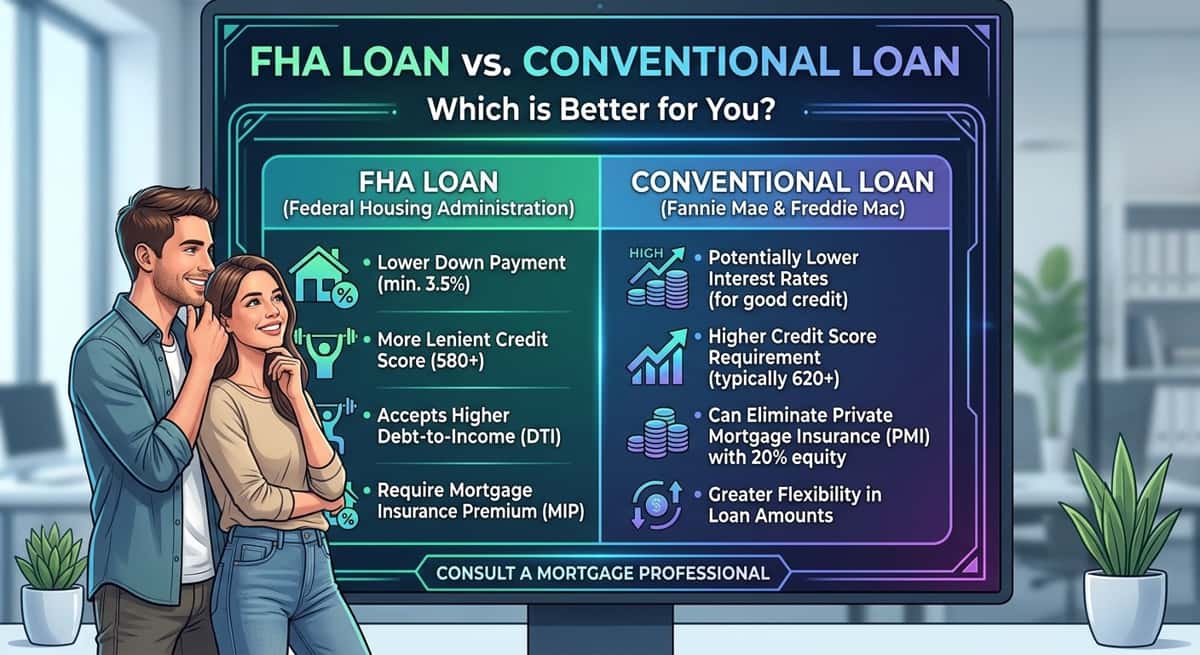
If you have a credit score above 720 and at least 20% equity in your home, a Conventional Refinance is usually your best path. These loans are not backed by the government, which often means they have the lowest fees for those with strong financial standing. The biggest advantage here is the removal of private mortgage insurance (PMI). If your home’s value has increased significantly since you bought it, moving into a conventional loan can instantly lower your monthly bill by eliminating that insurance requirement.
Government-Backed Options: Accessibility and Speed
For those who may not have a perfect credit score or who want a simpler process, government-backed loans are incredibly effective tools.
FHA Streamline Refinance: If you currently have an FHA loan, this "streamline" option is designed for speed. It often requires much less documentation and, in many cases, does not require a new appraisal. This is ideal if you want to lower your rate quickly without a mountain of paperwork.
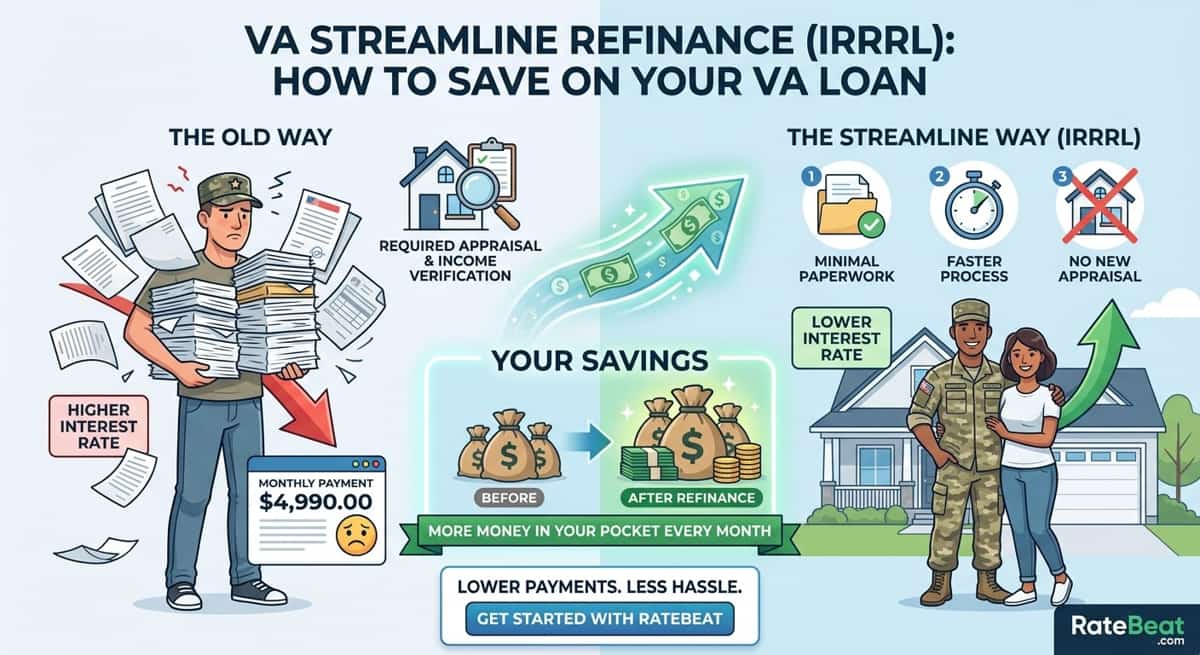
VA IRRRL (Interest Rate Reduction Refinance Loan): Reserved for veterans and active-duty service members with an existing VA loan, the "V-A Earl" is one of the most powerful financial tools available. It is famous for its "no-appraisal" and "no-income verification" features, making it a very low-cost way for military families to reduce their interest rates.
The Jumbo Refinance: For High-Value Properties
If your mortgage balance exceeds the standard limits set by the government (which have adjusted upward in 2026), you’ll likely need a Jumbo Loan. These refinances are for high-value properties and typically require more equity and a higher credit score. Because these loans represent a larger risk to lenders, the documentation process is more thorough, but the interest rates for Jumbo loans in 2026 have become very competitive compared to standard mortgages.
ARM to Fixed-Rate: Seeking Long-Term Security
Many homeowners who took out Adjustable-Rate Mortgages (ARMs) a few years ago are now looking to "lock in." While an ARM might have offered a lower initial rate, the 2026 market is an ideal time to convert to a Fixed-Rate Mortgage.
By switching to a fixed rate, you protect yourself from any future economic volatility. You gain the peace of mind of knowing that your principal and interest payment will never change for the next 15 or 30 years. If you plan on staying in your home for the long haul, this stability is often worth more than the small, temporary savings an adjustable rate might provide.
Conclusion: Your Path to Financial Freedom
The mortgage market of 2026 offers a unique window of stability for homeowners who are ready to take a proactive look at their finances. We have moved past the era of unpredictable rate spikes and entered a time where home equity can be used as a deliberate tool for building wealth, improving your quality of life, or simply finding more room in your monthly budget.
However, the most important takeaway is that numbers on a screen only tell part of the story. While general trends are helpful, your home is likely your largest financial asset, and every household’s situation is different. What works for a neighbor might not be the right move for your specific retirement goals or family plans.
This is why I highly recommend a "Mortgage Check-up." Just as you would visit a doctor for an annual physical, a quick review of your current loan terms against today’s options can reveal hidden savings or better ways to manage your debt. Whether you are looking to lower your payment, pay off your home faster, or tap into the value you’ve built, having a clear plan is the only way to ensure you aren't leaving money on the table.
Deciding to refinance is a major step toward long-term financial freedom. Don't leave your biggest investment to chance or outdated "rules of thumb." Take the time to get the facts that apply specifically to you.
Ready to see what your equity can do for you? Schedule a Consultation with a Home Equity Expert today to get a personalized look at your options.