
In the modern American housing market, the traditional "nuclear family" model is rapidly evolving. Recent data from the National Association of REALTORS (NAR) highlights that multi-generational home purchases have reached record highs, with nearly 17% to 20% of American households now consisting of two or more adult generations. This shift is not merely a social trend but a strategic response to the increasing cost of living and the economic volatility of 2025–2026.
Families are increasingly turning to shared equity models, where multiple income earners pool resources to qualify for larger mortgages that would be unattainable individually. For many, this arrangement is a primary vehicle for aging in place, allowing seniors to remain in a supportive family environment while receiving care from adult children. Conversely, "boomerang" adult children are returning home to combat high rents and save for their own future down payments. By consolidating household composition, families are effectively creating a private safety net—sharing everything from mortgage payments and property taxes to childcare and eldercare responsibilities. This new landscape is why lenders have developed specific, nuanced requirements for multi-generational financing.
Identifying the Property Type: Single-Family vs. Multi-Unit
When financing a home for multiple generations, the first hurdle is how the property is legally classified. This distinction—often hidden in local zoning laws—dictates which mortgage products you can access and how much you can borrow.
The Single-Family Home with an ADU
An Accessory Dwelling Unit (ADU), often called a "granny flat" or "mother-in-law suite," is legally part of a single-family residence. Under Fannie Mae and Freddie Mac guidelines, a property with an ADU is typically treated as a one-unit dwelling. This is a significant advantage for families because it allows you to utilize standard conforming loan products, which often carry lower interest rates and more flexible down payment options. To qualify as an ADU, the space must have its own kitchen, bathroom, and sleeping area, but it cannot be sold separately from the main house.
The 2-4 Unit Multi-Family Property
If the home has separate utility meters, unique postal addresses, or was originally built as a duplex or triplex, it is classified as a multi-unit property. Financing these requires a different approach. While you can still use a conforming loan, the down payment requirements and "loan limits" change. For instance, the maximum loan amount for a two-unit property is higher than for a single-family home to account for the increased property value.
Impact on Mortgage Choice: Conforming vs. FHA
Your property classification directly impacts your loan choice.
- Conforming Loans: Best for those with strong credit who want to avoid the lifelong mortgage insurance associated with FHA. They are highly "ADU-friendly."
- FHA Loans: Ideal for multi-unit (2-4 units) purchases because they allow a low 3.5% down payment even for a duplex, provided you occupy one of the units. FHA also allows you to count a portion of the projected rental income from the other units to help you qualify for the loan.
Mortgage Multi-Generational Home Requirements: An Overview
Navigating the financial requirements for a multi-generational mortgage in 2025 requires understanding how lenders evaluate collective risk. Unlike a standard single-applicant loan, these transactions often involve multiple income streams and complex residency statuses.
The Role of the "Occupying" vs. "Non-Occupying" Borrower
In a multi-generational setup, not every person on the loan has to live in the home.
- Occupying Borrowers: These are family members who will use the property as their primary residence. Their income and credit are central to the application.
- Non-Occupying Co-Borrowers: Often, parents or adult children with stronger financial profiles act as co-borrowers to help the household qualify, even if they live elsewhere. Under Fannie Mae and FHA guidelines, using a non-occupant co-borrower can significantly increase your purchasing power, though some programs may require a slightly higher down payment (typically around 25% LTV for FHA unless a family-type relationship is proven).
Key Financial Thresholds
Lenders focus on two primary metrics to ensure the "safety" of the loan:
- Credit Score Thresholds: While FHA loans may allow scores as low as 580 with a 3.5% down payment, Conventional lenders typically look for a minimum of 620. In a multi-generational application, lenders usually use the lower of the median scores among all borrowers to determine the interest rate.
- Debt-to-Income Ratio (DTI): Your DTI is the percentage of gross monthly income that goes toward debt payments. For 2025, most lenders prefer a back-end DTI of 43% or lower, though FHA and VA loans can sometimes stretch to 50% with compensating factors like high cash reserves.
Down Payment Requirements for Multi-Generational Homes
One of the most common questions I receive as a Mortgage Consultant is: "How much do we actually need to put down?" In a multi-generational purchase, your down payment strategy is often the "glue" that holds the deal together. For 2025, the landscape has shifted to offer more low-down-payment options, even for properties with multiple units or Accessory Dwelling Units (ADUs).
Conventional Loan Down Payments (3% to 20%)
Conventional loans are the gold standard for flexibility. If you are a first-time homebuyer or qualify under specific income-limited programs like HomeReady or HomePossible, you may be able to secure a multi-generational home with as little as 3% down.
- The 20% Benchmark: While 20% is not required, it remains popular for multi-generational families who have significant equity from a previous home sale. Putting 20% down eliminates Private Mortgage Insurance (PMI), immediately lowering the monthly collective burden for the household.
FHA Loans: A Low-Barrier Entry (3.5%)
FHA loans are a powerhouse for multi-generational living, especially if you are looking at a 2–4 unit property.
- The Advantage: You can buy a duplex or triplex with just 3.5% down, provided one of the family members on the loan occupies one of the units.
- Boarder Income: In some cases, FHA guidelines allow you to use a portion of the projected rental income from the additional units to help the family qualify for a higher loan amount.
VA Loans for Multi-Generational Veterans (0% Down)
For our Veterans and active-duty service members, the VA Home Loan is the most powerful tool available.
- Zero Down: You can purchase a primary residence—including a multi-unit property (up to 4 units)—with $0 down payment.
- Joint Loans: If a Veteran is buying with a non-Veteran family member (other than a spouse), the VA "Guaranty" only covers the Veteran's portion, which may result in a small down payment requirement (typically 12.5% of the non-Veteran's portion).
Using Gift Funds and "Equity Gift" Rules
Multi-generational moves often involve a "Gift of Equity" or a cash gift from a parent to a child (or vice versa).
- Gift of Equity: This occurs when a family member sells you their home at a price below market value. The "missing" value acts as your down payment.
- The Paper Trail: Lenders are legally required to follow Anti-Money Laundering (AML) protocols. Every cent of a gift must be documented with a Gift Letter signed by the donor, stating that no repayment is expected. Lenders will also require bank statements from the donor to prove the funds were "seasoned" (held for at least 60 days) and sourced legally.
Expert Tip: Never move large sums of gift money between family accounts right before applying. Wait until your Mortgage Advisor gives you the "green light." Lenders track the source of every dollar to ensure transparency and compliance with federal banking regulations.
Understanding Deed Requirements and Ownership Structures
Deciding how to hold the title is just as critical as securing the loan. In a multi-generational household, the deed determines who legally owns the property, how interest is transferred upon death, and how much protection each family member has. As your Mortgage Advisor, I ensure the deed aligns with your loan terms, but the legal structure you choose has lifelong implications.
Joint Tenancy with Right of Survivorship (JTWROS)
This is a popular choice for families who want a seamless transition of ownership. Under Joint Tenancy, all parties own an equal share of the home. The defining feature is the Right of Survivorship: if one owner passes away, their share automatically transfers to the surviving owners without going through probate. This is common when parents and adult children buy together to ensure the home remains in the family without legal delays.
Tenants in Common (TIC)
Tenants in Common offers more flexibility regarding ownership percentages. For example, a parent might own 70% of the home while the adult child owns 30%. Unlike Joint Tenancy, there is no automatic right of survivorship. Each owner can bequeath their share to whoever they choose in their will. This structure is often preferred if one party is providing the bulk of the down payment and wants their specific investment protected for other heirs.
Adding Parents or Children to the Title: Legal and Tax Implications
Adding a family member to a deed—whether at the time of purchase or later via a quitclaim deed—is a significant financial move.
Gift Tax Issues: If you add a child to a deed for a home you already own, the IRS may view this as a taxable gift if the value exceeds annual exclusion limits.
Step-up in Basis: If children are added to a deed while the parents are living, they may lose out on a "step-up in basis" upon the parents' death, potentially resulting in higher capital gains taxes when the home is eventually sold.
- Liability: If one person on the deed faces a legal judgment or bankruptcy, the property could potentially be attached to that debt, risking the entire family's housing security.
Refinancing for Multi-Generational Upgrades
Many families already own a home but need to adapt the space to accommodate aging parents or returning adult children. If your current property has sufficient appraisal value, you can perform an equity tap to fund the construction of separate living quarters. This is often more cost-effective than moving to a new property in a high-interest-rate environment.
Cash-Out Refinance for ADU Construction
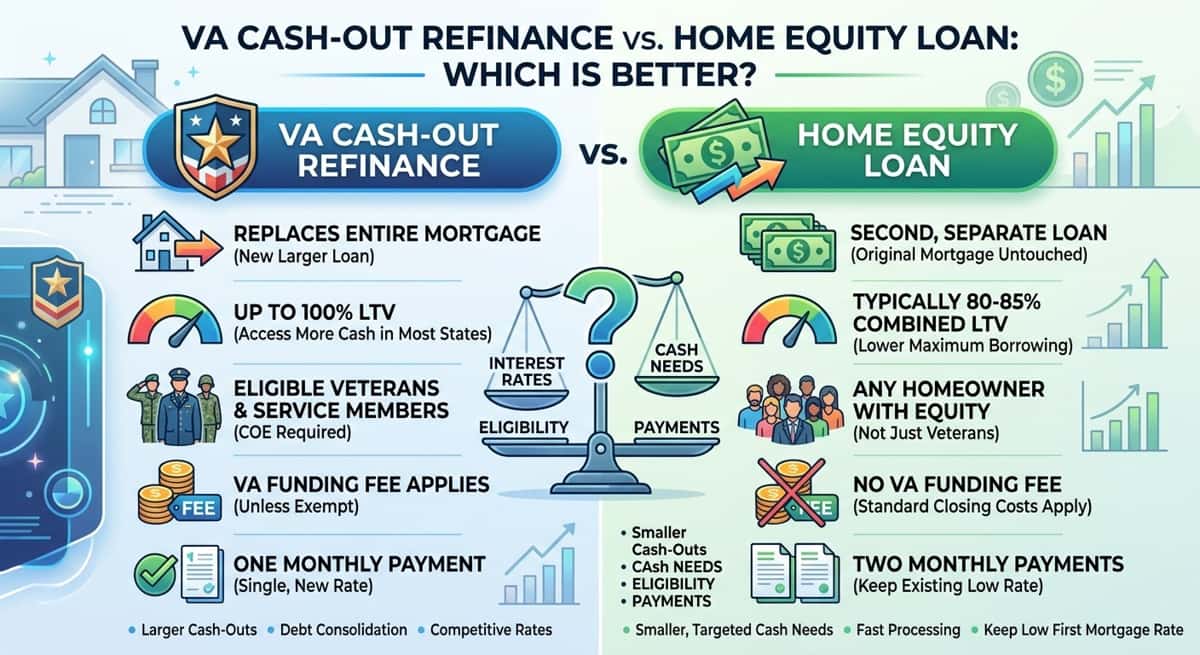
A Cash-Out Refinance replaces your existing mortgage with a new, larger loan, allowing you to take the difference in cash. This is a primary tool for funding the construction of a detached Accessory Dwelling Unit (ADU).
- The LTV Factor: Lenders typically allow you to borrow up to an 80% Loan-to-Value (LTV) ratio. For example, if your home is appraised at $500,000 and you owe $200,000, your maximum total loan would be $400,000, giving you $200,000 in cash for construction.
- Future Value Appraisals: Some specialized renovation loans, such as the Fannie Mae HomeStyle or FHA 203(k), allow you to borrow based on the as-completed value of the home, which factors in the added value the ADU will bring.
Using Home Equity Lines of Credit (HELOC) for In-Law Suites
If you have a low interest rate on your primary mortgage that you don't want to lose, a Home Equity Line of Credit (HELOC) is often the superior choice for building an in-law suite.
- Flexibility: A HELOC works like a credit card secured by your home. You only pay interest on the money you draw. This is ideal for multi-phase renovations where costs are spread out over several months.
- Interest-Only Options: Many HELOCs offer interest-only payment periods during the "draw phase," which can keep monthly costs manageable while the family is in transition.
Strategic Equity Planning
When refinancing for multi-generational upgrades, it is vital to consider how the new debt affects the collective Debt-to-Income (DTI) ratio. If multiple family members are contributing to the household, we can often add them to the refinance application to strengthen the file and secure a more competitive rate. This ensures the "renovation burden" is shared across the household’s total income rather than falling on a single borrower.
The Role of the Mortgage Advisor in Complex Transactions
Navigating a multi-generational mortgage is significantly more complex than a standard home loan. When you have three or four borrowers on a single application—each with different credit profiles, debt loads, and income types—the "automated" underwriting systems used by big-box lenders often struggle. This is where the expertise of a specialized Mortgage Advisor becomes indispensable.
In my experience, the primary challenge in these "mixed-income" applications is balancing the aggregate debt-to-income ratio. For instance, one family member may have high income but significant student loan debt, while another may have a modest retirement pension but a perfect credit score. I work to "stack" these profiles strategically. I analyze how each borrower’s financial background affects the whole, identifying which loan program—be it Conventional, FHA, or VA—will offer the highest approval probability based on the group's collective strengths.
Furthermore, a Mortgage Advisor acts as a project manager between the lenders, title companies, and your family. I ensure that every borrower understands their liability and that the "source of funds" for the down payment is meticulously documented to meet federal compliance standards. We don't just look at getting you "cleared to close"; we look at how this mortgage fits into your family’s long-term financial health, ensuring the structure of the debt supports everyone involved for years to come.
Checklist: Documents You’ll Need for a Multi-Generational Application
When applying for a mortgage with multiple family members, the paperwork can feel overwhelming. Lenders require a complete financial picture for every individual appearing on the loan application. To ensure a smooth underwriting process and avoid last-minute delays, start gathering these documents for all borrowers involved:
Proof of Income & Employment
- Pay Stubs: The most recent 30 days of consecutive pay stubs.
- W-2 Forms: Two years of federal W-2 statements.
- Tax Returns: Two years of personal (and business, if self-employed) federal tax returns, including all schedules.
- Secondary Income: Proof of Social Security, pension, or disability income (Award Letters).
Asset Verification
- Bank Statements: Two months of most recent, full statements for all checking, savings, and investment accounts.
- Gift Letters: If a family member is providing funds for the down payment, a signed gift letter and proof of the transfer of funds.
Identity & Legal Status
- Identification: Government-issued ID (Driver’s License or Passport).
- Credit Explanations: Letter of explanation for any recent credit inquiries or derogatory marks.
- Property Documents: If any borrower currently owns other real estate, provide the most recent mortgage statement, insurance, and tax bill for those properties.
Conclusion: Securing Your Family’s Financial Future
Financing a multi-generational home is about more than just square footage; it is a strategic investment in your family’s collective stability and long-term wealth. By navigating the specific mortgage multi-generational home requirements—from choosing between Conventional and FHA products to establishing a clear deed structure—you are creating a resilient financial foundation. Whether you are pooling resources to afford a larger property, building an ADU for aging parents, or refinancing to adapt your current space, the right mortgage structure ensures that every generation is protected.
The road to a "full house" is paved with complex paperwork and legal nuances, but you don’t have to walk it alone. As an expert Mortgage Consultant, I specialize in the "mixed-income" applications and unique property types that define the modern American home.
Ready to explore your options? [Schedule a Free Multi-Generational Financing Consultation today] to discuss your family’s specific needs and get a custom roadmap for your purchase or refinance.