As we move through the first quarter of 2026, the American housing market is finally breathing a sigh of relief. After years of aggressive Federal Reserve hikes and a "lock-in effect" that kept inventory at record lows, we are seeing a significant shift. In early 2026, a major $200 billion government-backed intervention in the mortgage bond market successfully pushed the average 30-year fixed rate below the 6% threshold for the first time in over three years. Currently, rates are hovering around 5.8% to 6.0%, a welcome departure from the nearly 8% peaks we saw in late 2023.
From my perspective as a mortgage consultant helping families navigate this new volatility, the central question for 2026 is no longer just "When will rates drop?" but "Which loan structure protects my equity best?" The Federal Reserve has paused its rate-cutting cycle for now, leaving us in a "wait-and-see" environment where inflation is cooling but still present.
The old "rule of thumb" that Fixed-Rate Mortgages are for everyone and Adjustable-Rate Mortgages (ARMs) are only for "risky" borrowers no longer holds up. In 2026, the spread between these options has narrowed, but the strategic advantages of each have widened. Whether you are looking to refinance a high-interest loan from 2024 or pull equity for home improvements, understanding the battle between long-term stability and short-term savings is the key to mastering your financial future this year.
Understanding the Basics: Definitions for the Modern Borrower
Before choosing a path, you need to understand the two primary engines that drive American mortgages in 2026.
Fixed-Rate Mortgage (FRM)
The Fixed-Rate Mortgage is the gold standard for predictability. Whether you choose a 15-year or 30-year term, your interest rate is locked in on day one and never changes. This "set-it-and-forget-it" model protects you from future inflation. If market rates climb to 8% or 9% in three years, your payment remains exactly what it was the day you signed your papers.
Adjustable-Rate Mortgage (ARM)
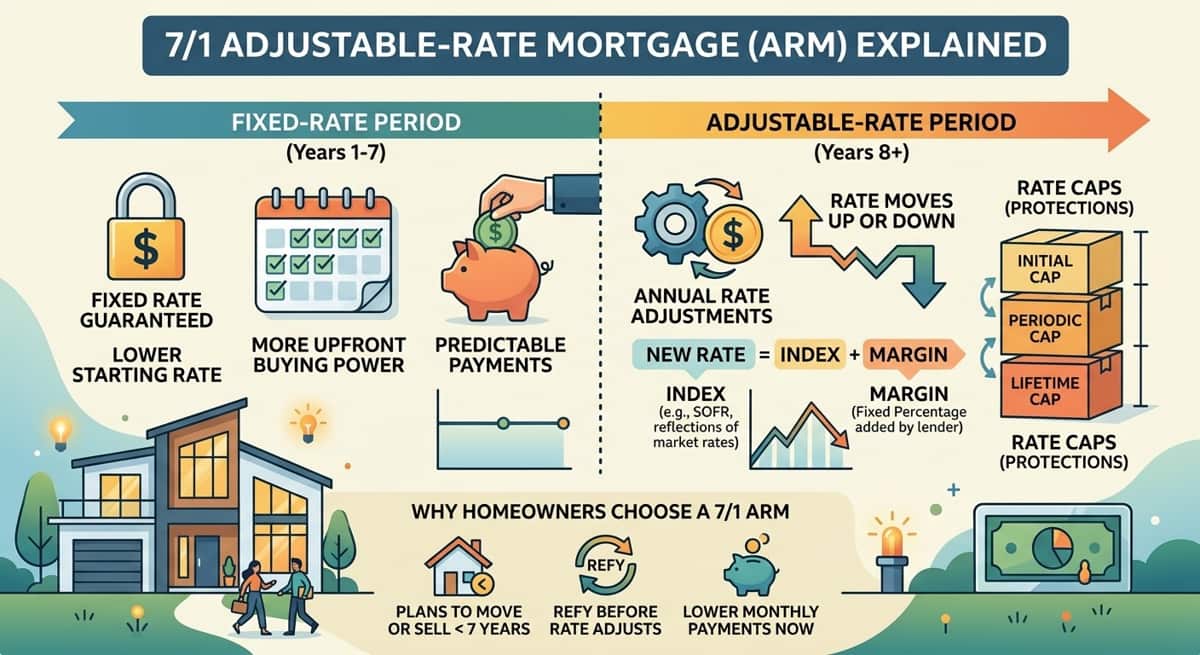
An Adjustable-Rate Mortgage offers a lower interest rate for an initial "teaser" period—typically 5, 7, or 10 years. In 2026, most ARMs follow a "6-month" adjustment cycle after that period ends. For example, a 7/6 ARM stays at a low fixed rate for seven years, then adjusts every six months based on the SOFR (Secured Overnight Financing Rate).
To understand how your ARM changes, keep three terms in mind:
Index: The fluctuating market rate (like SOFR).
Margin: A set percentage the lender adds to the index (your "markup").
Caps: Legal limits on how much your rate can rise in a single period or over the life of the loan.
The Case for Fixed-Rate Mortgages: Stability in 2026
In a 2026 economy where global markets can shift overnight, the Fixed-Rate Mortgage (FRM) remains the bedrock of American financial security. While it may not offer the lowest possible starting rate on the market, its value lies in its absolute certainty. For many homeowners, the peace of mind that comes with a "locked-in" payment is worth more than a few fractional percentage points of savings.
When a Fixed Rate is Your Best Move
Choosing a fixed-rate mortgage is a strategic decision centered on your long-term life goals. I generally recommend this path for homeowners who fall into three specific categories:
The "Forever Home" Strategy: If you plan to stay in your current residence for 10 years or more, the fixed-rate mortgage is almost always the superior choice. Over a decade, market cycles will inevitably fluctuate. By locking in a rate now especially while rates are under 6% you insulate your household budget from future inflation or economic shocks.
Risk Aversion: If the idea of a fluctuating monthly bill causes you stress, the fixed rate is your safety net. Financial planning is significantly easier when you know exactly what your housing costs will be in 2030, 2035, and beyond. It allows you to build other investment portfolios without worrying about a sudden spike in your primary debt.
Debt Consolidation Refinancing: Many homeowners in 2026 are using their home equity to pay off high-interest credit card debt or personal loans. When you are consolidating debt, the goal is usually to simplify and stabilize your finances. Swapping variable high-interest debt for a stable, low-interest fixed mortgage creates a predictable path to becoming debt-free.
The Psychological Advantage: The "Payment Floor"
There is a profound psychological benefit to having a "payment floor." In an uncertain economy, your mortgage is likely your largest monthly expense. When that expense is fixed, you gain a sense of control. As wages typically rise over time due to inflation, a fixed mortgage payment actually becomes "cheaper" in real-world dollars as the years go by.
Essentially, you are betting against the bank that rates will eventually go up—and even if they don't, you’ve purchased "insurance" against them ever rising for you. For families prioritizing long-term wealth building and domestic stability, the fixed-rate mortgage is the ultimate tool for financial calm.
The Resurgence of the ARM: Strategy over Risk
In 2026, the Adjustable-Rate Mortgage (ARM) shed its "risky" reputation to become a sophisticated tool for strategic homeowners. While many associate these loans with the housing crisis of decades past, today’s ARMs are built with significant consumer protections. In a market where the Yield Curve the relationship between short-term and long-term interest rates—has shifted, an ARM can often provide a much-needed financial breathing room.
The Strategic Refinance: Bridging the Gap
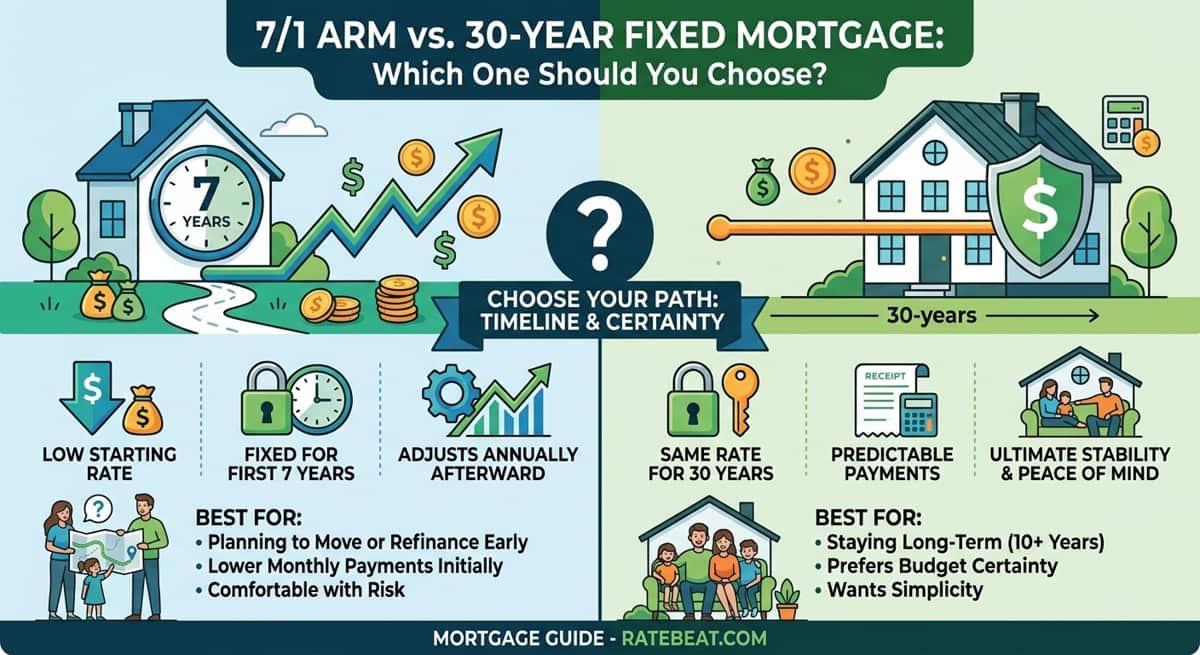
Many homeowners who purchased at the height of interest rates in 2024 are now looking to lower their monthly overhead. By choosing a 7/6 ARM, you secure an Initial Teaser Rate that is typically 0.50% to 1.0% lower than a 30-year fixed mortgage.
The strategy here is simple: Use the lower rate now to save hundreds of dollars a month, with the full intention of selling the home or refinancing again before the first Rate Reset occurs in seven years. For a family that knows they will outgrow their starter home within five years, paying a premium for a 30-year fixed rate is essentially paying for "protection" they will never use.
Tapping into Home Equity for High-ROI Projects
For those looking to access cash, an ARM is an excellent vehicle for a Cash-Out Refinance. If you are pulling $100,000 in equity to add a modern kitchen or an ADU (Accessory Dwelling Unit) project with a high Return on Investment (ROI) using an ARM minimizes your borrowing costs during the construction and appreciation phase. You aren't just borrowing money; you are leveraging a lower interest rate to increase your home's value faster than the debt grows.
The Math: Finding Your Break-Even Point
To decide if an ARM is right for you, you must calculate the break-even point. This is the moment when the total savings from the lower ARM rate are surpassed by the potential costs of a rate increase after the fixed period ends.
Example Case Study:
30-Year Fixed: 6.0% ($2,398 Monthly P&I)
5-Year ARM: 5.125% ($2,177 Monthly P&I)
Monthly Savings: $221
Total Savings over 5 years: $13,260
If you sell your home at the 5-year mark, you have "won" by over $13,000. Even if you stay and the rate adjusts upward later, that $13,000 head start provides a massive cushion. In 2026, the ARM isn't a gamble; it's a calculated math problem that favors the short-to-mid-term resident.
ARM vs. Fixed-Rate: A Side-by-Side 2026 Comparison
Choosing between these two paths often comes down to a simple question: How much do you value current savings versus future certainty? In the March 2026 market, the gap between these products has created a clear distinction for different types of borrowers.
2026 Comparison at a Glance
Below is a breakdown of how a typical $400,000 loan compares across both products using current 2026 national averages.
Feature | 30-Year Fixed-Rate | 7/6 Adjustable-Rate (ARM) |
Typical 2026 Rate | 6.04% | 5.50% |
Monthly Payment (P&I) | $2,408 | $2,271 |
Payment Flexibility | Rigid; stays the same for 30 years. | Lower for first 7 years; adjusts later. |
Interest Paid (First 7 Years) | $160,540 | $144,950 |
Total 7-Year Savings | $0 (Baseline) | $15,590 |
Which "Bucket" Do You Fall Into?
To help you decide, look at your primary motivation for seeking a mortgage advisor today:
The Stability Seeker (Fixed-Rate): You fall into this bucket if you are refinancing to "lock in" your housing costs for the long haul. If the thought of a rate adjustment in 2033 keeps you up at night, the extra $137 per month for a fixed rate is essentially a small insurance premium for total peace of mind.
The Strategic Mover (ARM): You fall into this bucket if you plan to sell your home or refinance again within the next 5 to 7 years. By choosing the ARM, you keep over $15,000 in your pocket during that time. For families using a mortgage to bridge the gap until a planned relocation or a significant income increase, the ARM is the more efficient financial tool.
Risk Mitigation: Understanding ARM Caps and Floors
One of the most common concerns I hear as a mortgage consultant is: "How high can my payment actually go?" While the word "adjustable" can feel unpredictable, modern ARMs are governed by strict rules designed to protect you from extreme market swings. In 2026, these consumer protections act as a safety net, ensuring your mortgage remains manageable even if global interest rates spike.
The Three Safety Valves of an ARM
To understand your protection, you need to look at the Adjustment Frequency and the Cap Structure of your specific loan. Most 7/6 ARMs today use a "5/2/5" cap structure. Here is exactly what those numbers mean for your bank account:
Initial Cap (The First Reset): This is the maximum your rate can increase the very first time it adjusts. If your initial rate is 5.5% and you have a 5% initial cap, your rate cannot exceed 10.5% in year eight, regardless of how high market rates have climbed.
Periodic Cap (Ongoing Adjustments): This limits how much the rate can move during each subsequent adjustment period (usually every six months). A 2% periodic cap means your rate can only move up or down by 2% at a time.
Lifetime Cap (The Ultimate Ceiling): This is the most important number. It is the absolute maximum interest rate you will ever pay over the life of the loan. Typically, this is 5% or 6% above your starting rate. If you start at 5.5%, your rate will never exceed 11.5%.
Expert Advice: The "Worst-Case" Stress Test
In my professional practice, I always advise clients to perform a "Worst-Case Scenario" stress test. Before signing, we calculate exactly what your monthly payment would be if the loan hit its Lifetime Cap tomorrow.
Could your household budget handle that maximum payment? If the answer is "yes," then the ARM is a statistically sound way to save money in the short term. If the answer is "no," and you plan to stay in the home for more than seven years, the stability of a fixed-rate mortgage is the more responsible choice for your financial health. Transparency about these limits is how we ensure your home remains an asset, not a liability.
Refinancing in 2026: Which Option Wins?
In the current 2026 market, refinancing has become a tactical move rather than just a way to "lower a rate." Many homeowners who were forced to accept rates near 7% or 8% in 2024 and 2025 are now sitting on a golden opportunity. The question for 2026 is: do you take the safe bet of a new 30-year fixed rate, or do you leverage a 7/6 ARM to maximize your cash flow?
The "Swap" Strategy: High Fixed to 2026 ARM
If your current mortgage rate starts with a "7," moving into a 2026 ARM could be the single most effective way to lower your overhead. For example, swapping an 8% fixed rate for a 5.5% initial rate on a 7/6 ARM could save the average homeowner over $500 per month on a $400,000 loan.
This strategy is particularly effective because 2026 trends suggest that the Federal Reserve may deliver further rate cuts. By taking an ARM now, you capture immediate savings. If rates continue to fall in 2027 or 2028, you can refinance again into an even lower fixed rate later, having used the ARM as a high-savings "bridge."
Accessing Home Equity: Refi vs. HELOC
If you are looking to tap into your home's equity for a major project, you have two main paths:
Cash-Out Refinance (Fixed or ARM): This replaces your entire mortgage. It’s best if your current mortgage rate is higher than today's market rates. You get a lump sum and one single monthly payment.
HELOC (Home Equity Line of Credit): This is a "second mortgage." It’s best if you already have a very low rate (like the 3% rates from 2021) that you don't want to lose. HELOCs act like a credit card tied to your home, where you only pay for what you use.
A Note on Tax Benefits
In 2026, mortgage interest remains one of the few significant tax deductions available to homeowners, but there are rules to follow. Currently, you can generally deduct interest on the first $750,000 of mortgage debt. However, for that interest to be deductible on a home equity loan or HELOC, the funds must be used to "buy, build, or substantially improve" the home that secures the loan.
If you use the equity to pay off credit cards or buy a car, that portion of the interest is typically not deductible. Because tax laws can change and individual situations vary, I always recommend a quick call to a tax professional to ensure you are maximizing your return.
The "Expert’s Framework": 5 Questions to Ask Before You Decide
Deciding between an ARM and a fixed-rate mortgage in 2026 isn't just about finding the lowest number on a screen; it’s about matching a loan's behavior to your life’s timeline. To find the right fit, run your situation through this five-question framework.
1. How long do you plan to stay in the home?
If your answer is five years or less, the 30-year fixed mortgage is likely costing you money unnecessarily. A 7/6 ARM provides a lower rate for seven years—longer than you actually need allowing you to pocket the savings before you ever hit a rate adjustment.
2. Is your income expected to rise?
If you are early in a high-growth career (such as a medical residency or tech professional), an ARM can be a powerful tool. You benefit from a lower payment now, and if the rate resets higher in the future, your increased earning power can easily absorb the change.
3. What is your "Risk Tolerance Score"?
Be honest with yourself: Will a potential $200 increase in your monthly payment seven years from now cause you sleepless nights? If you value certainty above all else, the fixed-rate mortgage is the right choice, regardless of the potential savings an ARM offers.
4. Are you planning to sell or refinance before the reset?
Most homeowners don't keep their original 30-year loan for the full three decades. If you view your home as a "stepping stone" or if you believe market rates will drop further in 2027, the ARM serves as a strategic bridge.
5. What is the current spread between Fixed and ARM rates?
The "spread" is the difference between the two rates. In 2026, if the spread is 0.75% or higher, the ARM is very attractive. If the spread narrows to 0.25%, the "insurance" of a fixed-rate mortgage becomes much more affordable and is usually the better deal.
Conclusion: Your Path to Home Equity Mastery
In the 2026 housing market, the choice between an ARM and a fixed-rate mortgage is a strategic business decision for your household. There is no single "best" loan only the one that aligns with your specific timeline and risk comfort.
A Fixed-Rate Mortgage is your shield against future economic shifts, perfect for long-term stability and "forever homes." Conversely, an Adjustable-Rate Mortgage is a high-performance tool for those seeking maximum cash flow, lower initial payments, or a smart bridge until a planned move or refinance.
The right path depends on your equity goals and your 5-to-10-year plan. Don't leave your largest financial asset to guesswork. To see exactly how these numbers look for your specific property and credit profile, contact us today for a Personalized Mortgage Health Audit. We will run the math together to ensure your mortgage works for you, not the other way around.