
For many South Asian families in the United States, owning real estate is more than just having a roof over your head; it is a cornerstone of family legacy and financial security. If you are a Veteran or an active-duty service member, you hold a powerful tool that can jumpstart this journey: the VA loan.
A common question many ask is: Can I buy an investment property with a VA loan? The short answer is yes, but with specific rules. While the Department of Veterans Affairs (VA) designs these loans for primary residences, you can strategically use them to build an investment portfolio through "house hacking" or by converting a home into a rental later.
In our community, we often prioritize multi-generational stability and smart asset growth. The VA loan aligns perfectly with these values. Because it typically requires no down payment and offers lower interest rates than conventional loans, it allows you to keep your capital for other family needs while still acquiring a high-value asset.
As a financial management expert working within the veteran community, I have seen how shifting your perspective from "buying a house" to "acquiring an asset" can change your family's financial trajectory. By understanding the guidelines set by the VA, you can honor your service and secure your future. Whether you are looking to house your parents in a multi-unit property or move into a larger home while keeping your first one as a rental, the VA loan provides a unique path to wealth that is unavailable to the general public.
The "Primary Residence" Rule: The Golden Gatekeeper
To understand how to build wealth with a VA loan, you first have to understand its most important rule: the primary residence requirement. Unlike a traditional investment loan you might get from a bank to buy a rental property, a VA loan is specifically intended to help you buy a home that you actually live in.
The 60-Day Rule and Intent to Occupy
When you close on a home using a VA loan, the Department of Veterans Affairs requires you to have a clear intent to occupy the property. In simple terms, this means you must plan to move in and make it your main home.
The standard guideline is the 60-day rule. Generally, you are expected to move into the house within 60 days of the closing date. While there are some exceptions such as if you are currently deployed or the home needs major repairs before it is livable the goal is to prove that the home is for your personal use, not just a business venture.
Residential vs. Commercial Assets
It is important to know that you cannot use a VA loan for "pure" investments. This includes:
Vacant Land: You cannot buy a random plot of land just to hold onto it. You can only buy land with a VA loan if you are building a home on it immediately.
Commercial Property: You cannot buy an office building, a retail shop, or a large apartment complex (more than four units).
The VA benefit is strictly for residential housing. However, "residential" can include properties with up to four separate living units, which is where the investment opportunity truly begins.
The South Asian Perspective: Multi-Generational Wealth
In many South Asian households, "home" often includes more than just the immediate family. We frequently look for ways to keep our parents or extended family close while also being smart about our finances.
The primary residence rule actually supports this lifestyle. You can use a VA loan to buy a large home or a multi-unit property where your parents live in one section while you live in another. Because you are occupying the property, you fulfill the VA’s requirements. At the same time, if the property has extra units (like a basement apartment or a duplex), you can rent those out to other tenants. This allows you to care for your family and generate rental income simultaneously turning the "Golden Rule" of occupancy into a powerful engine for family wealth.
Strategy 1: House Hacking with a Multi-Unit Property (2-4 Units)
If you are looking for the fastest way to build wealth through real estate, "house hacking" is a strategy you should consider. This involves buying a property that has multiple living spaces, living in one, and renting out the others. This is one of the few ways you can use a VA loan to acquire an income-producing asset right from day one.
How many units can I buy with a VA loan?
The VA allows you to purchase a residential property with up to four separate units (a duplex, triplex, or fourplex). As long as you intend to live in one of those units as your primary residence, the entire building qualifies for the VA’s $0-down payment benefit. This is a massive advantage, as most investors have to put down 20% or 25% for these types of properties.
Qualifying with Rental Income
One of the most powerful features of the VA loan is that you can often use the projected rental income from the units you aren't living in to help you qualify for the loan. If the mortgage payment for a fourplex seems too high for your current salary, the lender can look at what those other three units will earn in rent.
Usually, lenders will take about 75% of the expected rent and add it to your monthly income. This helps lower your Debt-to-Income (DTI) ratio, making it easier to get approved for a more expensive property. Within South Asian families, where we often have high financial goals but may be early in our careers, this "income boost" can be the difference between buying a single-family home and a multi-unit wealth generator.
Managing a Multi-Unit Property
Becoming a "landlord" while living on-site requires a shift in mindset. When you live in a duplex or fourplex, your tenants are also your neighbors. This can be a great benefit for South Asian owners who prefer to keep a close eye on their investments and ensure the property is well-maintained.
However, it also means you are responsible for repairs and tenant relations. It is wise to set aside a portion of your rental income every month for a "maintenance fund." Since your neighbors' rent could potentially cover your entire mortgage payment, you can use the money you would have spent on housing to pay down other debts or save for your next investment. This strategy allows you to live for free or very cheaply while the property grows in value and you build equity in a significant piece of real estate.
Strategy 2: The "Move Out" Strategy (Converting to a Rental)
Not every veteran starts their investment journey with a multi-unit building. In fact, many begin by simply buying a single-family home to live in. The "Move Out" strategy is a perfectly legal way to turn that initial home into a long-term rental property, allowing you to build a real estate portfolio one house at a time.
The 12-Month Rule and Legitimate Move-Outs
When you buy a home with a VA loan, the expectation is that you will live there. However, life and military service often change. The VA generally considers one year (12 months) of occupancy as sufficient evidence that you fulfilled your intent to live in the home as your primary residence.
After this period, if your family outgrows the space, or if you receive a Permanent Change of Station (PCS) order, you can move out and rent the property to someone else. At this point, the home officially becomes an investment property. You do not have to refinance it into a different type of loan or pay off the balance; you can keep that low VA interest rate while a tenant pays down your mortgage.
Using "Bonus Entitlement" to Buy Again
A common misconception is that you can only have one VA loan at a time. This is not true. Through something called secondary entitlement (often called bonus entitlement), you may be able to buy a second home with a VA loan while still keeping your first home as a rental.
If you have enough entitlement left, you could buy your next primary residence with a low or even zero down payment. This allows you to "leapfrog" from one property to the next, building a collection of rentals over several years. For South Asian families looking to create wealth for the next generation, this is a sustainable way to acquire high-quality suburban homes that tend to appreciate well over time.
A Serious Warning: Avoiding Occupancy Fraud
While the "Move Out" strategy is a powerful tool, it must be done honestly. Occupancy fraud occurs when someone applies for a VA loan claiming they will live in the house, but they actually intend to rent it out immediately.
The legal risks of misrepresenting your intent are severe. It can lead to federal charges, heavy fines, and the loss of your VA loan benefits. To stay safe, always ensure that your primary motive when buying is to live in the home. If your circumstances change later such as a job relocation or a growing family the law allows you to pivot. By following the rules, you protect your military record and your financial future, ensuring that your path to wealth remains on solid legal ground
Understanding VA Loan Entitlement for Multiple Properties
One of the most valuable secrets of the VA loan is its flexibility. A common question veterans ask is: "Can I have two VA loans at once?" The answer is a clear yes. You can own more than one home using your VA benefits at the same time, which is a major advantage for building a real estate portfolio. This is possible through a concept called "entitlement."
Primary vs. Secondary Entitlement
Think of your VA entitlement as a specific amount of insurance the government provides to your lender. If you have never used a VA loan before, or if you have paid off a previous one and sold the house, you have full entitlement. This means there is no "hard cap" on how much you can borrow with $0 down, provided you qualify for the monthly payments.
If you already have a VA loan and decide to keep that house as a rental while buying a new primary home, you tap into your secondary entitlement (also known as bonus entitlement). This is an additional pool of "insurance" that kicks in for homes priced over $144,000.
The "Tier 2" Calculation
When you have one VA loan active and want a second, your lender uses a "Tier 2" calculation to see how much more you can borrow without a down payment. Here is the simple way they look at it:
Find the Limit: They take the 2026 conforming loan limit for your county (for most of the U.S., the baseline is $832,750) and multiply it by 25%.
Subtract Current Use: They subtract the entitlement amount already tied up in your first home (usually 25% of that original loan).
The Remainder: The leftover amount is what the VA will guarantee for your new house.
If your remaining entitlement covers at least 25% of the new home's price, you can still buy with $0 down. If it doesn't quite cover that 25% mark, you might have to make a small down payment to bridge the gap.
County Loan Limits and Zero-Down Thresholds
While the national baseline for a single-family home is $832,750 in 2026, many South Asian families live in higher-cost areas like New Jersey, California, or New York. In these "high-cost" counties, the limit can jump to $1,249,125.
If you are buying a multi-unit property (like a duplex or fourplex) to live on one side and rent the other, the limits are even higher. For a four-unit building, the baseline limit is $1,601,750.
Understanding these numbers is vital because they represent your "zero-down payment threshold." As long as you have your entitlement available, you can secure these large, income-producing assets without draining your family's cash savings. This allows you to keep your liquid capital available for other investments or family needs while the VA benefit does the heavy lifting for your mortgage.
VA Refinancing: IRRRL and Cash-Out for Investors
Once you have acquired a property with a VA loan, your financial journey doesn't stop at the closing table. As an investor, your goal is to maximize your monthly cash flow and build equity. The VA offers two powerful refinancing tools that can help you do exactly that: the IRRRL and the Cash-Out Refinance.
The IRRRL: A Shortcut for Better Cash Flow
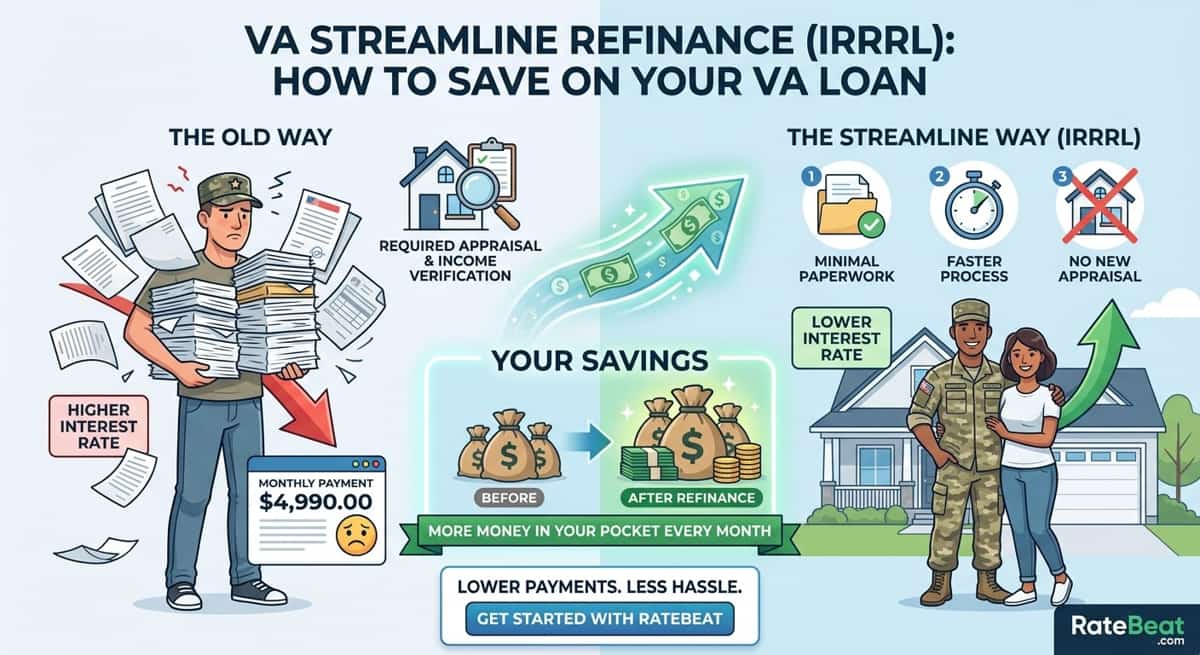
The Interest Rate Reduction Refinance Loan (IRRRL), often called a "VA Streamline," is one of the most investor-friendly tools in the mortgage world. Its primary purpose is to lower your interest rate or move you from an adjustable rate to a fixed rate.
What makes this a "secret weapon" for investors is its unique rule regarding occupancy. While almost every other VA product requires you to live in the home, the IRRRL is the only exception. You only need to certify that you used to live there as your primary residence. This means if you have already moved out of your first home and turned it into a rental, you can still use an IRRRL to lower your interest rate. By reducing your monthly mortgage payment, you immediately increase the profit (cash flow) you earn from your tenants.
Net Tangible Benefit
To protect you, the VA requires that any refinance provides a Net Tangible Benefit. This means the new loan must actually improve your financial position. Usually, this is proven by showing that your new monthly payment (including the costs of the loan) is lower than your old one, or that you are switching to a much safer loan type.
Cash-Out Refinance: Accessing Capital
If your property has gained significant value as many homes in high-growth areas have you might consider a Cash-Out Refinance. This replaces your current mortgage with a new, larger one, and gives you the difference in cash.
For a South Asian investor, this cash can be life-changing. It could be used as a down payment for a second (non-VA) investment property, to fund a child’s education, or to renovate the existing home to increase its rental value. However, unlike the IRRRL, a Cash-Out Refinance does require you to live in the home at the time you apply.
The Cost of Growth: Fees and ROI
Every financial move has a cost. The VA charges a funding fee to keep the program running:
IRRRL: A very low 0.5% fee.
Cash-Out Refinance: 2.15% for first-time use or 3.3% for subsequent use.
When calculating your Return on Investment (ROI), you must factor these fees into your math. If an IRRRL costs you $2,000 in fees but saves you $200 a month, you will "break even" in just 10 months. As an expert, I always advise looking at the long-term horizon. If you plan to keep the property for 20 years, paying a small fee today to secure a lower rate for two decades is a winning strategy for family wealth.
Alternatives for Pure Investment Properties
While the VA loan is a powerful tool for building a portfolio, it isn't always the right fit. For example, if you want to buy a property that you have no intention of living in, or if you are looking to purchase a large apartment complex with more than four units, you will need to look at other financing options. In the 2026 market, three main alternatives stand out for South Asian investors.
Conventional Loans for Investors
A conventional loan is the most common path for buying a "pure" investment property. Unlike a VA loan, you do not have to live in the home. However, the requirements are stricter:
Down Payment: You will typically need to put down 15% to 25% of the home's price. For a single-unit rental, 15% is often the minimum, but for a multi-unit property (2-4 units), lenders usually require 25% down.
Credit and Reserves: You’ll generally need a credit score of at least 620, though scores above 720 get the best rates. Lenders also want to see that you have "reserves" enough cash in the bank to cover 6 months of mortgage payments just in case the property is vacant.
DSCR Loans: The Entrepreneur’s Choice
Many South Asian entrepreneurs and business owners have complex tax returns with many deductions. This can sometimes make it hard to prove "income" for a traditional loan. This is where the DSCR (Debt Service Coverage Ratio) loan shines.
How it works: Instead of looking at your personal tax returns or pay stubs, the lender looks at the property's income. If the expected rent is enough to cover the mortgage, taxes, and insurance (usually by a ratio of 1.2 or higher), you can qualify.
Benefit: It is ideal for self-employed individuals who want to scale their portfolio quickly without the paperwork of a traditional bank loan. Be prepared to put down 20% to 25% for this option.
FHA Multi-Unit Loans: The VA Alternative
If you have already used your VA entitlement and want to buy another multi-unit property to live in, the FHA loan is a strong backup.
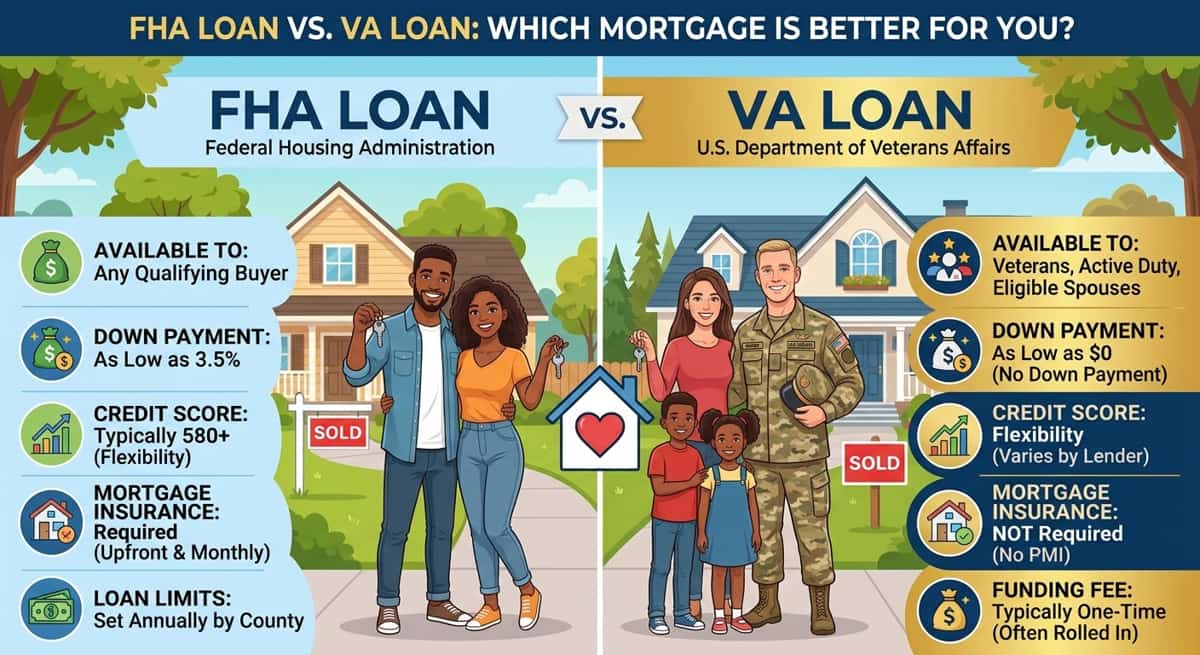
Low Down Payment: You can buy a 2, 3, or 4-unit property with only 3.5% down.
Comparison: While the VA loan is better (0% down and no monthly mortgage insurance), the FHA loan is much more accessible than a conventional investment loan. For a young professional or first-time buyer in our community who may not have a massive savings account yet, the FHA loan offers a way to "house hack" just like you would with a VA loan.
Choosing the right alternative depends on your goals. If you have the cash, a conventional loan offers lower fees. If you have a complex business income, DSCR is your best bet. And if you want to keep your down payment as low as possible for another multi-unit home, the FHA loan is the way to go.
Financial Management: Risks and Tax Implications for South Asians
Building a real estate portfolio using your VA benefits is a journey toward financial independence, but it requires careful management of both risks and taxes. For many in our community, this process is intertwined with cultural financial traditions and responsibilities.
Consulting with Experts (EEAT)
Because real estate laws and tax codes change frequently including significant updates in 2026 it is vital to work with a Certified Public Accountant (CPA) or a tax professional who understands real estate investment. Managing a rental property is no longer just a "home purchase"; it is a business. A professional can help you navigate state-specific property tax exemptions (which are often available to Veterans) and ensure you are maximizing your deductions correctly.
Balancing "Remittances" vs. "Mortgage Obligations"
A unique aspect of financial management for South Asian Americans is the balance between local financial growth and supporting family abroad through remittances.
The Conflict: High mortgage obligations in the U.S. can limit your ability to send money home during family emergencies or celebrations.
The Strategy: Using your VA loan to house hack or move out of your first home can create a new stream of passive income. By directing rental profits toward a dedicated "family support fund," you can fulfill your cultural duties without draining your personal savings or falling behind on your mortgage. This turns your U.S. investment into a tool that supports your global family.
Tax Advantages: Depreciation and Capital Gains
The U.S. tax code offers several "incentives" for property owners:
Depreciation: The IRS allows you to "write off" the value of your building over 27.5 years. This is a "paper loss" that can lower your taxable income, even if your property is actually making money every month.
Capital Gains: When you eventually sell a property that has increased in value, you will owe capital gains tax. However, if you lived in the home for at least two of the last five years, you might qualify for an exclusion (up to $250,000 for individuals or $500,000 for married couples) on that profit.
The 1031 Exchange: The Wealth Multiplier
If you decide to sell a rental property to buy a larger one, you can use a 1031 Exchange. This allows you to "swap" one investment property for another and defer paying capital gains taxes. Instead of giving 15-20% of your profit to the IRS, you reinvest 100% of that money into your next building. For a family focused on intergenerational wealth, this is the most effective way to scale from a single house to a multi-unit empire without losing momentum to taxes.
Conclusion: Building a Legacy
Building a real estate portfolio is not just about monthly profit; it is about creating a lasting legacy for your family. For South Asian Veterans, the VA loan provides a unique and powerful "pipeline" to achieve this. By starting with a multi-unit home or moving out of your first residence after a year, you can legally transform a government benefit into a wealth-generating engine.
This strategy allows you to acquire high-value assets with $0 down, keep your savings liquid for family needs, and build equity that can be passed down to the next generation. Whether you are housing parents in a duplex or collecting rent from a former home while living in a new one, the path from service member to successful investor is well-defined.
As we move through 2026, the real estate market continues to offer opportunities for those who understand their benefits. However, every financial situation is different, and the rules around entitlement can be technical.
Your next step is simple: Consult with a lender who specializes in VA loans. Ask them for a "Certificate of Eligibility" (COE) and a breakdown of your "Tier 2 entitlement." With the right professional guidance, you can stop just dreaming about financial freedom and start building it one property at a time.