I've sat across the table from a lot of veterans who came in convinced they needed to save up a 20% down payment before they could even think about buying a home. Some had been waiting years. What they didn't know and what nobody had ever told them is that their military service had already earned them one of the most powerful home loan benefits available in this country.
As a mortgage advisor who has helped hundreds of service members and veterans navigate the home buying process, I want to make sure you're not leaving this benefit on the table.
In this guide, I'll walk you through who qualifies for a VA home loan benefit, the real advantages that most people overlook, how the process works start to finish, and when refinancing might make sense for you. This is a government-backed home loan you've earned. Let's make sure you understand it fully.
What Is a VA Loan — And Why It's One of the Best Mortgage Options Available
A VA loan isn't a handout or a special assistance program. It's a benefit you earned by serving this country plain and simple.
Here's how it works: the U.S. Department of Veterans Affairs guarantees a portion of the loan, which gives private lenders the confidence to offer you better terms than you'd typically find on the open market. You still borrow from a bank or mortgage company, but the government's backing is what makes the difference.
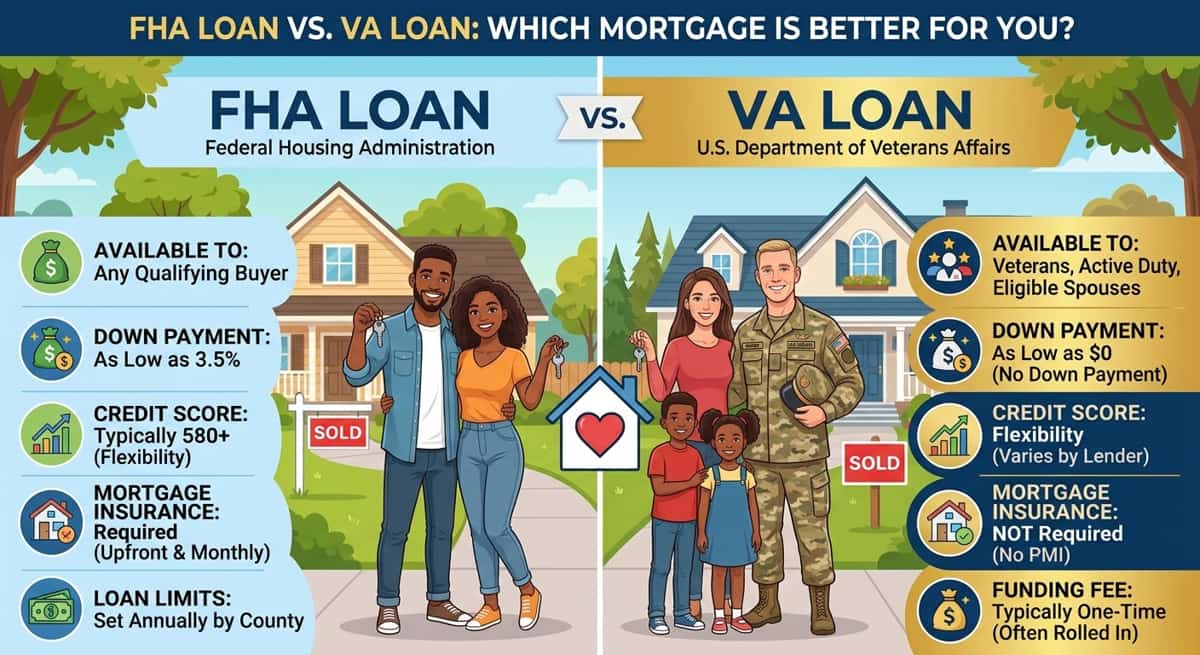
And what a difference it makes. No down payment. No private mortgage insurance eating into your monthly budget. Interest rates that consistently come in below the conventional market average. Compare loans to what most homebuyers are dealing with, and it's not even close.
VA Loan | FHA Loan | Conventional Loan | |
Down Payment | 0% | 3.5% minimum | 3%–20% |
Private Mortgage Insurance | None | Required | Required under 20% down |
Minimum Credit Score | No federal minimum (most lenders: 580–620) | 580 | 620–640 typically |
One-Time Loan Fee | VA Funding Fee (waived for some) | Upfront MIP | None |
The numbers speak for themselves. For most veterans, this is simply the smartest mortgage on the market.
Who Qualifies for a VA Loan in 2026 — Eligibility Requirements Explained
One of the first questions I hear from veterans and their families is simply: "Do I even qualify?" The answer depends on your service history, but the eligibility rules are broader than most people realize. Here's a straightforward breakdown.
Active Duty Service Members
If you're currently serving, you're generally eligible after 90 continuous days of active duty. You don't have to wait until you're out.
Veterans
Eligibility depends on when you served. Generally, it's 90 days during wartime or 181 days during peacetime. The key requirement is that your discharge was under conditions other than dishonorable. If you're uncertain about how your discharge status is classified, it's worth a quick conversation before you assume you don't qualify.
National Guard and Reserve Members
You qualify with 6 years of service in the Guard or Reserves or if you were called up to active duty, just 90 days under Title 10 orders may be enough.
Surviving Spouses
This one often goes unmentioned. If you're the unremarried spouse of a veteran who died in service or as a result of a service-connected disability, you may be fully eligible. Spouses of POW and MIA veterans can also qualify.
Not sure if your service qualifies? Your Certificate of Eligibility (COE) is the official document that confirms your VA entitlement and in most cases, we can pull it for you in minutes. You don't have to figure that part out alone.
One more thing worth knowing: if you have a service-connected disability rating, you may be completely exempt from the VA funding fee which can save you thousands at closing.
The Real Benefits of a VA Loan — Beyond Just "No Down Payment"
Most people have heard the "no down payment" part. But honestly, that's just the beginning. When you look at the full picture, VA loan offers a combination of advantages that's genuinely hard to match regardless of what's happening in the broader housing market.
1. No Down Payment Required With the median U.S. home price sitting well above $400,000, coming up with 20% down means saving $80,000 or more before you can even make an offer. The VA loan removes that barrier entirely. You can buy a home with zero down and keep your savings intact.
2. No Private Mortgage Insurance On a conventional loan, if you put down less than 20%, you're paying PMI every single month, often between $100 and $300, sometimes more. That's money out of your pocket that builds no equity and benefits no one but the lender. VA loans eliminate PMI completely.
In my experience, the PMI savings alone often make a VA loan the smartest financial move for veterans even for those who actually have a 20% down payment sitting in the bank.
3. Competitive Interest Rates Because the government backs a portion of the loan, lenders take on less risk and they pass those savings on to you in the form of lower rates. Over a 30-year loan, even a quarter-point difference adds up to tens of thousands of dollars.
4. Controlled Closing Costs The VA limits what lenders are allowed to charge you at closing. On top of that, sellers can contribute toward your closing costs which means you may be able to get to the closing table with very little out of pocket.
5. No Prepayment Penalty Life changes. If you want to sell in five years, pay the loan off early, or refinance when rates drop, there's no penalty for doing so. You have full flexibility.
6. A Benefit You Can Use More Than Once VA loan entitlement restoration is real. Once your loan is paid off and in some situations even before that your benefit can be reused. Veterans have used VA loans two, three, even four times throughout their lives.
Understanding the VA Funding Fee — What It Is and When You Don't Have to Pay It
If the VA funding fee has given you pause, you're not alone. It's one of the most misunderstood parts of the whole process and for some veterans, it's the reason they hesitate when they shouldn't.
Here's the straightforward version: the funding fee is a one-time charge typically between 1.25% and 3.3% of your loan amount that helps keep the VA loan program funded for future generations of veterans. Think of it as the trade-off for having no PMI. And critically, you don't have to pay it out of pocket. It can be rolled directly into your loan balance.
0% Down | 5%+ Down | 10%+ Down | |
First Use | 2.15% | 1.50% | 1.25% |
Subsequent Use | 3.30% | 1.50% | 1.25% |
Note: Rates current as of 2026. Confirm with your lender at time of application.
Who doesn't pay it at all?
Veterans with a service-connected disability rating
Surviving spouses of veterans who died in service or from a service-connected disability
Active-duty Purple Heart recipients
If any of these apply to you, the fee is waived entirely which can mean thousands of dollars in savings right at closing.
The VA Loan Process — Step by Step
Knowing you're eligible is one thing. Knowing exactly what happens next is what actually gets you into a home. Here's how the process unfolds, from start to finish.
Step 1: Confirm Your Eligibility The first thing you'll need is your Certificate of Eligibility. This is the document that officially confirms your VA entitlement. You can get it through the VA's eBenefits portal, but honestly, most lenders can pull it directly on your behalf in just a few minutes. You don't need to track it down on your own.
Step 2: Find the Right Lender Not every lender works with VA loans regularly, and that gap in experience shows. You want someone who understands how VA appraisals work, how entitlement is calculated, and how to handle funding fee exemptions correctly. The right lender makes the whole process smoother and protects you from costly mistakes.
Step 3: Get Pre-Approved Pre-approval gives you a clear, realistic picture of what you can afford and it tells sellers you're serious. There's no federally mandated minimum credit score for VA loans, but most lenders want to see 620 or above. If your credit needs a little work first, a good advisor will tell you exactly what to do and how long it'll take.
Step 4: Find Your Home and Make an Offer The home you choose needs to meet VA Minimum Property Requirements meaning it has to be safe, structurally sound, and move-in ready. This protects you as much as it protects the loan. Your lender will order a VA appraisal once you're under contract to verify the property qualifies.
Step 5: Appraisal and Underwriting The VA appraisal does two things: it confirms the home's market value and checks that it meets property standards. After that, underwriting takes a thorough look at your income, debts, and overall financial picture before issuing final approval. This is normal every loan goes through it.
Step 6: Close and Move In From application to closing, VA loans typically take around 40 to 50 days. At the closing table, you'll sign the final paperwork and walk away as a homeowner, often with little to nothing paid out of pocket.
VA Loan Refinancing — Two Options Worth Knowing
Your VA benefit doesn't stop the day you close on your home. If you already own a home whether you used a VA loan to buy it or not there are two refinancing options that could put you in a significantly better financial position.
VA IRRRL — The Streamline Refinance
If you already have a VA loan and interest rates have dropped since you closed, the VA IRRRL (Interest Rate Reduction Refinance Loan) is the simplest way to lower your monthly payment. Most borrowers go through it with minimal paperwork, no new appraisal, and no out-of-pocket costs when it's structured correctly. It's genuinely one of the easiest refinances available to any homeowner.
VA Cash-Out Refinance
This option lets you tap into the equity you've built and refinance into a new VA loan even if your current mortgage isn't a VA loan at all. Veterans use it for home renovations, paying off high-interest debt, covering tuition, or handling major expenses. In many cases, you can access up to 100% of your home's value.
If you bought your home two or more years ago, it's worth a quick conversation to find out whether a VA cash-out refinance could put that equity to better use for you and your family.
Ready to Use the Benefit You've Earned?
You served. You sacrificed. And somewhere along the way, a powerful home loan benefit was attached to that service, one that most veterans never fully use, simply because nobody walked them through it clearly.
Whether you're buying your first home, considering a refinance, or just trying to figure out if a VA loan makes sense for where you are right now let's have that conversation. No pressure, no complicated paperwork to start. Just a straightforward talk about your situation and your options.
Schedule a Free Consultation . We'll take it from there.