If you're a veteran or active-duty service member sitting on a good chunk of home equity, you've probably landed on two options: a VA cash-out refinance or a home equity loan. Both let you turn part of your home's value into cash you can use for anything paying off high-interest debt, covering a big renovation, helping a kid through college. But they work very differently, and picking the wrong one can quietly cost you thousands of dollars over the life of your loan.
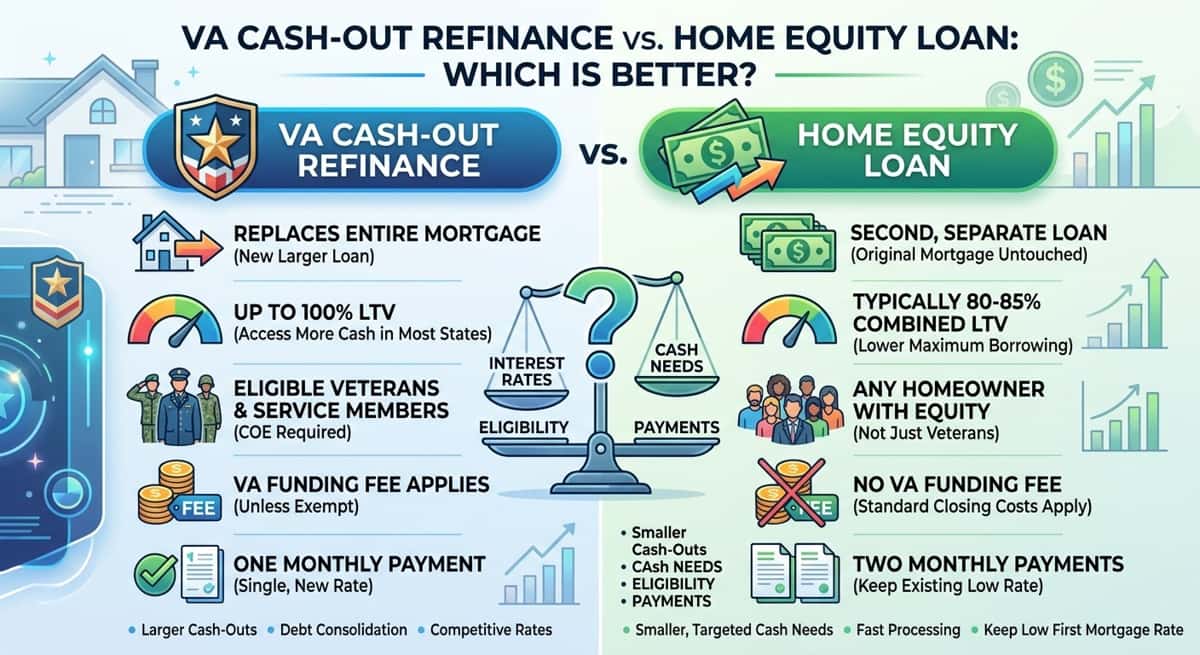
A cash-out refinance replaces your entire existing mortgage with a new, larger one, sometimes up to 100% of your home's value. A home equity loan leaves your current mortgage exactly where it is and adds a second, separate loan on top of it. Which one actually makes sense for you depends on your current interest rate, how much cash you need, and whether you still have VA loan entitlement available.
What Is a VA Cash-Out Refinance? (Quick Definition)
A VA cash-out refinance replaces your current home loan with a brand-new VA-backed loan, and you pocket the difference between what you owed and your new loan amount as cash.
This option is backed by the Department of Veterans Affairs, which means it's available to eligible veterans, active-duty service members, and certain surviving spouses who have a valid Certificate of Eligibility (COE). One thing that surprises a lot of people: you don't need to already have a VA loan to use this. If you currently have a conventional or FHA mortgage, a VA cash-out refinance can actually convert that loan into a VA loan while pulling out cash at the same time. In most states, you can borrow up to 100% of your home's appraised value, which is significantly higher than what most other loan types allow.
What Is a Home Equity Loan?
A home equity loan option is a second, separate loan that sits on top of your existing mortgage, giving you a lump sum of cash while your original mortgage stays completely untouched.
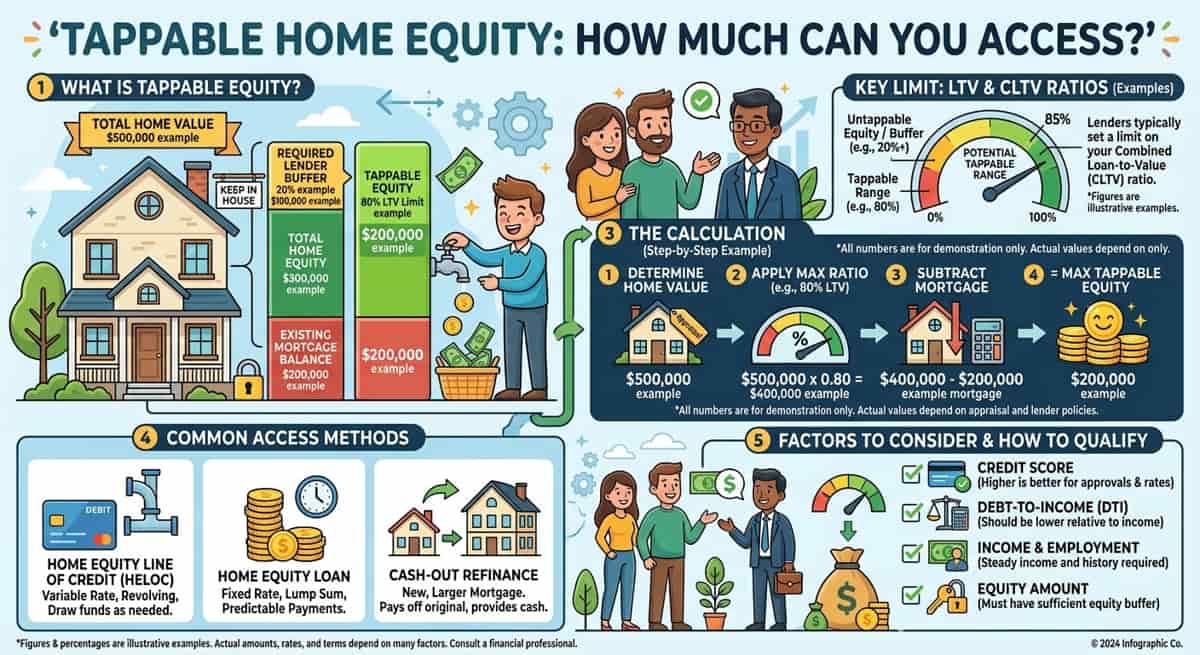
You get the money upfront, in one payment, and you pay it back over a fixed term at a fixed interest rate so your payment amount never changes. Unlike a VA cash-out refinance, a home equity loan doesn't touch your first mortgage at all; you'll simply have two separate payments going forward. Most lenders cap how much you can borrow at around 80–85% of your home's combined value (your first mortgage plus the new loan combined). It's worth noting there's also a cousin product called a HELOC (home equity line of credit), which works more like a credit card with a revolving balance rather than a one-time lump sum that's a separate comparison worth having with your loan officer if flexibility matters more to you than a fixed payment.
Side-by-Side Comparison: Key Differences at a Glance
Before diving deeper, here's how the two stack up on the things that matter most:
Feature | VA Cash-Out Refinance | Home Equity Loan |
Loan structure | Replaces your first mortgage entirely | Second loan, first mortgage stays as-is |
Maximum loan-to-value | Up to 100% in most states | Typically 80–85% combined |
Who qualifies | Veterans, service members, eligible surviving spouses with a COE | Any homeowner with enough equity and credit |
VA funding fee | Yes, unless exempt | No |
Closing costs | Standard refinance closing costs | Typically 2–5% of the loan amount |
Rate type | Usually fixed, sometimes adjustable | Almost always fixed |
Private mortgage insurance | Not required | Not typically required either |
Impact on your current mortgage rate | Replaces it good or bad depending on your rate | Leaves it untouched |
Common use case | Larger cash-outs, debt consolidation, dropping a non-VA loan into VA terms | Smaller, targeted cash needs while keeping a low first-mortgage rate |
Loan-to-Value (LTV) and How Much Cash You Can Access
Because a VA cash-out refinance can go up to 100% of your home's value in most states, it generally lets you access more cash than a home equity loan will. If you have $400,000 in home value and owe $250,000, a VA cash-out refinance could theoretically let you access close to the full remaining equity, whereas a home equity loan lender might cap your combined loans around $320,000–$340,000, leaving a smaller amount available to borrow. If your goal is a large sum paying off significant debt, funding a major renovation, or covering a big one-time expense the VA option usually gives you more room to work with. If you only need a smaller amount, this difference may not matter much to you at all.
Costs: VA Funding Fee vs. Home Equity Loan Closing Costs
A VA cash-out refinance comes with a VA funding fee, which is a percentage of your loan amount that helps keep the VA loan program running without needing taxpayer-funded mortgage insurance. The fee is typically higher on a cash-out refinance than on a standard VA purchase loan, and it's higher again if this isn't your first time using your VA loan benefit. The good news is that veterans with a service-connected disability rating are often exempt from this fee entirely, so it's worth confirming your exemption status before assuming you'll owe it.
A home equity loan doesn't carry this specific fee, but it typically comes with its own closing costs, often in the 2–5% range of the loan amount, covering things like the appraisal, origination fees, and title work. Neither option is free, so it really comes down to comparing your actual numbers side by side rather than assuming one is automatically cheaper.
Interest Rates: Why the "Blended Rate" Question Matters
This is often the single biggest factor in this decision, and it's easy to overlook. If you already have a low interest rate on your current mortgage, say, something you locked in a few years ago, a VA cash-out refinance replaces that entire loan, including that low rate, with a new rate on the full balance. If rates have gone up since you first bought your home, that can mean paying more interest overall, even on the portion of the loan you already had.
A home equity loan, on the other hand, leaves your original low-rate mortgage completely alone. You only take on a new rate for the smaller amount you're borrowing, so your overall blended cost across both loans can end up lower than refinancing everything at today's rate. Before deciding, run your numbers through a refinance savings calculator or ask a loan officer to calculate your blended rate across both scenarios. . The answer isn't always obvious just by comparing the two interest rates side by side.
Who Qualifies for Each Option?
To qualify for a VA cash-out refinance, you'll need a valid Certificate of Eligibility, and the home must be your primary residence. The VA itself doesn't set a strict minimum credit score, but individual lenders apply their own credit and debt-to-income requirements on top of the VA's guidelines, so your approval odds still depend on your personal financial picture.
A home equity loan doesn't require any military service at all; it's available to any homeowner, veteran or not, as long as you have enough equity built up and meet the lender's credit score and debt-to-income requirements. If you're not sure whether you currently qualify for VA benefits, or your COE has expired or was never requested, that's often the first thing to sort out before comparing these two paths any further.
Pros and Cons of a VA Cash-Out Refinance
A VA cash-out refinance can be a strong option if you want to access a large amount of equity and are comfortable resetting your mortgage under new terms.
Pros:
Access up to 100% of your home's value in most states
No private mortgage insurance required
Can convert a non-VA loan into VA financing while pulling out cash
One single mortgage payment going forward
Often comes with competitive VA interest rates
Cons:
Replaces your entire mortgage, including any low rate you currently have
Comes with a VA funding fee (unless exempt)
Resets your loan term, which can extend how long you're paying off your home
Full underwriting and closing process, similar to a new mortgage
Pros and Cons of a Home Equity Loan
A home equity loan tends to make sense when you want a smaller, targeted amount of cash and don't want to disturb your existing mortgage.
Pros:
Keeps your current mortgage and its rate completely untouched
Fixed payment and fixed rate, so your budget stays predictable
Faster and often simpler closing process than a full refinance
Available to any homeowner, not just those with VA eligibility
Cons:
Lower maximum borrowing amount than a VA cash-out refinance
Two separate payments to manage each month
Closing costs still apply, even though there's no VA funding fee
Adds a second lien on your home, which can affect future refinancing plans
Which Option Is Better? It Depends on These 4 Factors
There's no single right answer here; it genuinely depends on your numbers. These four factors tend to drive the decision more than anything else:
Your current first-mortgage rate. If you're sitting on a rate well below today's market rate, a home equity loan protects that rate while a VA cash-out refinance would replace it. If your current rate is already close to or above today's rates, this advantage disappears and a refinance becomes much more worth considering.
How much cash you need and your current equity. Need a large sum relative to your home's value? A VA cash-out refinance typically gives you more room. Need a smaller, specific amount? A home equity loan may cover it without the need to touch your existing mortgage at all.
Whether you want one payment or two. Some homeowners strongly prefer the simplicity of a single mortgage payment. Others don't mind managing two payments if it means protecting a great rate on the first one. This is partly a math question and partly a personal preference question.
Your VA eligibility status and funding fee exposure. If you're exempt from the VA funding fee due to a service-connected disability, that removes one of the biggest cost differences between the two options and can tip the decision toward the refinance. If you're not exempt and this isn't your first use of your VA benefit, that fee is worth weighing carefully against home equity loan closing costs.
When a VA Cash-Out Refinance Makes More Sense
This option tends to fit best when you need a larger amount of cash, your current mortgage rate isn't significantly better than today's rates, or you're currently in a non-VA loan and want to move into VA financing while accessing equity at the same time. It also makes sense if you'd rather manage one mortgage payment instead of two, and you qualify for a funding fee exemption or have factored the fee into your overall cost comparison.
When a Home Equity Loan Makes More Sense
A home equity loan tends to be the better fit when you have a low rate on your current mortgage that you don't want to lose, you only need a smaller, more targeted amount of cash, or you'd rather keep the process simpler and faster than a full refinance. It's also worth a closer look if you're not eligible for VA benefits, or if your VA entitlement is better saved for a future purchase.
Common Mistakes Veterans Make When Choosing Between These Options
The most common mistake I see is homeowners comparing the two interest rates directly without calculating the blended cost across both loans. A home equity loan's higher rate can still work out cheaper overall if it's protecting a much lower rate on your first mortgage. Another frequent misstep is assuming the VA funding fee applies automatically, without checking whether a disability rating makes you exempt; that single check can change the entire cost comparison. Veterans also sometimes overlook how adding a second lien through a home equity loan can complicate or limit refinancing options down the road, especially if home values shift. None of these mistakes are hard to avoid; they just require running the actual numbers instead of comparing the two options at a glance.
Talk to a Licensed Mortgage Loan Officer Before You Decide
The right choice between these two options comes down to your specific rate, your equity, and your VA entitlement numbers that look different for every homeowner. A licensed mortgage loan officer at Ratebeat can help you get a custom rate quote and run both scenarios side by side using your actual figures, so you're comparing real costs rather than general rules of thumb . There's no obligation in having that conversation, and it's often the quickest way to see, in dollars and cents, which option actually puts you ahead.